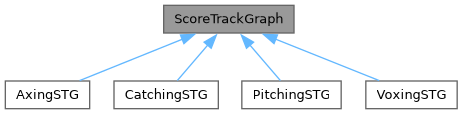
Shared base of the four per-instrument gameplay stages. More...
#include <scoretrackgraph.h>
Public Member Functions | |
| ScoreTrackGraph (TrackData *pTrackData) | |
| Build the stage's quantiser, phrase manager, phrase player, mixer, and synthesiser. | |
| virtual | ~ScoreTrackGraph () |
| PhraseDatabase * | GetPhraseDatabase () |
| Report the phrase database of this stage's phrase manager. | |
| virtual void | Start () |
| Start the stage. | |
| virtual void | Stop () |
| Stop the stage. | |
| virtual void | ConnectInputs (MsgSource *pPrimary, MsgSource *pOptional, MsgSource *pSecondary)=0 |
| Wire the stage's objects to the sources that drive it. | |
| virtual void | ConnectGamer (MsgSource *pSource) |
| Register the mixer with one source. | |
| virtual void | SetMixerOutput (MsgSink *pOutput)=0 |
| Attach the mixer to the synthesiser and give it its output sink. | |
| virtual void | ConnectToTunnel (MsgSink *pSink)=0 |
| Register one sink with every source the stage provides. | |
| virtual void | SetNetSink (MsgSink *pSink)=0 |
| Install the sink the phrase manager reports phrase changes to. | |
| virtual int | HasNothingPending () |
| Report whether the stage has nothing outstanding. | |
| virtual void | GivePhrases (int nTick, Player *pPlayer) |
| Give every phrase of the track to one player. | |
| virtual int | CanGivePhrases () |
| Report whether GivePhrases() acts on this stage. | |
| virtual void | CreatePowerbarMgr () |
| Create the phrase manager's powerbar manager. | |
| int | StartMF () |
| Run Start() and report zero. | |
| int | StopMF () |
| Run Stop() and report zero. | |
Static Public Member Functions | |
| static void | Delete (ScoreTrackGraph *pGraph) |
| Delete a stage, which may be null. | |
Public Attributes | |
| TrackData * | mTrackData |
| The track description, the constructor's argument. | |
Protected Attributes | |
| int | mTrack |
| PhraseMgr * | mPhraseMgr |
| PhrasePlayer * | mPhrasePlayer |
| Quantizer * | mQuantizer |
| MuseSynth * | mMuseSynth |
| int | mUnused |
| Mixer * | mMixer |
| Application * | mApplication |
| BarSequencer * | mSequencer |
Detailed Description
Shared base of the four per-instrument gameplay stages.
Its RTTI descriptor is at 0x0086f640, built through the built-in descriptor constructor with no base list. Four classes derive from it, and the RTTI records each with this class at offset 0: AxingSTG at 0x008efe70, CatchingSTG at 0x00902230, PitchingSTG at 0x00902240, and VoxingSTG at 0x008efe80. The shared base is recovered from those four descriptors and from the table walk rather than inferred from the names.
Its table is at 0x007e5148 and runs thirteen entries to the zero terminator, and all four derived tables run thirteen as well, so no subclass introduces a virtual of its own. Slots 4, 6, 7, and 8 address the shared pure-virtual stub at 0x005381a8, which makes this class abstract. Slots 5, 9, 10, 11, and 12 are inert defaults with real bodies here.
The object is 0x2c bytes with the vptr at +0x28, which is where this toolchain places it for a class with no base. Derived members therefore start at +0x2c.
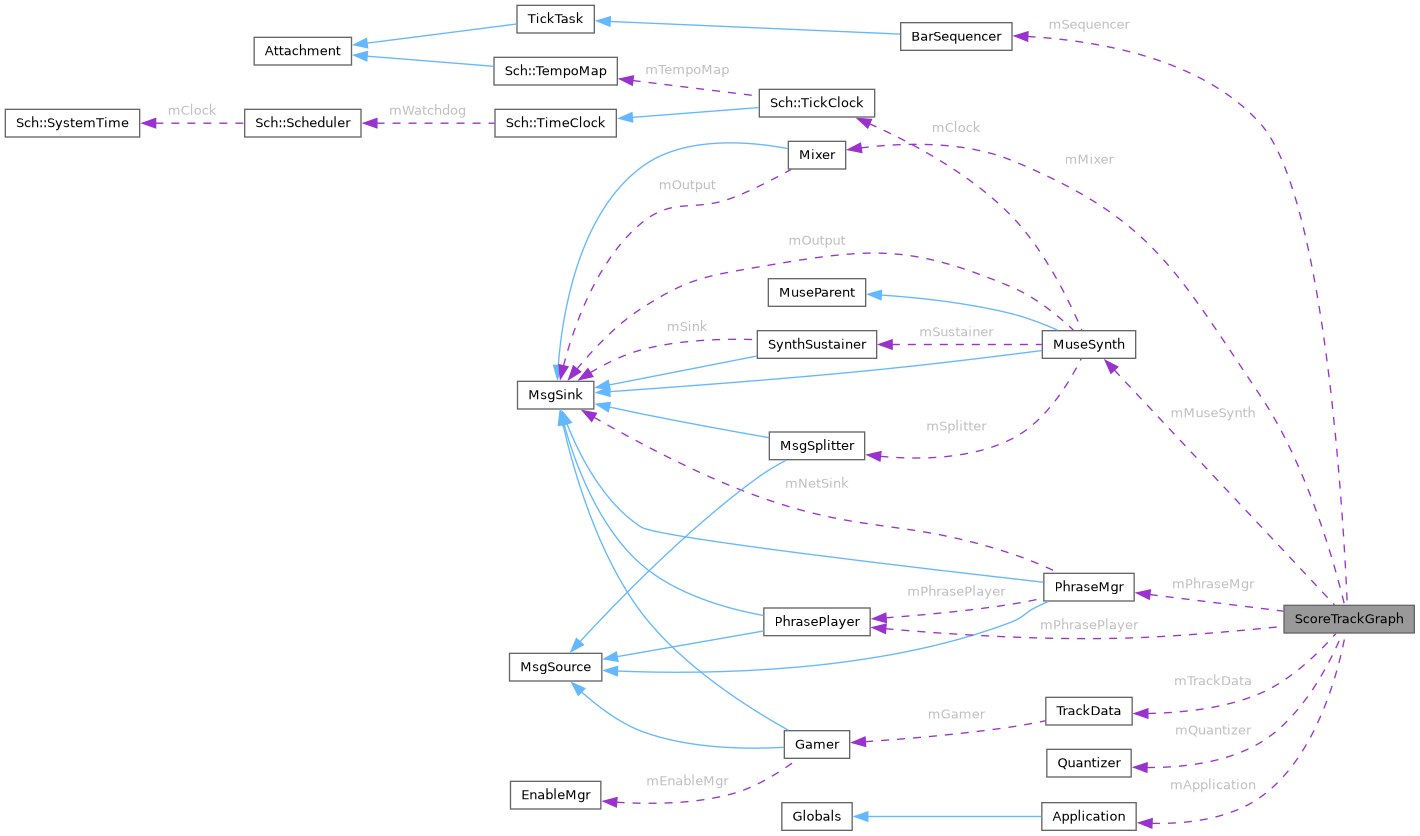
The constructor builds the five objects the members below store. The phrase manager, phrase player, mixer, and synthesiser go through the tagged allocator under the tag MsgSink, and the quantiser through the plain allocator.
The five default bodies at 0x001cf750, 0x001cf758, 0x001cf760, 0x001cf768, and 0x001cf778 sit in this class's table at slots 5, 9, 10, 11, and 12, and AxingSTG, PitchingSTG, and VoxingSTG inherit all five.
Each slot's comment records its table index. Start() and Stop() (slots 2 and 3) are the start and the stop of a stage, as the four overrides establish between them. Each Start() override sends controller 0x52 with value 0x7f on the track's channel and each Stop() override sends the same controller with value zero, and every other pairing in the four classes is symmetric in the same way.
Every data member apart from mTrackData is protected. The four derived classes read seven of the ten directly and no accessor for any of them exists in the image.
Constructor & Destructor Documentation
◆ ScoreTrackGraph()
|
explicit |
Build the stage's quantiser, phrase manager, phrase player, mixer, and synthesiser.
The phrase manager takes the song clock, a bar of 1920 ticks, the play map, and configuration code 0x2be. The phrase player is then installed in the phrase manager.
- Parameters
-
pTrackData The track description.
- Ghidra address:
- NTSC-U/C: 0x001cee50
- Ghidra address:
- PAL: 0x001d4d08
◆ ~ScoreTrackGraph()
|
virtual |
- Ghidra address:
- NTSC-U/C: 0x001cf840
- Ghidra address:
- PAL: 0x001d56f8
Member Function Documentation
◆ GetPhraseDatabase()
| PhraseDatabase * ScoreTrackGraph::GetPhraseDatabase | ( | ) |
Report the phrase database of this stage's phrase manager.
GrooveWorld's phrase save and load paths call it for every stage.
- Returns
- The phrase manager's database.
- Ghidra address:
- NTSC-U/C: 0x001cf978
- Ghidra address:
- PAL: 0x001d5830
◆ Start()
|
virtual |
Start the stage.
Slot 2. Starts the phrase manager's commands, chases the MIDI of every bar of the play map into the synthesiser so controllers and programs are current, and then builds and starts a BarSequencer at the song start that plays the track into the synthesiser.
- Ghidra address:
- NTSC-U/C: 0x001cf088
- Ghidra address:
- PAL: 0x001d4f40
Reimplemented in AxingSTG, CatchingSTG, PitchingSTG, and VoxingSTG.
◆ Stop()
|
virtual |
Stop the stage.
Slot 3. Withdraws the phrase manager's commands and deletes the sequencer Start() built.
- Ghidra address:
- NTSC-U/C: 0x001cf918
- Ghidra address:
- PAL: 0x001d57d0
Reimplemented in AxingSTG, CatchingSTG, PitchingSTG, and VoxingSTG.
◆ ConnectInputs()
|
pure virtual |
Wire the stage's objects to the sources that drive it.
Slot 4, pure. Each override registers the stage's own objects with the first and third sources, and with the second only when it is supplied. The second source is the only argument any override guards against a null pointer.
- Parameters
-
pPrimary The source every override registers with first. pOptional A further source, ignored when null. pSecondary The source every override registers the phrase manager with.
Implemented in AxingSTG, CatchingSTG, PitchingSTG, and VoxingSTG.
◆ ConnectGamer()
|
virtual |
Register the mixer with one source.
Slot 5. The default body is empty. CatchingSTG is the only class that overrides it, and its override registers the mixer.
- Parameters
-
pSource The source to register with.
- Ghidra address:
- NTSC-U/C: 0x001cf750
- Ghidra address:
- PAL: 0x001d5608
Reimplemented in CatchingSTG.
◆ SetMixerOutput()
|
pure virtual |
Attach the mixer to the synthesiser and give it its output sink.
Slot 6, pure. All four overrides are the same three instructions: they register the mixer with the synthesiser through MuseSynth::AddSink() and then store the argument in Mixer::mOutput, which types it as a sink.
- Parameters
-
pOutput The sink the mixer sends to.
Implemented in AxingSTG, CatchingSTG, PitchingSTG, and VoxingSTG.
◆ ConnectToTunnel()
|
pure virtual |
Register one sink with every source the stage provides.
Slot 7, pure. Each override registers the sink with the phrase manager and with each of its own objects that is a source.
- Parameters
-
pSink The sink to register.
Implemented in AxingSTG, CatchingSTG, PitchingSTG, and VoxingSTG.
◆ SetNetSink()
|
pure virtual |
Install the sink the phrase manager reports phrase changes to.
Slot 8, pure. All four overrides store the argument in PhraseMgr::mNetSink and ignore a null sink. PhraseMgr sends messages through that member's MsgSink::Dispatch(), which is what types the argument.
- Parameters
-
pSink The sink to install, ignored when null.
Implemented in AxingSTG, CatchingSTG, PitchingSTG, and VoxingSTG.
◆ HasNothingPending()
|
virtual |
Report whether the stage has nothing outstanding.
Slot 9. The default reports that nothing is outstanding. CatchingSTG is the only class that overrides it, and its override forwards to Catcher::IsPhraseRunEmpty(). That routine reports whether the catcher's counter at +0x60 is zero. Gamer ends the game for a player out of juice only once every stage reports non-zero.
- Returns
- Non-zero when nothing is outstanding.
- Ghidra address:
- NTSC-U/C: 0x001cf758
- Ghidra address:
- PAL: 0x001d5610
Reimplemented in CatchingSTG.
◆ GivePhrases()
|
virtual |
Give every phrase of the track to one player.
Slot 10. The default body is empty. CatchingSTG is the only class that overrides it, and its override forwards both arguments to SingleCatcher::ResetOwners(). The Gamer routine at 0x001123b0 calls the slot for every track whose CanGivePhrases() reports non-zero, with the winning player, and discards the return register.
- Parameters
-
nTick The song position the caller received. No implementation reads it. pPlayer The player the phrases go to.
- Ghidra address:
- NTSC-U/C: 0x001cf760
- Ghidra address:
- PAL: 0x001d5618
Reimplemented in CatchingSTG.
◆ CanGivePhrases()
|
virtual |
Report whether GivePhrases() acts on this stage.
Slot 11. The default returns zero and CatchingSTG, the one class whose GivePhrases() has a body, returns 1. Gamer tests it before each GivePhrases() call.
- Returns
- Zero here.
- Ghidra address:
- NTSC-U/C: 0x001cf768
- Ghidra address:
- PAL: 0x001d5620
Reimplemented in CatchingSTG.
◆ CreatePowerbarMgr()
|
virtual |
Create the phrase manager's powerbar manager.
Slot 12. The default body is empty. CatchingSTG is the only class that overrides it, and its override runs PhraseMgr::CreatePowerbarMgr(). GrooveWorld::BuildGraphs() calls it for each catch track after loading saved phrases.
- Ghidra address:
- NTSC-U/C: 0x001cf778
- Ghidra address:
- PAL: 0x001d5630
Reimplemented in CatchingSTG.
◆ StartMF()
|
inline |
Run Start() and report zero.
Inline. GrooveWorld::StartSequencers() reaches it through a pointer to member, and the address is its uncalled out-of-line copy.
- Returns
- Always 0.
- Ghidra address:
- NTSC-U/C: 0x001cf6b8
- Ghidra address:
- PAL: 0x001d5570
◆ StopMF()
|
inline |
Run Stop() and report zero.
Inline. GrooveWorld::FinishSong() reaches it through a pointer to member, and the address is its uncalled out-of-line copy.
- Returns
- Always 0.
- Ghidra address:
- NTSC-U/C: 0x001cf6e8
- Ghidra address:
- PAL: 0x001d55a0
◆ Delete()
|
inlinestatic |
Delete a stage, which may be null.
Inline. GrooveWorld::DestroyGraphs() passes it to std::for_each.
- Parameters
-
pGraph The stage.
- Ghidra address:
- NTSC-U/C: 0x001cf718
- Ghidra address:
- PAL: 0x001d55d0
Member Data Documentation
◆ mTrack
|
protected |
◆ mTrackData
| TrackData* ScoreTrackGraph::mTrackData |
The track description, the constructor's argument.
+0x04
Public because GrooveWorld::BuildGraphs() loads it directly at 0x0018d730 and passes it to TrackData::AddPhrases(), and the image has no accessor.
◆ mPhraseMgr
|
protected |
◆ mPhrasePlayer
|
protected |
◆ mQuantizer
|
protected |
◆ mMuseSynth
|
protected |
◆ mUnused
|
protected |
◆ mMixer
|
protected |
◆ mApplication
|
protected |
◆ mSequencer
|
protected |
The documentation for this class was generated from the following file:
- src/game/scoretrackgraph.h