Gameplay stage for a track whose gems are caught rather than played. More...
#include <catchingstg.h>
Public Member Functions | |
| CatchingSTG (TrackData *pTrackData) | |
| Build the neutraliser and the catcher, and set the phrase manager's export lead. | |
| virtual | ~CatchingSTG () |
| Stop the stage and release the catcher and the neutraliser. | |
| virtual void | Start () |
| Start the stage. | |
| virtual void | Stop () |
| Stop the stage. | |
| virtual void | ConnectInputs (MsgSource *pPrimary, MsgSource *pOptional, MsgSource *pSecondary) |
| Wire the stage's objects to the sources that drive it. | |
| virtual void | ConnectGamer (MsgSource *pSource) |
| Register the mixer with one source. | |
| virtual void | SetMixerOutput (MsgSink *pOutput) |
| Attach the mixer to the synthesiser and give it its output sink. | |
| virtual void | ConnectToTunnel (MsgSink *pSink) |
| Register one sink with every source the stage provides. | |
| virtual void | SetNetSink (MsgSink *pSink) |
| Install the sink the phrase manager reports phrase changes to. | |
| virtual int | HasNothingPending () |
| Report whether the stage has nothing outstanding. | |
| virtual void | GivePhrases (int nTick, Player *pPlayer) |
| Give every phrase of the track to one player. | |
| virtual int | CanGivePhrases () |
| Report that GivePhrases() acts on this stage. | |
| virtual void | CreatePowerbarMgr () |
| Rebuild the phrase manager's powerbar source. | |
| Public Member Functions inherited from ScoreTrackGraph | |
| ScoreTrackGraph (TrackData *pTrackData) | |
| Build the stage's quantiser, phrase manager, phrase player, mixer, and synthesiser. | |
| virtual | ~ScoreTrackGraph () |
| PhraseDatabase * | GetPhraseDatabase () |
| Report the phrase database of this stage's phrase manager. | |
| int | StartMF () |
| Run Start() and report zero. | |
| int | StopMF () |
| Run Stop() and report zero. | |
Additional Inherited Members | |
| Static Public Member Functions inherited from ScoreTrackGraph | |
| static void | Delete (ScoreTrackGraph *pGraph) |
| Delete a stage, which may be null. | |
| Public Attributes inherited from ScoreTrackGraph | |
| TrackData * | mTrackData |
| The track description, the constructor's argument. | |
| Protected Attributes inherited from ScoreTrackGraph | |
| int | mTrack |
| PhraseMgr * | mPhraseMgr |
| PhrasePlayer * | mPhrasePlayer |
| Quantizer * | mQuantizer |
| MuseSynth * | mMuseSynth |
| int | mUnused |
| Mixer * | mMixer |
| Application * | mApplication |
| BarSequencer * | mSequencer |
Detailed Description
Gameplay stage for a track whose gems are caught rather than played.
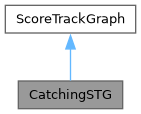
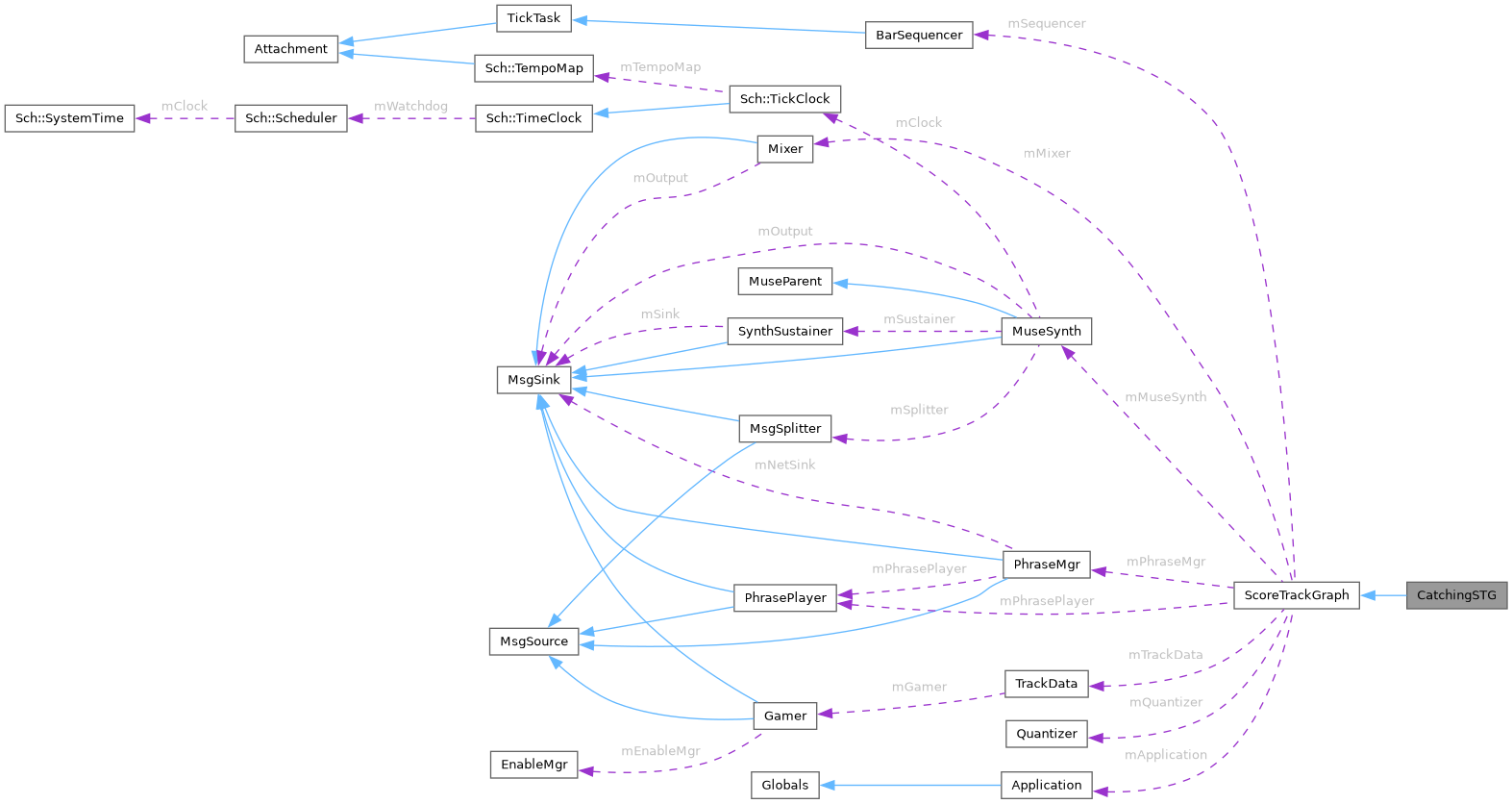
Its RTTI descriptor is at 0x00902230. It has ScoreTrackGraph as its only base at offset 0. Its table is at 0x007de4a0 and runs thirteen entries, the same as the base's. The class introduces no virtual. It is the one stage that overrides every slot, and the five defaults the other three inherit are all replaced here. The object is 0x34 bytes.
The constructor builds a PhraseNeutralizer and then one catcher, a SingleCatcher in game mode 1 and a MultiCatcher in every other mode. The catch window it hands the catcher is configuration code 0x39c, in milliseconds, converted to MIDI ticks through the song clock's tempo map.
Constructor & Destructor Documentation
◆ CatchingSTG()
| CatchingSTG::CatchingSTG | ( | TrackData * | pTrackData | ) |
Build the neutraliser and the catcher, and set the phrase manager's export lead.
The export lead is 120 ticks for each track index plus 120.
- Parameters
-
pTrackData The track description the base retains.
- Ghidra address:
- NTSC-U/C: 0x0019fb80
- Ghidra address:
- PAL: 0x001a58e8
◆ ~CatchingSTG()
|
virtual |
Stop the stage and release the catcher and the neutraliser.
Slot 1.
- Ghidra address:
- NTSC-U/C: 0x001a0450
- Ghidra address:
- PAL: 0x001a61b8
Member Function Documentation
◆ Start()
|
virtual |
Start the stage.
Slot 2. The routine starts the base and then schedules the catcher's commands through Catcher::Start().
- Ghidra address:
- NTSC-U/C: 0x001a04d8
- Ghidra address:
- PAL: 0x001a6240
Reimplemented from ScoreTrackGraph.
◆ Stop()
|
virtual |
Stop the stage.
Slot 3. The routine withdraws the catcher's commands through Catcher::Stop() and then stops the base.
- Ghidra address:
- NTSC-U/C: 0x001a0518
- Ghidra address:
- PAL: 0x001a6280
Reimplemented from ScoreTrackGraph.
◆ ConnectInputs()
|
virtual |
Wire the stage's objects to the sources that drive it.
Slot 4.
- Parameters
-
pPrimary The source the stage registers five of its objects with. pOptional A further source, which receives the phrase manager and the catcher when it is supplied. pSecondary The source that receives the phrase manager and the catcher.
- Ghidra address:
- NTSC-U/C: 0x0019fd88
- Ghidra address:
- PAL: 0x001a5af0
Implements ScoreTrackGraph.
◆ ConnectGamer()
|
virtual |
Register the mixer with one source.
Slot 5. This class is the only one of the four that overrides the base's empty default.
- Parameters
-
pSource The source to register with.
- Ghidra address:
- NTSC-U/C: 0x001a0558
- Ghidra address:
- PAL: 0x001a62c0
Reimplemented from ScoreTrackGraph.
◆ SetMixerOutput()
|
virtual |
Attach the mixer to the synthesiser and give it its output sink.
Slot 6.
- Parameters
-
pOutput The sink the mixer sends to, stored in Mixer::mOutput.
- Ghidra address:
- NTSC-U/C: 0x001a0588
- Ghidra address:
- PAL: 0x001a62f0
Implements ScoreTrackGraph.
◆ ConnectToTunnel()
|
virtual |
Register one sink with every source the stage provides.
Slot 7.
- Parameters
-
pSink The sink to register.
- Ghidra address:
- NTSC-U/C: 0x001a05c8
- Ghidra address:
- PAL: 0x001a6330
Implements ScoreTrackGraph.
◆ SetNetSink()
|
virtual |
Install the sink the phrase manager reports phrase changes to.
Slot 8.
- Parameters
-
pSink The sink to install, ignored when null.
- Ghidra address:
- NTSC-U/C: 0x001a0650
- Ghidra address:
- PAL: 0x001a63b8
Implements ScoreTrackGraph.
◆ HasNothingPending()
|
virtual |
Report whether the stage has nothing outstanding.
Slot 9. The routine forwards to Catcher::IsPhraseRunEmpty().
- Returns
- Non-zero when the catcher has nothing outstanding.
- Ghidra address:
- NTSC-U/C: 0x001a06f0
- Ghidra address:
- PAL: 0x001a6458
Reimplemented from ScoreTrackGraph.
◆ GivePhrases()
|
virtual |
Give every phrase of the track to one player.
Slot 10. The routine casts the catcher to SingleCatcher with dynamic_cast and forwards both arguments to SingleCatcher::ResetOwners(). The cast is unguarded, so a MultiCatcher yields a null receiver and the forwarded call dereferences it.
The routine also calls the game-mode accessor on mApplication and discards the answer, which is what remains of an assertion the release build compiled away.
- Parameters
-
nTick The song position, forwarded unchanged. pPlayer The player the phrases go to.
- Ghidra address:
- NTSC-U/C: 0x001a0668
- Ghidra address:
- PAL: 0x001a63d0
Reimplemented from ScoreTrackGraph.
◆ CanGivePhrases()
|
virtual |
Report that GivePhrases() acts on this stage.
Slot 11. Returns 1 where the base returns zero.
- Returns
- Always 1.
- Ghidra address:
- NTSC-U/C: 0x001a0428
- Ghidra address:
- PAL: 0x001a6190
Reimplemented from ScoreTrackGraph.
◆ CreatePowerbarMgr()
|
virtual |
Rebuild the phrase manager's powerbar source.
Slot 12. The whole body is PhraseMgr::CreatePowerbarMgr().
- Ghidra address:
- NTSC-U/C: 0x001a0720
- Ghidra address:
- PAL: 0x001a6488
Reimplemented from ScoreTrackGraph.
The documentation for this class was generated from the following file:
- src/game/catchingstg.h