Gameplay stage for a vocal track. More...
#include <voxingstg.h>
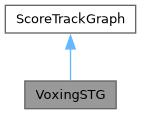
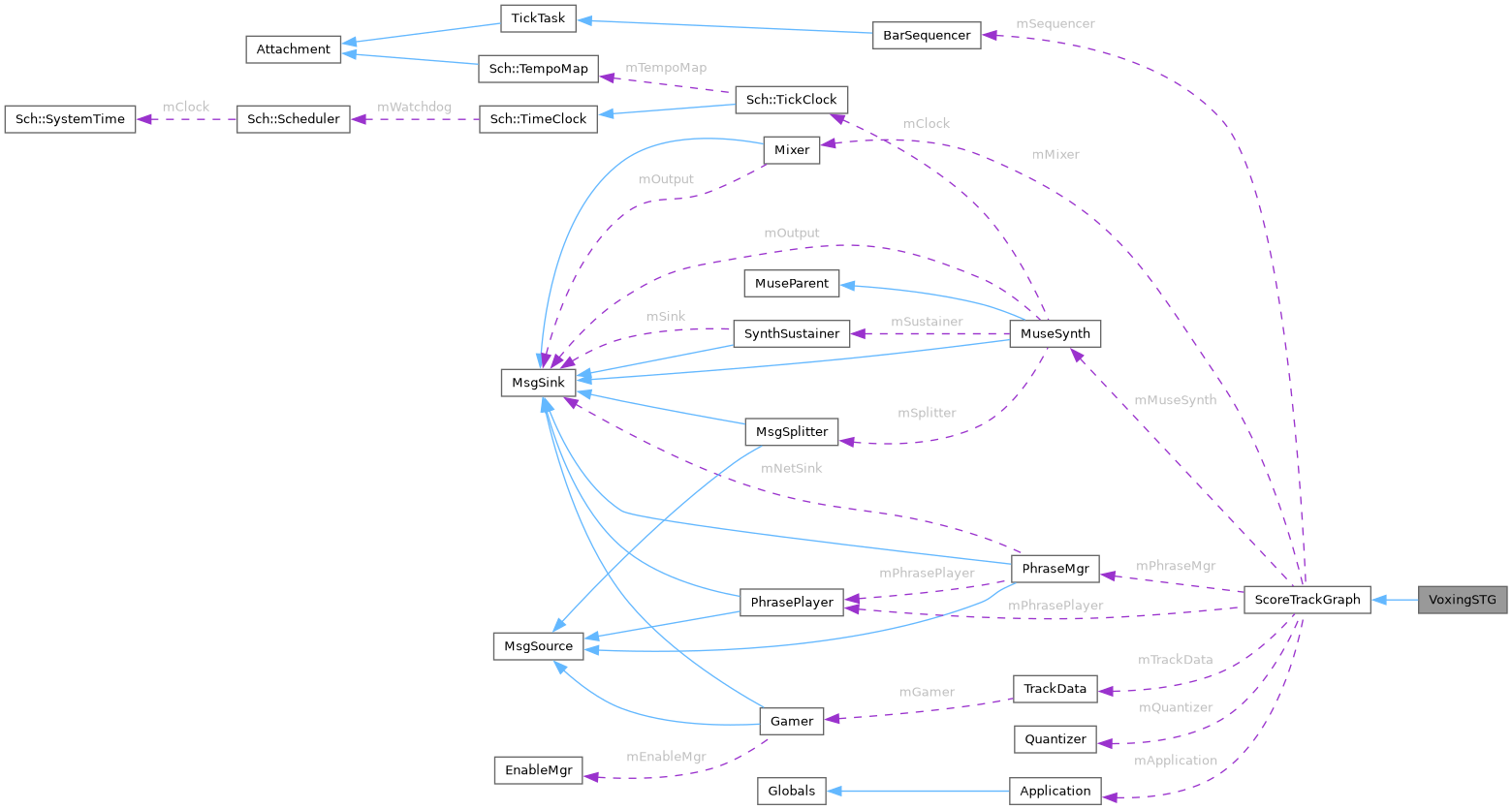
Public Member Functions | |
| VoxingSTG (TrackData *pTrackData) | |
| Build the producer, the old and then the new gem maker, and, in play mode 2, the jam effects manager. | |
| virtual | ~VoxingSTG () |
| Stop the stage and release the four objects the constructor built. | |
| virtual void | Start () |
| Start the stage. | |
| virtual void | Stop () |
| Stop the stage. | |
| virtual void | ConnectInputs (MsgSource *pPrimary, MsgSource *pOptional, MsgSource *pSecondary) |
| Wire the stage's objects to the sources that drive it. | |
| virtual void | SetMixerOutput (MsgSink *pOutput) |
| Attach the mixer to the synthesiser and give it its output sink. | |
| virtual void | ConnectToTunnel (MsgSink *pSink) |
| Register one sink with every source the stage provides. | |
| virtual void | SetNetSink (MsgSink *pSink) |
| Install the sink the phrase manager reports phrase changes to. | |
| Public Member Functions inherited from ScoreTrackGraph | |
| ScoreTrackGraph (TrackData *pTrackData) | |
| Build the stage's quantiser, phrase manager, phrase player, mixer, and synthesiser. | |
| virtual | ~ScoreTrackGraph () |
| PhraseDatabase * | GetPhraseDatabase () |
| Report the phrase database of this stage's phrase manager. | |
| virtual void | ConnectGamer (MsgSource *pSource) |
| Register the mixer with one source. | |
| virtual int | HasNothingPending () |
| Report whether the stage has nothing outstanding. | |
| virtual void | GivePhrases (int nTick, Player *pPlayer) |
| Give every phrase of the track to one player. | |
| virtual int | CanGivePhrases () |
| Report whether GivePhrases() acts on this stage. | |
| virtual void | CreatePowerbarMgr () |
| Create the phrase manager's powerbar manager. | |
| int | StartMF () |
| Run Start() and report zero. | |
| int | StopMF () |
| Run Stop() and report zero. | |
Additional Inherited Members | |
| Static Public Member Functions inherited from ScoreTrackGraph | |
| static void | Delete (ScoreTrackGraph *pGraph) |
| Delete a stage, which may be null. | |
| Public Attributes inherited from ScoreTrackGraph | |
| TrackData * | mTrackData |
| The track description, the constructor's argument. | |
| Protected Attributes inherited from ScoreTrackGraph | |
| int | mTrack |
| PhraseMgr * | mPhraseMgr |
| PhrasePlayer * | mPhrasePlayer |
| Quantizer * | mQuantizer |
| MuseSynth * | mMuseSynth |
| int | mUnused |
| Mixer * | mMixer |
| Application * | mApplication |
| BarSequencer * | mSequencer |
Detailed Description
Gameplay stage for a vocal track.
Its RTTI descriptor is at 0x008efe80. It has ScoreTrackGraph as its only base at offset 0. Its table is at 0x007e6460 and runs thirteen entries, the same as the base's. The class introduces no virtual. It overrides eight slots and inherits slots 5, 9, 10, 11, and 12 from the base. The object is 0x3c bytes.
The constructor builds the producer and both gem makers unconditionally, and the jam effects manager only in play mode 2. The two members it clears first are the producer and the jam effects manager, and the destructor guards the release of each.
Constructor & Destructor Documentation
◆ VoxingSTG()
| VoxingSTG::VoxingSTG | ( | TrackData * | pTrackData | ) |
Build the producer, the old and then the new gem maker, and, in play mode 2, the jam effects manager.
The jam effects manager is installed in the phrase player.
- Parameters
-
pTrackData The track description the base retains.
- Ghidra address:
- NTSC-U/C: 0x001da050
- Ghidra address:
- PAL: 0x001dffc0
◆ ~VoxingSTG()
|
virtual |
Stop the stage and release the four objects the constructor built.
Slot 1. The release order is the two gem makers, the producer, and then the jam effects manager, which is neither the order of their offsets nor the order they were built in.
- Ghidra address:
- NTSC-U/C: 0x001da730
- Ghidra address:
- PAL: 0x001e06a0
Member Function Documentation
◆ Start()
|
virtual |
Start the stage.
Slot 2. The routine starts the base and then posts the producer's tick task with the position kTickInfinity.
- Ghidra address:
- NTSC-U/C: 0x001da7f8
- Ghidra address:
- PAL: 0x001e0768
Reimplemented from ScoreTrackGraph.
◆ Stop()
|
virtual |
Stop the stage.
Slot 3. The routine withdraws the producer's tick task and then stops the base.
- Ghidra address:
- NTSC-U/C: 0x001da830
- Ghidra address:
- PAL: 0x001e07a0
Reimplemented from ScoreTrackGraph.
◆ ConnectInputs()
|
virtual |
Wire the stage's objects to the sources that drive it.
Slot 4.
- Parameters
-
pPrimary The source the stage registers five or six of its objects with. pOptional A further source, which receives the phrase manager when it is supplied. pSecondary The source that receives the phrase manager and the producer.
- Ghidra address:
- NTSC-U/C: 0x001da230
- Ghidra address:
- PAL: 0x001e01a0
Implements ScoreTrackGraph.
◆ SetMixerOutput()
|
virtual |
Attach the mixer to the synthesiser and give it its output sink.
Slot 6.
- Parameters
-
pOutput The sink the mixer sends to, stored in Mixer::mOutput.
- Ghidra address:
- NTSC-U/C: 0x001da868
- Ghidra address:
- PAL: 0x001e07d8
Implements ScoreTrackGraph.
◆ ConnectToTunnel()
|
virtual |
Register one sink with every source the stage provides.
Slot 7.
- Parameters
-
pSink The sink to register.
- Ghidra address:
- NTSC-U/C: 0x001da8a8
- Ghidra address:
- PAL: 0x001e0818
Implements ScoreTrackGraph.
◆ SetNetSink()
|
virtual |
Install the sink the phrase manager reports phrase changes to.
Slot 8.
- Parameters
-
pSink The sink to install, ignored when null.
- Ghidra address:
- NTSC-U/C: 0x001da978
- Ghidra address:
- PAL: 0x001e08e8
Implements ScoreTrackGraph.
The documentation for this class was generated from the following file:
- src/game/voxingstg.h