Gameplay stage for a guitar track. More...
#include <axingstg.h>
Public Member Functions | |
| AxingSTG (TrackData *pTrackData) | |
| virtual | ~AxingSTG () |
| Stop the stage and release everything the constructor built. | |
| virtual void | Start () |
| Start the stage. | |
| virtual void | Stop () |
| Stop the stage. | |
| virtual void | ConnectInputs (MsgSource *pPrimary, MsgSource *pOptional, MsgSource *pSecondary) |
| Wire the stage's objects to the sources that drive it. | |
| virtual void | SetMixerOutput (MsgSink *pOutput) |
| Attach the mixer to the base's synthesiser and give it its output sink. | |
| virtual void | ConnectToTunnel (MsgSink *pSink) |
| Register one sink with every source the stage provides. | |
| virtual void | SetNetSink (MsgSink *pSink) |
| Install the sink the phrase manager reports phrase changes to. | |
| Public Member Functions inherited from ScoreTrackGraph | |
| ScoreTrackGraph (TrackData *pTrackData) | |
| Build the stage's quantiser, phrase manager, phrase player, mixer, and synthesiser. | |
| virtual | ~ScoreTrackGraph () |
| PhraseDatabase * | GetPhraseDatabase () |
| Report the phrase database of this stage's phrase manager. | |
| virtual void | ConnectGamer (MsgSource *pSource) |
| Register the mixer with one source. | |
| virtual int | HasNothingPending () |
| Report whether the stage has nothing outstanding. | |
| virtual void | GivePhrases (int nTick, Player *pPlayer) |
| Give every phrase of the track to one player. | |
| virtual int | CanGivePhrases () |
| Report whether GivePhrases() acts on this stage. | |
| virtual void | CreatePowerbarMgr () |
| Create the phrase manager's powerbar manager. | |
| int | StartMF () |
| Run Start() and report zero. | |
| int | StopMF () |
| Run Stop() and report zero. | |
Additional Inherited Members | |
| Static Public Member Functions inherited from ScoreTrackGraph | |
| static void | Delete (ScoreTrackGraph *pGraph) |
| Delete a stage, which may be null. | |
| Public Attributes inherited from ScoreTrackGraph | |
| TrackData * | mTrackData |
| The track description, the constructor's argument. | |
| Protected Attributes inherited from ScoreTrackGraph | |
| int | mTrack |
| PhraseMgr * | mPhraseMgr |
| PhrasePlayer * | mPhrasePlayer |
| Quantizer * | mQuantizer |
| MuseSynth * | mMuseSynth |
| int | mUnused |
| Mixer * | mMixer |
| Application * | mApplication |
| BarSequencer * | mSequencer |
Detailed Description
Gameplay stage for a guitar track.
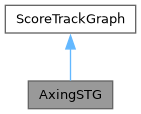
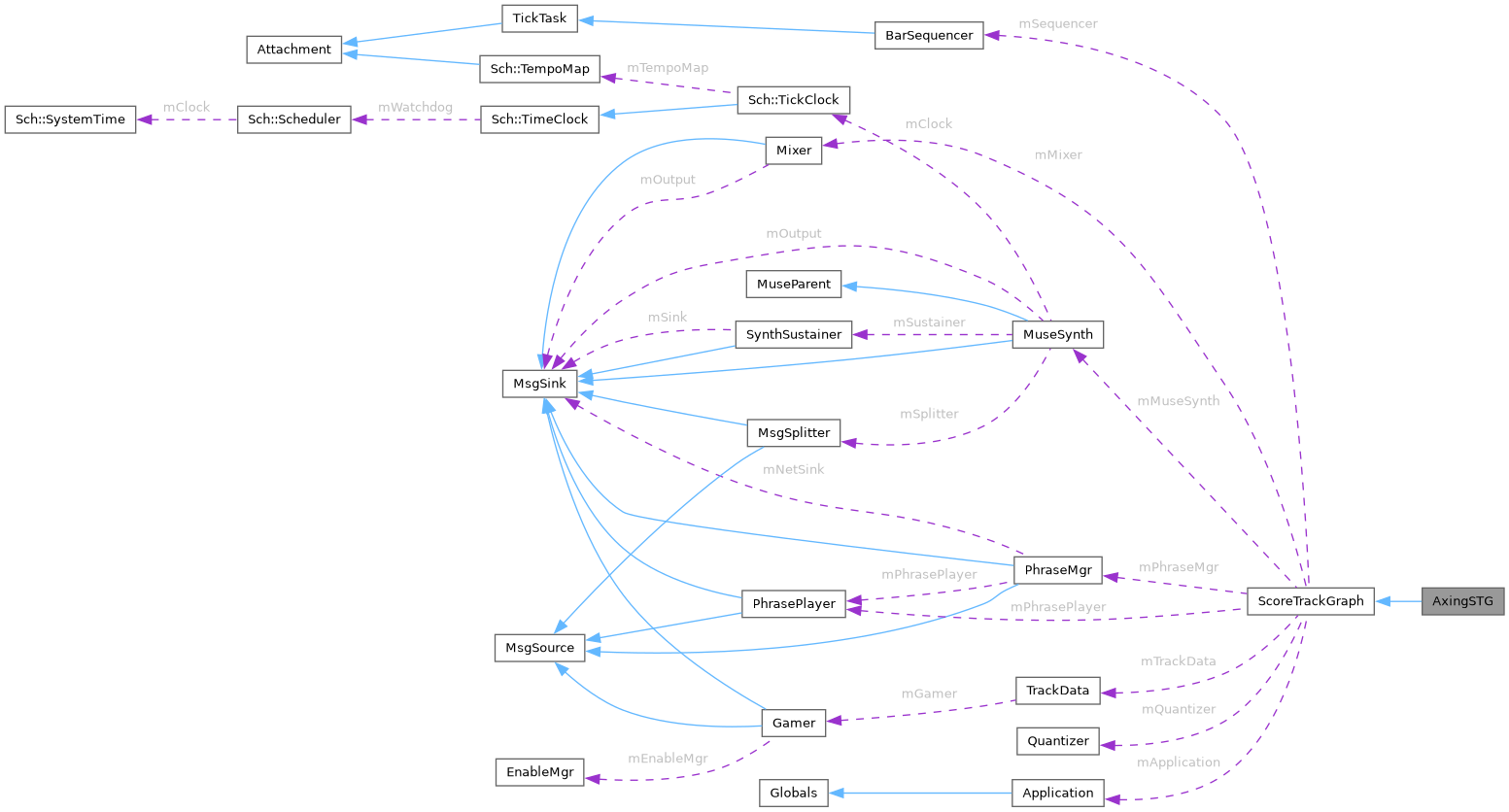
Its RTTI descriptor is at 0x008efe70. It has ScoreTrackGraph as its only base at offset 0. Its table is at 0x007ddf88 and runs thirteen entries, the same as the base's. The class introduces no virtual. It overrides eight slots and inherits slots 5, 9, 10, 11, and 12 from the base. The object is 0x54 bytes.
The constructor builds nine objects. The GsPeriodical goes through the plain allocator and the other eight through the tagged allocator. It also calls MuseSynth::CreateSustainer() on the base's synthesiser before it builds anything of its own.
The member at +0x34 is the one the constructor never writes. It is declared so that the two members around it retain their offsets, and no reader for it was found.
The names of three of its members (AutoRiffer, AxisControl, and AxePhraseMaker) come from the descriptor that the slot 0 accessor of each one's table guards on.
Constructor & Destructor Documentation
◆ AxingSTG()
| AxingSTG::AxingSTG | ( | TrackData * | pTrackData | ) |
- Parameters
-
pTrackData The track description the base retains.
- Ghidra address:
- NTSC-U/C: 0x0019daf0
- Ghidra address:
- PAL: 0x001a3858
◆ ~AxingSTG()
|
virtual |
Stop the stage and release everything the constructor built.
Slot 1. The routine stops the stage through a direct call to this class's own Stop(), then releases the periodical post and the eight objects it built, in an order that is not the order of their offsets.
- Ghidra address:
- NTSC-U/C: 0x0019de08
- Ghidra address:
- PAL: 0x001a3b70
Member Function Documentation
◆ Start()
|
virtual |
Start the stage.
Slot 2. In play mode 2 the routine sends controller 0x52 with value 0x7f on the track's MIDI channel, then starts the base and queues the periodical post.
- Ghidra address:
- NTSC-U/C: 0x0019e720
- Ghidra address:
- PAL: 0x001a4488
Reimplemented from ScoreTrackGraph.
◆ Stop()
|
virtual |
Stop the stage.
Slot 3. In play mode 2 the routine sends controller 0x52 with value zero on the track's MIDI channel, then withdraws the periodical post and stops the base.
- Ghidra address:
- NTSC-U/C: 0x0019e798
- Ghidra address:
- PAL: 0x001a4500
Reimplemented from ScoreTrackGraph.
◆ ConnectInputs()
|
virtual |
Wire the stage's objects to the sources that drive it.
Slot 4.
- Parameters
-
pPrimary The source the stage registers eight of its objects with. pOptional A further source, which receives the phrase manager when it is supplied. pSecondary The source that receives the phrase manager and the phrase maker.
- Ghidra address:
- NTSC-U/C: 0x0019df58
- Ghidra address:
- PAL: 0x001a3cc0
Implements ScoreTrackGraph.
◆ SetMixerOutput()
|
virtual |
Attach the mixer to the base's synthesiser and give it its output sink.
Slot 6.
- Parameters
-
pOutput The sink the mixer sends to, stored in Mixer::mOutput.
- Ghidra address:
- NTSC-U/C: 0x0019e810
- Ghidra address:
- PAL: 0x001a4578
Implements ScoreTrackGraph.
◆ ConnectToTunnel()
|
virtual |
Register one sink with every source the stage provides.
Slot 7.
- Parameters
-
pSink The sink to register.
- Ghidra address:
- NTSC-U/C: 0x0019e850
- Ghidra address:
- PAL: 0x001a45b8
Implements ScoreTrackGraph.
◆ SetNetSink()
|
virtual |
Install the sink the phrase manager reports phrase changes to.
Slot 8.
- Parameters
-
pSink The sink to install, ignored when null.
- Ghidra address:
- NTSC-U/C: 0x0019e928
- Ghidra address:
- PAL: 0x001a4690
Implements ScoreTrackGraph.
The documentation for this class was generated from the following file:
- src/game/axingstg.h