One front-end screen, a set of panels shown together with one panel holding the focus. More...
#include <uiscreen.h>
Classes | |
| struct | Transition |
| One entry of the screen's transition table. More... | |
Public Member Functions | |
| UIScreen (DataArray *pData) | |
| Construct a screen from its script description. | |
| ~UIScreen () override | |
| Destroy the screen. | |
| bool | Dispatch (Message *pMsg) override |
| Offer a message to the manager, then handle it here, then pass a navigation message on. | |
| bool | DispatchPriv (Message *pMsg) override |
| Follow the transition of a pressed button or a chosen component. | |
| virtual void | Poll (float fTime) |
| Advance the panels to a time, and finish the exit or the entry once their animations stop. | |
| virtual void | Draw () |
| Draw the panels. | |
| virtual void | Exit (UIScreen *pNextScreen, float fTime) |
| Start the exit to another screen. | |
| virtual void | Enter (UIScreen *pPrevScreen, float fTime) |
| Become the current screen and start the entry animations of the panels. | |
| virtual void | Print (PrnStream &stream) |
| Write a description of the screen, its panels, and its transitions. | |
| void | ClearTransitions () |
| Empty the transition table. | |
| void | AddTransition (const char *pszComponent, int nButton, const char *pszScreen) |
| Append an entry to the transition table. | |
| void | AddPanel (UIPanel *pPanel) |
| Add a panel to the screen. | |
| bool | HandleJoypad (JoypadInputMsg *pMsg) |
| Follow the transition of a pressed controller button. | |
| bool | HandleSelect (UIComponentSelectMsg *pMsg) |
| Follow the transition of a component chosen with the cross button. | |
| void | SetFocus (UIPanel *pPanel) |
| Move the focus to a panel. | |
| UIComponent * | FindComponent (const char *pszName) |
| Find a component on any of the screen's panels. | |
| Transition * | FindTransition (UIComponent *pComponent, bool bFail) |
| Find the transition of a component. | |
| Transition * | FindTransition (int nButton, bool bFail) |
| Find the transition of a controller button. | |
| void | Load () |
| Load the panels. | |
| void | Unload () |
| Unload the panels. | |
| bool | IsLoaded () |
| Report whether every panel has loaded. | |
| const char * | GetName () const |
| const char * | GetGroup () const |
| UIPanel * | GetFocusPanel () const |
| UIScreen * | GetNextScreen () const |
| UIScreen * | GetPrevScreen () const |
| const std::map< const char *, UIPanel *, StrLess > & | GetPanels () const |
| Public Member Functions inherited from MsgSink | |
| void * | operator new (size_t nSize) |
| Allocate a sink from the pool heaps under the tag "MsgSink". | |
| void | operator delete (void *pBlock) |
| Return a sink to the pool heaps. | |
| virtual | ~MsgSink () |
| void * | operator new (size_t size) |
| Allocate from the main heap under the name MsgSink. | |
| void | operator delete (void *mem) |
| Return memory to its heap. | |
| virtual | ~MsgSink () |
| Destroy the sink. | |
Static Public Member Functions | |
| static UIScreen * | New (DataArray *pData) |
| Create a screen from its script description. | |
Protected Attributes | |
| const char * | mName |
| const char * | mGroup |
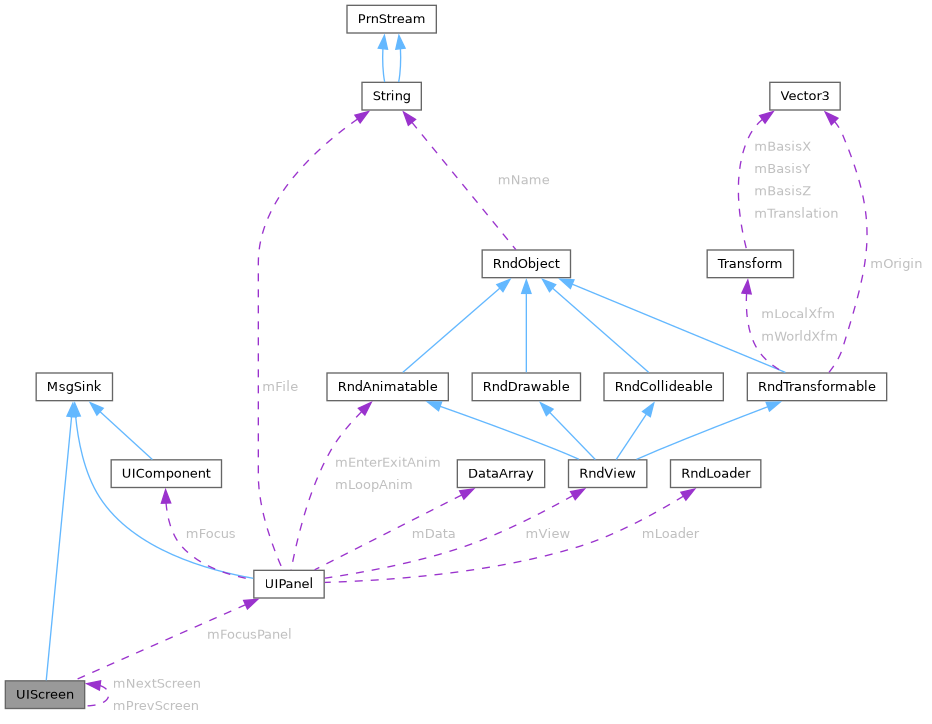
| std::map< const char *, UIPanel *, StrLess > | mPanels |
| UIPanel * | mFocusPanel |
| std::vector< Transition > | mTransitions |
| UIScreen * | mPrevScreen |
| UIScreen * | mNextScreen |
| int | mForceEntryExit |
Detailed Description
One front-end screen, a set of panels shown together with one panel holding the focus.
The RTTI records the class as deriving from MsgSink. The object is 0x3c bytes. UIManager creates one for each screen entry of the front-end description, through the factory registered for the entry's type. The entry provides these:
- index 1, the name;
- panels, the names of the panels the screen shows;
- focus, the panel that first receives the focus, or the first panel by name;
- screen_transitions, pairs of a component name or a controller button and the screen that choosing the component or pressing the button leads to;
- force_entry_exit, whether the panels skip their animations;
- group, the loading group, which must be one of the allowable_groups of the configuration.
UIManager::GotoScreen() calls Exit() on the current screen. Once the exit animations have played and the next screen has loaded, Poll() unloads this screen's panels and calls Enter() on the next screen, which becomes current. A screen that has entered dispatches a UITransitionCompleteMsg to itself.
Constructor & Destructor Documentation
◆ UIScreen()
|
explicit |
Construct a screen from its script description.
- Parameters
-
pData The script description.
- Ghidra address:
- NTSC-U/C: 0x0020a600
- Ghidra address:
- PAL: 0x00213400
◆ ~UIScreen()
|
override |
Destroy the screen.
- Ghidra address:
- NTSC-U/C: 0x0020aa10
- Ghidra address:
- PAL: 0x00213810
Member Function Documentation
◆ New()
Create a screen from its script description.
UIManager::Init() registers the routine for the entry type screen.
- Parameters
-
pData The script description.
- Returns
- The new screen.
- Ghidra address:
- NTSC-U/C: 0x00379470
- Ghidra address:
- PAL: 0x003e7ba0
◆ Dispatch()
|
overridevirtual |
Offer a message to the manager, then handle it here, then pass a navigation message on.
A message that is neither a controller button nor a keyboard key goes first to UIManager. A controller button or keyboard key that the screen does not handle goes to the panel with the focus.
- Parameters
-
pMsg The message.
- Returns
- Whether the message was handled.
- Ghidra address:
- NTSC-U/C: 0x0020af00
- Ghidra address:
- PAL: 0x00213d00
Reimplemented from MsgSink.
◆ DispatchPriv()
|
overridevirtual |
Follow the transition of a pressed button or a chosen component.
- Parameters
-
pMsg The message.
- Returns
- Whether the message was handled.
- Ghidra address:
- NTSC-U/C: 0x0020afb8
- Ghidra address:
- PAL: 0x00213db8
Implements MsgSink.
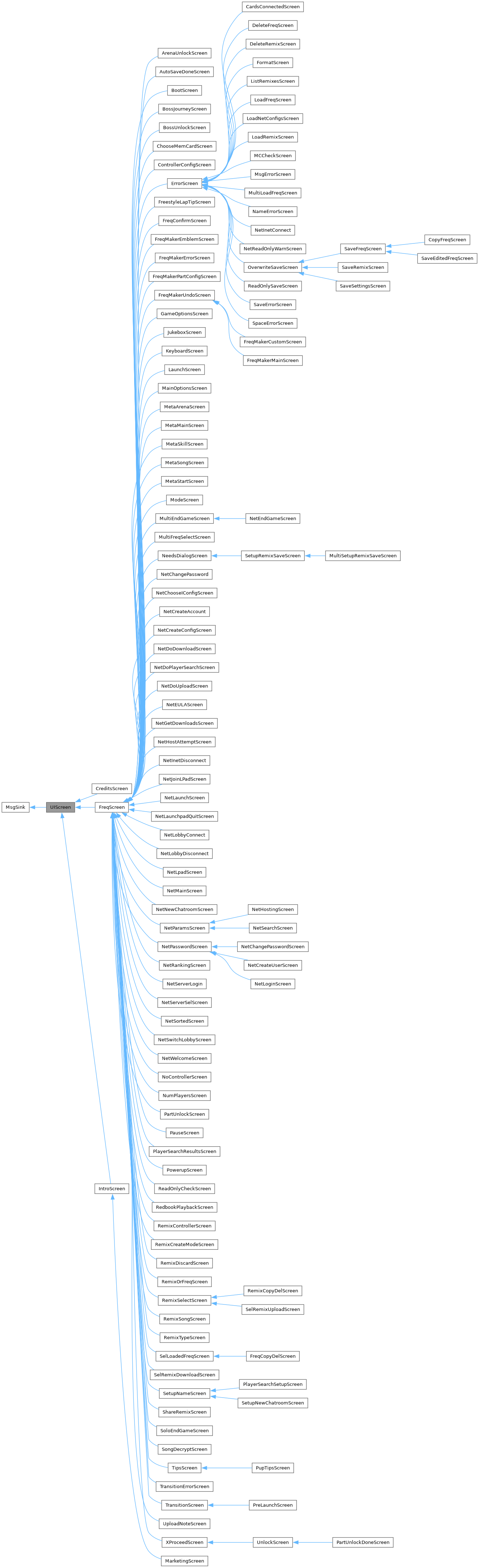
Reimplemented in UnlockScreen, UploadNoteScreen, and XProceedScreen.
◆ Poll()
|
virtual |
Advance the panels to a time, and finish the exit or the entry once their animations stop.
- Parameters
-
fTime The front-end time in milliseconds.
- Ghidra address:
- NTSC-U/C: 0x0020b138
- Ghidra address:
- PAL: 0x00213f38
Reimplemented in ArenaUnlockScreen, BossJourneyScreen, BossUnlockScreen, CardsConnectedScreen, CreditsScreen, IntroScreen, MCCheckScreen, MetaArenaScreen, MetaSongScreen, MetaStartScreen, MultiEndGameScreen, MultiLoadFreqScreen, NetEndGameScreen, NetLpadScreen, NumPlayersScreen, PartUnlockDoneScreen, PartUnlockScreen, RedbookPlaybackScreen, SoloEndGameScreen, and SongDecryptScreen.
◆ Draw()
|
virtual |
Draw the panels.
- Ghidra address:
- NTSC-U/C: 0x0020b3a8
- Ghidra address:
- PAL: 0x002141a8
Reimplemented in FreqScreen.
◆ Exit()
|
virtual |
Start the exit to another screen.
A panel the next screen shares stays, and one of those that is exiting enters again. The others start their exit animations.
- Parameters
-
pNextScreen The screen to change to. fTime The front-end time in milliseconds.
- Ghidra address:
- NTSC-U/C: 0x0020b6c8
- Ghidra address:
- PAL: 0x002144c8
Reimplemented in ArenaUnlockScreen, BossUnlockScreen, ControllerConfigScreen, FreqMakerEmblemScreen, FreqMakerMainScreen, FreqMakerPartConfigScreen, FreqScreen, JukeboxScreen, MainOptionsScreen, MCCheckScreen, MetaMainScreen, MetaSongScreen, MetaStartScreen, NetLpadScreen, NetMainScreen, NetParamsScreen, PartUnlockScreen, and SongDecryptScreen.
◆ Enter()
|
virtual |
Become the current screen and start the entry animations of the panels.
- Parameters
-
pPrevScreen The screen this one replaces, or null. fTime The front-end time in milliseconds.
- Ghidra address:
- NTSC-U/C: 0x0020b2e0
- Ghidra address:
- PAL: 0x002140e0
Reimplemented in ArenaUnlockScreen, BootScreen, BossJourneyScreen, BossUnlockScreen, CardsConnectedScreen, ChooseMemCardScreen, ControllerConfigScreen, CopyFreqScreen, CreditsScreen, FreqConfirmScreen, FreqCopyDelScreen, FreqMakerCustomScreen, FreqMakerEmblemScreen, FreqMakerMainScreen, FreqMakerPartConfigScreen, FreqScreen, GameOptionsScreen, JukeboxScreen, LaunchScreen, MainOptionsScreen, MetaArenaScreen, MetaMainScreen, MetaSkillScreen, MetaSongScreen, MetaStartScreen, ModeScreen, MsgErrorScreen, MultiEndGameScreen, MultiFreqSelectScreen, MultiLoadFreqScreen, MultiSetupRemixSaveScreen, NameErrorScreen, NetChangePasswordScreen, NetChooseIConfigScreen, NetCreateUserScreen, NetEULAScreen, NetHostingScreen, NetLoginScreen, NetLpadScreen, NetMainScreen, NetParamsScreen, NetPasswordScreen, NetRankingScreen, NetSearchScreen, NetServerSelScreen, NetSortedScreen, NetWelcomeScreen, NoControllerScreen, NumPlayersScreen, PartUnlockDoneScreen, PartUnlockScreen, PauseScreen, PlayerSearchResultsScreen, PowerupScreen, PupTipsScreen, RedbookPlaybackScreen, RemixOrFreqScreen, RemixSelectScreen, RemixSongScreen, RemixTypeScreen, SaveFreqScreen, SelLoadedFreqScreen, SelRemixDownloadScreen, SetupNameScreen, SetupNewChatroomScreen, SetupRemixSaveScreen, SoloEndGameScreen, SongDecryptScreen, SpaceErrorScreen, TipsScreen, TransitionErrorScreen, and UploadNoteScreen.
◆ Print()
|
virtual |
Write a description of the screen, its panels, and its transitions.
- Parameters
-
stream The stream to write to.
- Ghidra address:
- NTSC-U/C: 0x0020b888
- Ghidra address:
- PAL: 0x00214688
◆ ClearTransitions()
| void UIScreen::ClearTransitions | ( | ) |
Empty the transition table.
- Ghidra address:
- NTSC-U/C: 0x0020ab10
- Ghidra address:
- PAL: 0x00213910
◆ AddTransition()
| void UIScreen::AddTransition | ( | const char * | pszComponent, |
| int | nButton, | ||
| const char * | pszScreen ) |
Append an entry to the transition table.
Both names are interned first.
- Parameters
-
pszComponent The component that leads to the screen. nButton The controller button that leads to the screen. pszScreen The name of the screen.
- Ghidra address:
- NTSC-U/C: 0x0020ab50
- Ghidra address:
- PAL: 0x00213950
◆ AddPanel()
| void UIScreen::AddPanel | ( | UIPanel * | pPanel | ) |
Add a panel to the screen.
- Parameters
-
pPanel The panel.
- Ghidra address:
- NTSC-U/C: 0x0020ad90
- Ghidra address:
- PAL: 0x00213b90
◆ HandleJoypad()
| bool UIScreen::HandleJoypad | ( | JoypadInputMsg * | pMsg | ) |
Follow the transition of a pressed controller button.
- Parameters
-
pMsg The message of the button.
- Returns
- Whether the button is ignored because the screen is changing.
- Ghidra address:
- NTSC-U/C: 0x0020b050
- Ghidra address:
- PAL: 0x00213e50
◆ HandleSelect()
| bool UIScreen::HandleSelect | ( | UIComponentSelectMsg * | pMsg | ) |
Follow the transition of a component chosen with the cross button.
- Parameters
-
pMsg The message of the choice.
- Returns
- Whether a transition was found.
- Ghidra address:
- NTSC-U/C: 0x0020b0c8
- Ghidra address:
- PAL: 0x00213ec8
◆ SetFocus()
| void UIScreen::SetFocus | ( | UIPanel * | pPanel | ) |
Move the focus to a panel.
- Parameters
-
pPanel The panel, or null.
- Ghidra address:
- NTSC-U/C: 0x0020b420
- Ghidra address:
- PAL: 0x00214220
◆ FindComponent()
| UIComponent * UIScreen::FindComponent | ( | const char * | pszName | ) |
Find a component on any of the screen's panels.
A name found on two panels is reported, and the component of the later panel by name wins.
- Parameters
-
pszName The name.
- Returns
- The component, or null.
- Ghidra address:
- NTSC-U/C: 0x0020b490
- Ghidra address:
- PAL: 0x00214290
◆ FindTransition() [1/2]
| Transition * UIScreen::FindTransition | ( | UIComponent * | pComponent, |
| bool | bFail ) |
Find the transition of a component.
- Parameters
-
pComponent The component. bFail Treat a missing transition as an error. The shipped build ignores it.
- Returns
- The transition, or null.
- Ghidra address:
- NTSC-U/C: 0x0020b808
- Ghidra address:
- PAL: 0x00214608
◆ FindTransition() [2/2]
| Transition * UIScreen::FindTransition | ( | int | nButton, |
| bool | bFail ) |
Find the transition of a controller button.
- Parameters
-
nButton One of JoypadButton. bFail Treat a missing transition as an error. The shipped build ignores it.
- Returns
- The transition, or null.
- Ghidra address:
- NTSC-U/C: 0x0020b848
- Ghidra address:
- PAL: 0x00214648
◆ Load()
| void UIScreen::Load | ( | ) |
Load the panels.
- Ghidra address:
- NTSC-U/C: 0x0020baf0
- Ghidra address:
- PAL: 0x002148f0
◆ Unload()
| void UIScreen::Unload | ( | ) |
Unload the panels.
- Ghidra address:
- NTSC-U/C: 0x0020bb68
- Ghidra address:
- PAL: 0x00214968
◆ IsLoaded()
| bool UIScreen::IsLoaded | ( | ) |
Report whether every panel has loaded.
- Returns
- Whether the screen is ready to show.
- Ghidra address:
- NTSC-U/C: 0x0020bbe0
- Ghidra address:
- PAL: 0x002149e0
◆ GetName()
|
inline |
- Returns
- The name, a symbol.
◆ GetGroup()
|
inline |
- Returns
- The loading group, a symbol.
◆ GetFocusPanel()
|
inline |
- Returns
- The panel with the focus, or null.
◆ GetNextScreen()
|
inline |
- Returns
- The screen this one is exiting to, until the exit finishes.
◆ GetPrevScreen()
|
inline |
- Returns
- The screen this one is entering from, until the entry finishes.
◆ GetPanels()
- Returns
- The panels by name.
Member Data Documentation
◆ mName
|
protected |
The name, a symbol.
◆ mGroup
|
protected |
The loading group, a symbol.
◆ mPanels
The panels by name. Borrowed.
◆ mFocusPanel
|
protected |
The panel with the focus.
◆ mTransitions
|
protected |
The transition table.
◆ mPrevScreen
|
protected |
The screen this one is entering from, until the entry finishes.
◆ mNextScreen
|
protected |
The screen this one is exiting to, until the exit finishes.
◆ mForceEntryExit
|
protected |
Whether the panels skip their animations.
The documentation for this class was generated from the following file:
- src/ui/uiscreen.h