The game options menu: the size of the track display, the speaker output, the hints, and the controller vibration. More...
#include <gameoptionsscreen.h>
Public Types | |
| enum | Toggle { kToggleForceFeedback = 1 , kToggleHelpText = 2 } |
| Bits of mToggles. More... | |
Public Member Functions | |
| ~GameOptionsScreen () override=default | |
| Destroy the object. | |
| GameOptionsScreen (DataArray *pData) | |
| Construct the screen from its script description. | |
| bool | DispatchPriv (Message *pMsg) override |
| Route the start of a choice and a controller button, and pass on every other message. | |
| void | Enter (UIScreen *pPrevScreen, float fTime) override |
| Enter, remember the screen to return to, and show the stored settings. | |
| void | Refresh () |
| Copy the stored settings into the menu and show them. | |
| void | RefreshToggle (const char *pszComponent) |
| Show whether one of the two toggles is on. | |
| void | Commit () |
| Store the settings of the menu in the game database. | |
| bool | IsToggleOn (unsigned char nToggle) const |
| Report whether toggles are on. | |
| void | FlipToggle (unsigned char nToggle) |
| Turn toggles over. | |
| void | SetToggle (unsigned char nToggle, int nOn) |
| Turn toggles on or off. | |
| const char * | FreqSizeLabel (int nFreqSize) const |
| Report the label of a size of the track display. | |
| const char * | OnOffLabel (bool bOn) const |
| Report the label of a toggle. | |
| const char * | OutputModeLabel (int nOutputMode) const |
| Report the label of a speaker output mode. | |
| bool | HandleSelectStart (UIComponentSelectStartMsg *pMsg) |
| Change the setting of the component a button starts to choose, or leave with done. | |
| bool | HandleJoypad (JoypadInputMsg *pMsg) |
| Go back to the screen the menu was entered from on Triangle, unless the screen is between screens. | |
| Public Member Functions inherited from FreqScreen | |
| FreqScreen (DataArray *pData) | |
| Construct a screen from its script description. | |
| ~FreqScreen () override | |
| Destroy the screen. | |
| void | Draw () override |
| Draw what goes under each panel, then the panels. | |
| void | Exit (UIScreen *pNextScreen, float fTime) override |
| Move the projector to the next screen's place and start the exit. | |
| virtual const char * | Title () |
| Report the localised title of the screen, the token <name>_TITLE. | |
| virtual void | PlayButtonSound (int nButton) |
| Play the menu sound of a controller button. | |
| bool | HandleSelectStart (UIComponentSelectStartMsg *pMsg) |
| Play the sound of the button that chooses a component. | |
| bool | HandleTransitionComplete (UITransitionCompleteMsg *pMsg) |
| Choose the component the shortcuts section of the metagame configuration lists for the screen. | |
| bool | HandleJoypad (JoypadInputMsg *pMsg) |
| Pass on a controller button of a controller the players use, and swallow any other. | |
| Public Member Functions inherited from UIScreen | |
| UIScreen (DataArray *pData) | |
| Construct a screen from its script description. | |
| ~UIScreen () override | |
| Destroy the screen. | |
| bool | Dispatch (Message *pMsg) override |
| Offer a message to the manager, then handle it here, then pass a navigation message on. | |
| bool | DispatchPriv (Message *pMsg) override |
| Follow the transition of a pressed button or a chosen component. | |
| virtual void | Poll (float fTime) |
| Advance the panels to a time, and finish the exit or the entry once their animations stop. | |
| virtual void | Print (PrnStream &stream) |
| Write a description of the screen, its panels, and its transitions. | |
| void | ClearTransitions () |
| Empty the transition table. | |
| void | AddTransition (const char *pszComponent, int nButton, const char *pszScreen) |
| Append an entry to the transition table. | |
| void | AddPanel (UIPanel *pPanel) |
| Add a panel to the screen. | |
| bool | HandleJoypad (JoypadInputMsg *pMsg) |
| Follow the transition of a pressed controller button. | |
| bool | HandleSelect (UIComponentSelectMsg *pMsg) |
| Follow the transition of a component chosen with the cross button. | |
| void | SetFocus (UIPanel *pPanel) |
| Move the focus to a panel. | |
| UIComponent * | FindComponent (const char *pszName) |
| Find a component on any of the screen's panels. | |
| Transition * | FindTransition (UIComponent *pComponent, bool bFail) |
| Find the transition of a component. | |
| Transition * | FindTransition (int nButton, bool bFail) |
| Find the transition of a controller button. | |
| void | Load () |
| Load the panels. | |
| void | Unload () |
| Unload the panels. | |
| bool | IsLoaded () |
| Report whether every panel has loaded. | |
| const char * | GetName () const |
| const char * | GetGroup () const |
| UIPanel * | GetFocusPanel () const |
| UIScreen * | GetNextScreen () const |
| UIScreen * | GetPrevScreen () const |
| const std::map< const char *, UIPanel *, StrLess > & | GetPanels () const |
| Public Member Functions inherited from MsgSink | |
| void * | operator new (size_t nSize) |
| Allocate a sink from the pool heaps under the tag "MsgSink". | |
| void | operator delete (void *pBlock) |
| Return a sink to the pool heaps. | |
| virtual | ~MsgSink () |
| void * | operator new (size_t size) |
| Allocate from the main heap under the name MsgSink. | |
| void | operator delete (void *mem) |
| Return memory to its heap. | |
| virtual | ~MsgSink () |
| Destroy the sink. | |
Static Public Member Functions | |
| static UIScreen * | New (DataArray *pData) |
| Create a screen from its script description. | |
| Static Public Member Functions inherited from FreqScreen | |
| static UIScreen * | New (DataArray *pData) |
| Create a screen from its script description. | |
| Static Public Member Functions inherited from UIScreen | |
| static UIScreen * | New (DataArray *pData) |
| Create a screen from its script description. | |
Additional Inherited Members | |
| Public Attributes inherited from FreqScreen | |
| Vector3 | mGizmoOrig |
| Quat | mGizmoRot |
| Protected Attributes inherited from UIScreen | |
| const char * | mName |
| const char * | mGroup |
| std::map< const char *, UIPanel *, StrLess > | mPanels |
| UIPanel * | mFocusPanel |
| std::vector< Transition > | mTransitions |
| UIScreen * | mPrevScreen |
| UIScreen * | mNextScreen |
| int | mForceEntryExit |
Detailed Description
The game options menu: the size of the track display, the speaker output, the hints, and the controller vibration.
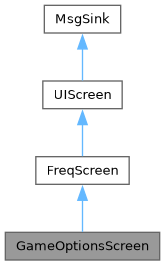
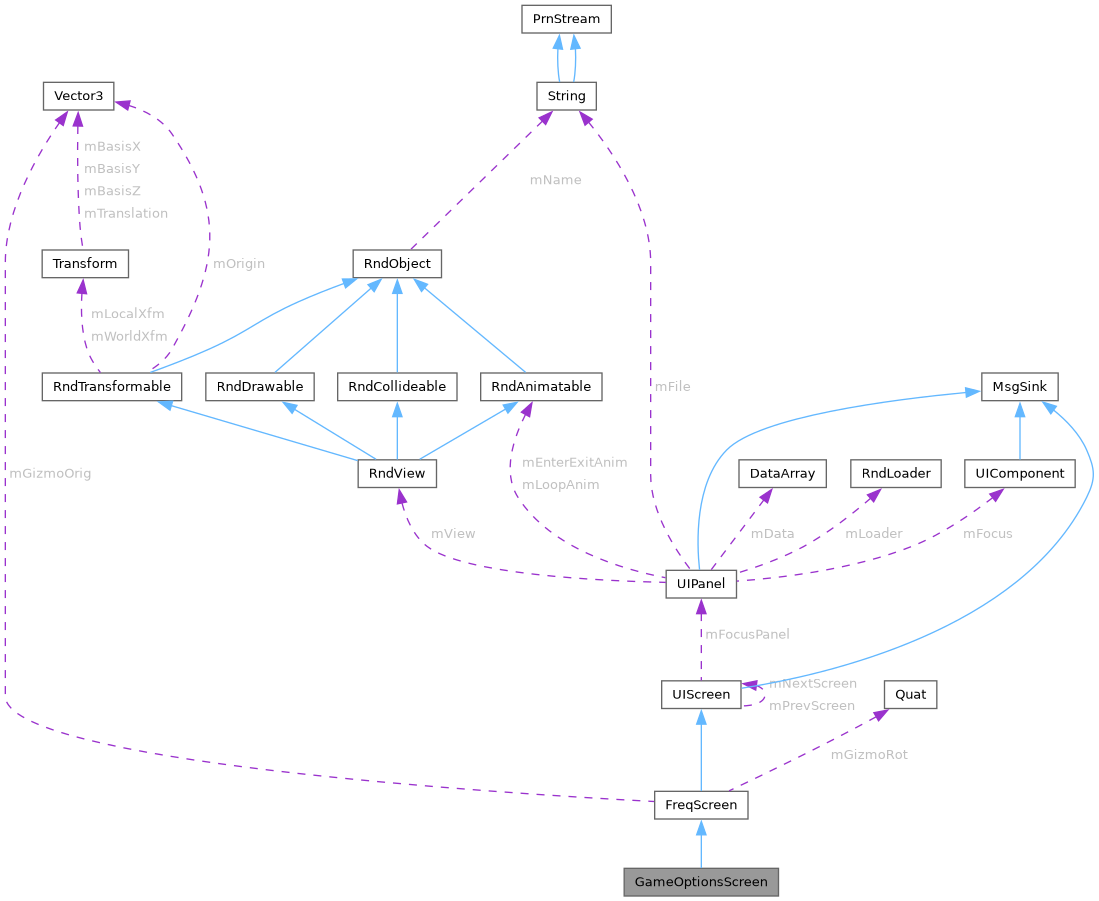
The RTTI records the class as deriving from FreqScreen. The object is 0x80 bytes and its vtable is at 0x003cc370. The menu edits a copy of the settings and stores it in the game database when its done button is chosen.
Member Enumeration Documentation
◆ Toggle
Constructor & Destructor Documentation
◆ ~GameOptionsScreen()
|
overridedefault |
Destroy the object.
- Ghidra address:
- NTSC-U/C: 0x003568e0
- Ghidra address:
- PAL: 0x003c3b40
◆ GameOptionsScreen()
|
inlineexplicit |
Construct the screen from its script description.
- Parameters
-
pData The script description.
- Ghidra address:
- NTSC-U/C: 0x00356938
- Ghidra address:
- PAL: 0x003c3b98
Member Function Documentation
◆ New()
Create a screen from its script description.
- Parameters
-
pData The script description.
- Returns
- The new screen.
- Ghidra address:
- NTSC-U/C: 0x003568a0
- Ghidra address:
- PAL: 0x003c3b00
◆ DispatchPriv()
|
overridevirtual |
Route the start of a choice and a controller button, and pass on every other message.
- Parameters
-
pMsg The message.
- Returns
- Whether the message was handled.
- Ghidra address:
- NTSC-U/C: 0x0016c018
- Ghidra address:
- PAL: 0x0016f1a0
Reimplemented from FreqScreen.
◆ Enter()
|
overridevirtual |
Enter, remember the screen to return to, and show the stored settings.
- Parameters
-
pPrevScreen The screen this one replaces, and the one done returns to. fTime The front-end time in milliseconds.
- Ghidra address:
- NTSC-U/C: 0x0016b850
- Ghidra address:
- PAL: 0x0016e9d8
Reimplemented from FreqScreen.
◆ Refresh()
| void GameOptionsScreen::Refresh | ( | ) |
Copy the stored settings into the menu and show them.
- Ghidra address:
- NTSC-U/C: 0x0016b890
- Ghidra address:
- PAL: 0x0016ea18
◆ RefreshToggle()
| void GameOptionsScreen::RefreshToggle | ( | const char * | pszComponent | ) |
Show whether one of the two toggles is on.
- Parameters
-
pszComponent The component of the toggle, helptext or vibration.
- Ghidra address:
- NTSC-U/C: 0x0016b9c8
- Ghidra address:
- PAL: 0x0016eb50
◆ Commit()
| void GameOptionsScreen::Commit | ( | ) |
Store the settings of the menu in the game database.
- Ghidra address:
- NTSC-U/C: 0x0016bab0
- Ghidra address:
- PAL: 0x0016ec38
◆ IsToggleOn()
| bool GameOptionsScreen::IsToggleOn | ( | unsigned char | nToggle | ) | const |
Report whether toggles are on.
- Parameters
-
nToggle The bits of Toggle.
- Returns
- Whether any of the toggles is on.
- Ghidra address:
- NTSC-U/C: 0x0016bb30
- Ghidra address:
- PAL: 0x0016ecb8
◆ FlipToggle()
| void GameOptionsScreen::FlipToggle | ( | unsigned char | nToggle | ) |
Turn toggles over.
When any of the toggles is on, all of them turn off. Otherwise all of them turn on.
- Parameters
-
nToggle The bits of Toggle.
- Ghidra address:
- NTSC-U/C: 0x0016bb48
- Ghidra address:
- PAL: 0x0016ecd0
◆ SetToggle()
| void GameOptionsScreen::SetToggle | ( | unsigned char | nToggle, |
| int | nOn ) |
Turn toggles on or off.
- Parameters
-
nToggle The bits of Toggle. nOn Non-zero for on.
- Ghidra address:
- NTSC-U/C: 0x0016bb78
- Ghidra address:
- PAL: 0x0016ed00
◆ FreqSizeLabel()
| const char * GameOptionsScreen::FreqSizeLabel | ( | int | nFreqSize | ) | const |
Report the label of a size of the track display.
- Parameters
-
nFreqSize One of GameOptions::FreqSize.
- Returns
- The localized label, or NONE for another value.
- Ghidra address:
- NTSC-U/C: 0x0016bba8
- Ghidra address:
- PAL: 0x0016ed30
◆ OnOffLabel()
| const char * GameOptionsScreen::OnOffLabel | ( | bool | bOn | ) | const |
Report the label of a toggle.
- Parameters
-
bOn Whether the toggle is on.
- Returns
- The localized label.
- Ghidra address:
- NTSC-U/C: 0x0016bc38
- Ghidra address:
- PAL: 0x0016edc0
◆ OutputModeLabel()
| const char * GameOptionsScreen::OutputModeLabel | ( | int | nOutputMode | ) | const |
Report the label of a speaker output mode.
- Parameters
-
nOutputMode The mode, 0 for mono, 1 for stereo, or 2 for surround.
- Returns
- The localized label, or NONE for another value.
- Ghidra address:
- NTSC-U/C: 0x0016bc80
- Ghidra address:
- PAL: 0x0016ee08
◆ HandleSelectStart()
| bool GameOptionsScreen::HandleSelectStart | ( | UIComponentSelectStartMsg * | pMsg | ) |
Change the setting of the component a button starts to choose, or leave with done.
The directional buttons step the display size and the output mode, and the other components turn their toggle over.
- Parameters
-
pMsg The message.
- Returns
- The result of FreqScreen::HandleSelectStart().
- Ghidra address:
- NTSC-U/C: 0x0016bd10
- Ghidra address:
- PAL: 0x0016ee98
◆ HandleJoypad()
| bool GameOptionsScreen::HandleJoypad | ( | JoypadInputMsg * | pMsg | ) |
Go back to the screen the menu was entered from on Triangle, unless the screen is between screens.
- Parameters
-
pMsg The message.
- Returns
- The result of FreqScreen::HandleJoypad(), or true between screens.
- Ghidra address:
- NTSC-U/C: 0x0016bf98
- Ghidra address:
- PAL: 0x0016f120
The documentation for this class was generated from the following file:
- src/met/gameoptionsscreen.h