|
| | DeleteFreqScreen (DataArray *pData) |
| | Construct the screen from its script description, with no Freq.
|
| | ~DeleteFreqScreen () override |
| | Destroy the screen.
|
| const char * | Title () override |
| | Report the empty title of the screen.
|
| bool | DispatchPriv (Message *pMsg) override |
| | Route the end of the entry to HandleTransitionComplete().
|
| void | OnFreqDeleted (int nStatus) override |
| | Go to the done screen after the deletion, or open the dialog of a failure of the memory card.
|
| void | SetFreqName (const char *pszFreqName) |
| | ErrorScreen (DataArray *pData) |
| | Construct the screen from its script description.
|
| | ~ErrorScreen () override |
| | Destroy the screen.
|
| const char * | Title () override |
| | Report the empty title of the screen.
|
| virtual void | SetDoneScreen (const char *pszScreen) |
| | Set the screen the dialog leads to.
|
| virtual void | SetStartScreen (const char *pszScreen) |
| | Set the screen that opened the dialog.
|
| virtual void | SetSlot (int nSlot) |
| | Choose the memory card slot the dialog is about.
|
| const char * | GetSlotName () |
| | Report the localised name of the memory card slot the dialog is about.
|
| void | ShowCardError (int nStatus) |
| | Show the dialog of a memory card failure with retry, continue, and cancel buttons.
|
| void | ShowCardErrorTwoOption (int nStatus, int nOperation) |
| | Show the dialog of a memory card failure with retry and cancel buttons.
|
| void | ShowNoSpaceError (int nSpace) |
| | Show the no_space_error dialog of a memory card without enough space.
|
| | FreqScreen (DataArray *pData) |
| | Construct a screen from its script description.
|
| | ~FreqScreen () override |
| | Destroy the screen.
|
| bool | DispatchPriv (Message *pMsg) override |
| | Play the sound of a chosen component, follow a shortcut, and keep unused controllers out.
|
| void | Draw () override |
| | Draw what goes under each panel, then the panels.
|
| void | Exit (UIScreen *pNextScreen, float fTime) override |
| | Move the projector to the next screen's place and start the exit.
|
| void | Enter (UIScreen *pPrevScreen, float fTime) override |
| | Play the entry sound, show or hide the projector, and start the entry.
|
| virtual void | PlayButtonSound (int nButton) |
| | Play the menu sound of a controller button.
|
| bool | HandleSelectStart (UIComponentSelectStartMsg *pMsg) |
| | Play the sound of the button that chooses a component.
|
| bool | HandleTransitionComplete (UITransitionCompleteMsg *pMsg) |
| | Choose the component the shortcuts section of the metagame configuration lists for the screen.
|
| bool | HandleJoypad (JoypadInputMsg *pMsg) |
| | Pass on a controller button of a controller the players use, and swallow any other.
|
| | UIScreen (DataArray *pData) |
| | Construct a screen from its script description.
|
| | ~UIScreen () override |
| | Destroy the screen.
|
| bool | Dispatch (Message *pMsg) override |
| | Offer a message to the manager, then handle it here, then pass a navigation message on.
|
| bool | DispatchPriv (Message *pMsg) override |
| | Follow the transition of a pressed button or a chosen component.
|
| virtual void | Poll (float fTime) |
| | Advance the panels to a time, and finish the exit or the entry once their animations stop.
|
| virtual void | Print (PrnStream &stream) |
| | Write a description of the screen, its panels, and its transitions.
|
| void | ClearTransitions () |
| | Empty the transition table.
|
| void | AddTransition (const char *pszComponent, int nButton, const char *pszScreen) |
| | Append an entry to the transition table.
|
| void | AddPanel (UIPanel *pPanel) |
| | Add a panel to the screen.
|
| bool | HandleJoypad (JoypadInputMsg *pMsg) |
| | Follow the transition of a pressed controller button.
|
| bool | HandleSelect (UIComponentSelectMsg *pMsg) |
| | Follow the transition of a component chosen with the cross button.
|
| void | SetFocus (UIPanel *pPanel) |
| | Move the focus to a panel.
|
| UIComponent * | FindComponent (const char *pszName) |
| | Find a component on any of the screen's panels.
|
| Transition * | FindTransition (UIComponent *pComponent, bool bFail) |
| | Find the transition of a component.
|
| Transition * | FindTransition (int nButton, bool bFail) |
| | Find the transition of a controller button.
|
| void | Load () |
| | Load the panels.
|
| void | Unload () |
| | Unload the panels.
|
| bool | IsLoaded () |
| | Report whether every panel has loaded.
|
| const char * | GetName () const |
| const char * | GetGroup () const |
| UIPanel * | GetFocusPanel () const |
| UIScreen * | GetNextScreen () const |
| UIScreen * | GetPrevScreen () const |
| const std::map< const char *, UIPanel *, StrLess > & | GetPanels () const |
| void * | operator new (size_t nSize) |
| | Allocate a sink from the pool heaps under the tag "MsgSink".
|
| void | operator delete (void *pBlock) |
| | Return a sink to the pool heaps.
|
| virtual | ~MsgSink () |
| void * | operator new (size_t size) |
| | Allocate from the main heap under the name MsgSink.
|
| void | operator delete (void *mem) |
| | Return memory to its heap.
|
| virtual | ~MsgSink () |
| | Destroy the sink.
|
| virtual void | OnInitialCheck (int nStatus, int nFormat, int nFree, int nNeeded) |
| | Learn the outcome of MCManager::InitialCheck().
|
| virtual void | OnCardStatus (int nStatus) |
| | Learn the outcome of MCManager::GetCardStatus().
|
| virtual void | OnFreqSaved (int nStatus, int nNeeded) |
| | Learn the outcome of MCManager::SaveFreq().
|
| virtual void | OnFreqsLoaded (int nStatus, std::vector< Campaign > *pProfiles) |
| | Learn the outcome of MCManager::LoadFreqs().
|
| virtual void | UnusedReport () |
| | Do nothing.
|
| virtual void | OnRemixSaved (int nStatus, int nNeeded) |
| | Learn the outcome of MCManager::SaveRemix().
|
| virtual void | OnRemixLoaded (int nStatus) |
| | Learn the outcome of MCManager::LoadRemix().
|
| virtual void | OnRemixesListed (int nStatus, std::vector< RemixInfo > *pInfos) |
| | Learn the outcome of MCManager::ListRemixes().
|
| virtual void | OnRemixDeleted (int nStatus) |
| | Learn the outcome of MCManager::DeleteRemix().
|
| virtual void | OnSettingsSaved (int nStatus, int nNeeded) |
| | Learn the outcome of MCManager::SaveSettings().
|
| virtual void | OnSettingsLoaded (int nStatus, GameOptions settings) |
| | Learn the outcome of MCManager::LoadSettings().
|
| virtual void | OnNetConfigsListed (int nStatus, std::list< InetConfig > *pConfigs) |
| | Learn the outcome of MCManager::ListNetConfigs().
|
| virtual void | OnCardFormatted (int nStatus) |
| | Learn the outcome of MCManager::FormatCard().
|
| virtual void | OnCardUnformatted (int nStatus) |
| | Learn the outcome of the unformat work.
|
| virtual void | OnFileSaved (int nStatus) |
| | Learn the outcome of MCManager::SaveFile().
|
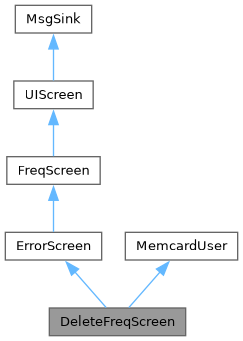
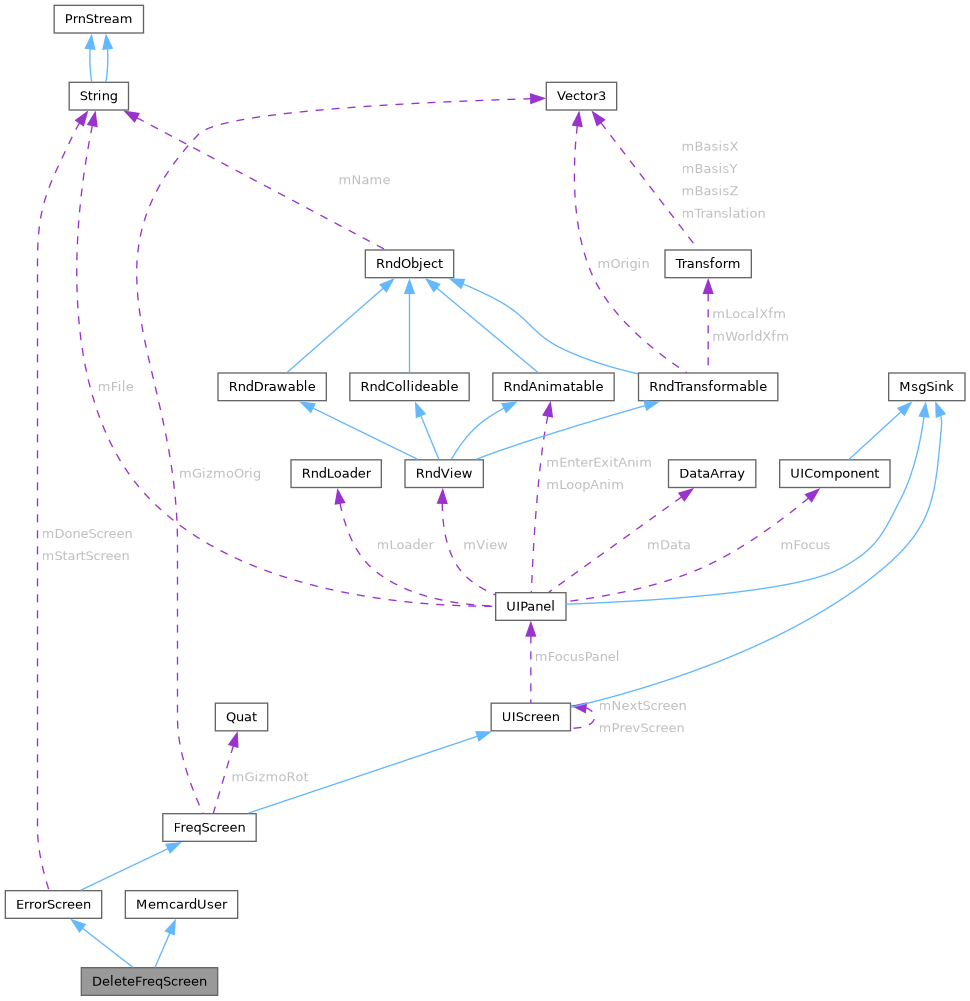
Screen that deletes a saved Freq from the memory card once it has entered.
The RTTI records the class as deriving from ErrorScreen and from MemcardUser at +0xa0. Its vtables are at 0x003d0e50 and, for MemcardUser, 0x003d0dc0. Deleting the Freq the first player uses in the first slot replaces that player with a default player_1.