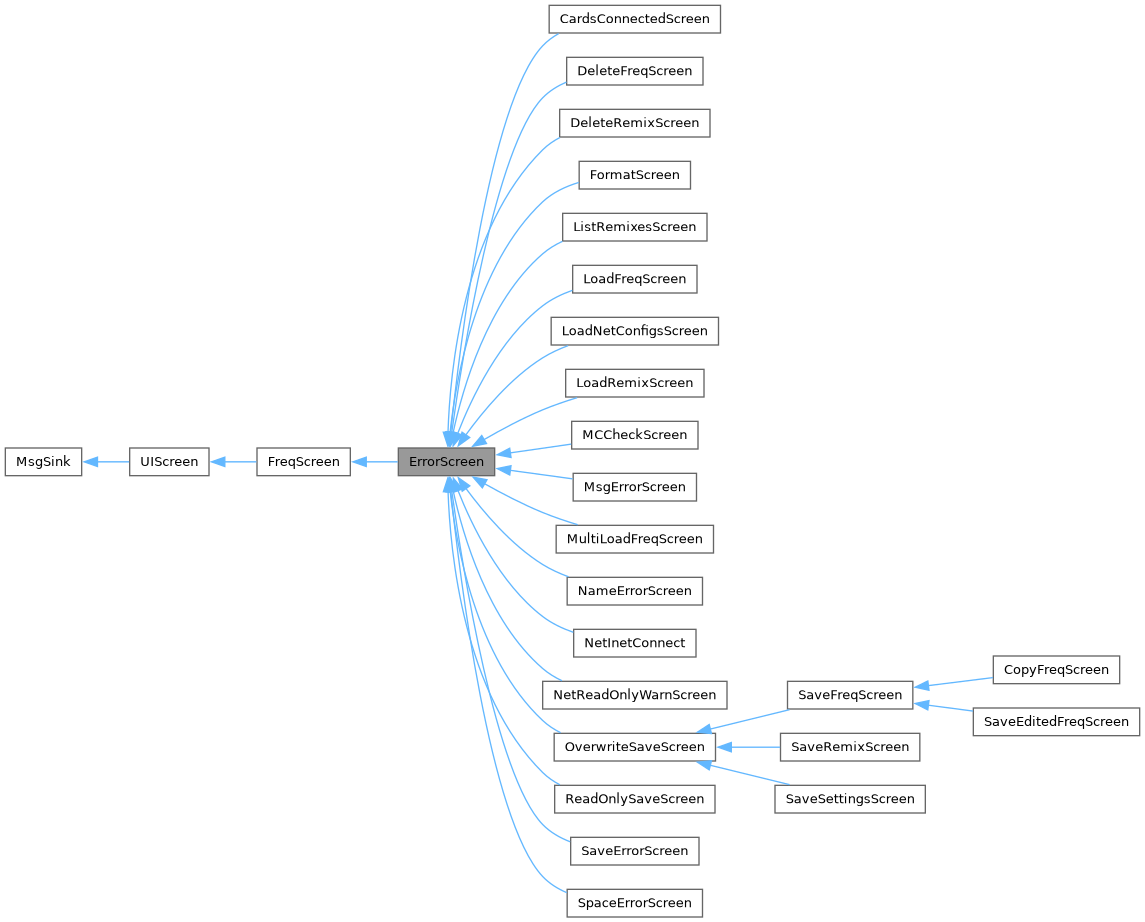
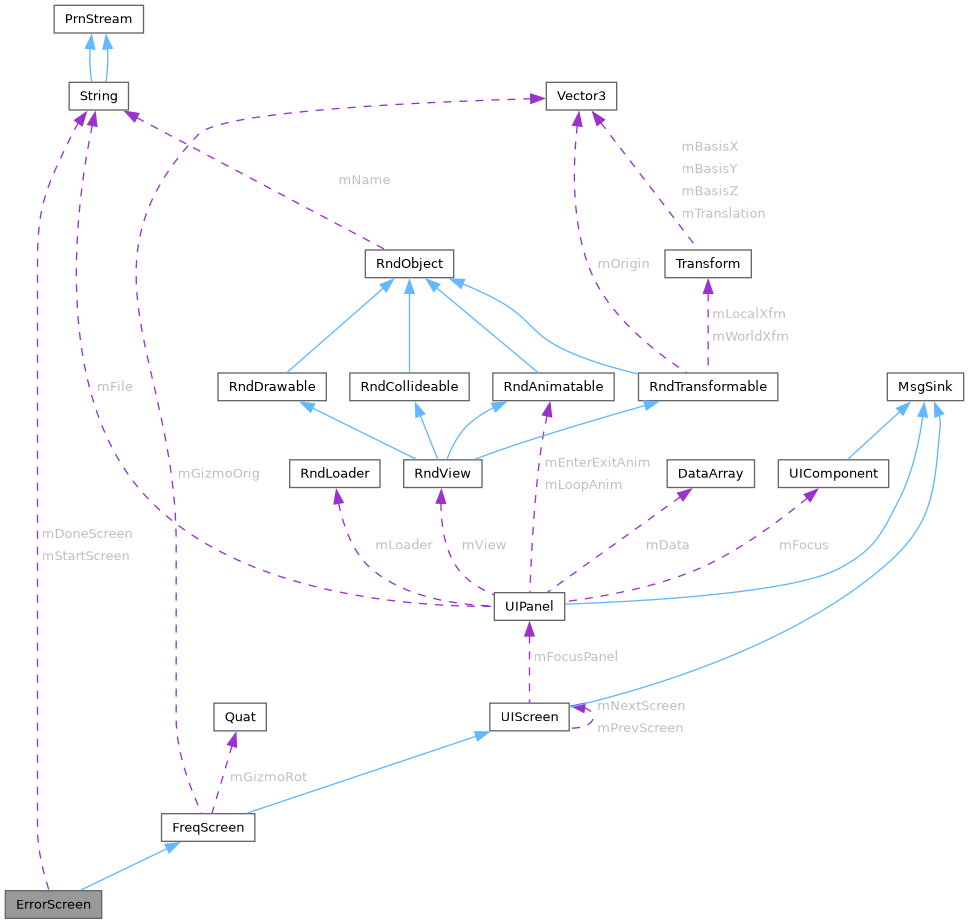
Screen of a dialog about the memory card or another error, between the screen that opened it and the screen it leads to.
More...
|
| | ErrorScreen (DataArray *pData) |
| | Construct the screen from its script description.
|
| | ~ErrorScreen () override |
| | Destroy the screen.
|
| const char * | Title () override |
| | Report the empty title of the screen.
|
| virtual void | SetDoneScreen (const char *pszScreen) |
| | Set the screen the dialog leads to.
|
| virtual void | SetStartScreen (const char *pszScreen) |
| | Set the screen that opened the dialog.
|
| virtual void | SetSlot (int nSlot) |
| | Choose the memory card slot the dialog is about.
|
| const char * | GetSlotName () |
| | Report the localised name of the memory card slot the dialog is about.
|
| void | ShowCardError (int nStatus) |
| | Show the dialog of a memory card failure with retry, continue, and cancel buttons.
|
| void | ShowCardErrorTwoOption (int nStatus, int nOperation) |
| | Show the dialog of a memory card failure with retry and cancel buttons.
|
| void | ShowNoSpaceError (int nSpace) |
| | Show the no_space_error dialog of a memory card without enough space.
|
| | FreqScreen (DataArray *pData) |
| | Construct a screen from its script description.
|
| | ~FreqScreen () override |
| | Destroy the screen.
|
| bool | DispatchPriv (Message *pMsg) override |
| | Play the sound of a chosen component, follow a shortcut, and keep unused controllers out.
|
| void | Draw () override |
| | Draw what goes under each panel, then the panels.
|
| void | Exit (UIScreen *pNextScreen, float fTime) override |
| | Move the projector to the next screen's place and start the exit.
|
| void | Enter (UIScreen *pPrevScreen, float fTime) override |
| | Play the entry sound, show or hide the projector, and start the entry.
|
| virtual void | PlayButtonSound (int nButton) |
| | Play the menu sound of a controller button.
|
| bool | HandleSelectStart (UIComponentSelectStartMsg *pMsg) |
| | Play the sound of the button that chooses a component.
|
| bool | HandleTransitionComplete (UITransitionCompleteMsg *pMsg) |
| | Choose the component the shortcuts section of the metagame configuration lists for the screen.
|
| bool | HandleJoypad (JoypadInputMsg *pMsg) |
| | Pass on a controller button of a controller the players use, and swallow any other.
|
| | UIScreen (DataArray *pData) |
| | Construct a screen from its script description.
|
| | ~UIScreen () override |
| | Destroy the screen.
|
| bool | Dispatch (Message *pMsg) override |
| | Offer a message to the manager, then handle it here, then pass a navigation message on.
|
| bool | DispatchPriv (Message *pMsg) override |
| | Follow the transition of a pressed button or a chosen component.
|
| virtual void | Poll (float fTime) |
| | Advance the panels to a time, and finish the exit or the entry once their animations stop.
|
| virtual void | Print (PrnStream &stream) |
| | Write a description of the screen, its panels, and its transitions.
|
| void | ClearTransitions () |
| | Empty the transition table.
|
| void | AddTransition (const char *pszComponent, int nButton, const char *pszScreen) |
| | Append an entry to the transition table.
|
| void | AddPanel (UIPanel *pPanel) |
| | Add a panel to the screen.
|
| bool | HandleJoypad (JoypadInputMsg *pMsg) |
| | Follow the transition of a pressed controller button.
|
| bool | HandleSelect (UIComponentSelectMsg *pMsg) |
| | Follow the transition of a component chosen with the cross button.
|
| void | SetFocus (UIPanel *pPanel) |
| | Move the focus to a panel.
|
| UIComponent * | FindComponent (const char *pszName) |
| | Find a component on any of the screen's panels.
|
| Transition * | FindTransition (UIComponent *pComponent, bool bFail) |
| | Find the transition of a component.
|
| Transition * | FindTransition (int nButton, bool bFail) |
| | Find the transition of a controller button.
|
| void | Load () |
| | Load the panels.
|
| void | Unload () |
| | Unload the panels.
|
| bool | IsLoaded () |
| | Report whether every panel has loaded.
|
| const char * | GetName () const |
| const char * | GetGroup () const |
| UIPanel * | GetFocusPanel () const |
| UIScreen * | GetNextScreen () const |
| UIScreen * | GetPrevScreen () const |
| const std::map< const char *, UIPanel *, StrLess > & | GetPanels () const |
| void * | operator new (size_t nSize) |
| | Allocate a sink from the pool heaps under the tag "MsgSink".
|
| void | operator delete (void *pBlock) |
| | Return a sink to the pool heaps.
|
| virtual | ~MsgSink () |
| void * | operator new (size_t size) |
| | Allocate from the main heap under the name MsgSink.
|
| void | operator delete (void *mem) |
| | Return memory to its heap.
|
| virtual | ~MsgSink () |
| | Destroy the sink.
|
Screen of a dialog about the memory card or another error, between the screen that opened it and the screen it leads to.
The RTTI records the class as deriving from FreqScreen. The object is 0xa0 bytes and its vtable is at 0x003d1630. The metagame registers the class for the screen type error_screen, and the front-end description's cur_freq_not_saved screen is one. The description's start_screen and done_screen give the two screens. The memory card screens derive from the class.