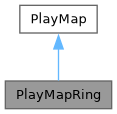
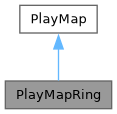
Traversal that wraps from the end of the sequence back to the start. More...
#include <playmapring.h>
Public Member Functions | |
| virtual int | MapBar (int nBar) |
| Wraps the bar into one turn of the ring. | |
| virtual std::vector< int > & | FindBarsPlaying (int nStart, int nMin, int nEnd) |
| Collects every position of one span into mFoundBars. | |
| virtual int | GetLength () const |
| Scales one turn of the ring by a repeat count. | |
| Public Member Functions inherited from PlayMap | |
| void * | operator new (size_t nSize) |
| Allocate a map from the tagged heap under the tag PlayMap. | |
| void | operator delete (void *pBlock) |
| Release a map to the tagged heap under the tag PlayMap. | |
| PlayMap () | |
| Construct an empty map whose first step is at zero. | |
| virtual | ~PlayMap () |
| Inline. | |
| virtual void | AddStep (int nPosition, HxStr strLabel) |
| Slot 2. | |
| virtual void | SetBarCount (int nBarCount) |
| Slot 3. | |
| virtual void | ResetSpans () |
| Slot 4. | |
| virtual int | MapToLinkedStep (int nPosition, int nSet) |
| Slot 7. | |
| virtual int | GetEndBar () |
| Slot 9. | |
| virtual int | GetNumSections () const |
| Slot 10. | |
| virtual int | GetPatternSection (int nIndex) |
| Slot 11. | |
| virtual int | GetPatternIndex (int nBar) |
| Slot 12. | |
| virtual int | GetAbsoluteSectionIndex (int nBar) |
| Slot 13. | |
| virtual int | IsLooping (int nBar) |
| Slot 14. | |
| virtual void | CloseSpan (int nRepeats) |
| Slot 15. | |
| virtual int | EndLoop (int nBar) |
| Slot 16. | |
| virtual int | StartLoop (int nBar) |
| Slot 17. | |
| virtual int | ToggleLoop (int nBar) |
| Slot 18. | |
| int | FindStepIndex (int nPosition) |
| Report the index of the step at or before a position that has already been mapped. | |
| int | IsStepStart (int nBar) |
| Report whether a bar maps exactly onto a step. | |
| int | StepStartBar (int nBar) |
| Report the bar at which the step containing a bar began. | |
| int | NextStepBar (int nBar) |
| Report the bar at which the first step at or after a bar begins. | |
| int | FollowingStepBar (int nBar) |
| Report the bar at which the first step strictly after a bar begins. | |
Additional Inherited Members | |
| Public Attributes inherited from PlayMap | |
| int | mBarCount |
| The number of bars SetBarCount() stores. | |
| std::vector< int > | mSteps |
| Ascending sequence of positions. | |
| std::vector< int > | mSectionLengths |
| Length of each section, the gap between one step and the previous one. | |
| std::vector< HxStr > | mSectionNames |
| Label of each section, the one AddStep() receives with the step. | |
| Protected Attributes inherited from PlayMap | |
| int | mUnusedValue |
| std::vector< int > | mFoundBars |
Detailed Description
Traversal that wraps from the end of the sequence back to the start.
PlayMapRing in the RTTI descriptor at 0x00901dd0, with PlayMap as its only base at offset
- Its table runs the same nineteen entries as the base, adding none, and it fills the two the base leaves pure, so the class is concrete. Beyond slots 1, 5, 6, and 8 every entry is the base implementation, which is the narrowest override set of the three subclasses.
No member is recovered, so none is declared, and the class adds no data to the 0x3c bytes of the base. The constructor at 0x0012daa0 is implicit for the same reason the destructor below is. It runs the PlayMap constructor and installs the table at 0x007d1598, and no routine in the image calls it.
The destructor at 0x0012e178 is declared nowhere here. Its body restores the base table pointer, tears down the four base vectors inline, and releases through the base allocation tag PlayMap rather than a tag of its own, which is exactly what an implicit destructor for this class compiles to. An empty destructor a programmer wrote would compile to the same bytes, so the two cannot be told apart, and the convention of this tree resolves that by declaring neither. The routine still occupies slot 1 of this class's own table, because the compiler emits an implicit destructor per class.
Member Function Documentation
◆ MapBar()
|
virtual |
Wraps the bar into one turn of the ring.
The body returns (nBar + mBarCount) % mSteps.back(). mSteps.back() is therefore the length of one turn, and mBarCount is the offset the ring starts at.
- Parameters
-
nBar The bar to wrap.
- Returns
- The wrapped position.
- Ghidra address:
- NTSC-U/C: 0x0012e408
- Ghidra address:
- PAL: 0x0012eb80
Implements PlayMap.
◆ FindBarsPlaying()
|
virtual |
Collects every position of one span into mFoundBars.
The body clears mFoundBars, then walks a value from nStart upward in steps of mSteps.back() while it remains below nEnd, appending each value that is not below nMin.
- Parameters
-
nStart The first position. nMin The lowest position to collect. nEnd The position to stop below.
- Returns
- mFoundBars.
- Ghidra address:
- NTSC-U/C: 0x0012dad8
- Ghidra address:
- PAL: 0x0012e238
Implements PlayMap.
◆ GetLength()
|
virtual |
Scales one turn of the ring by a repeat count.
The repeat count is configuration code 0x385, read through QueryConfigValue().
- Returns
- One turn scaled by the repeat count.
- Ghidra address:
- NTSC-U/C: 0x0012e430
- Ghidra address:
- PAL: 0x0012eba8
Reimplemented from PlayMap.
The documentation for this class was generated from the following file:
- src/game/playmapring.h