Heap-allocated NUL-terminated string. More...
#include <hxstr.h>
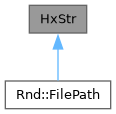
Public Member Functions | |
| HxStr () | |
| Construct an empty string. | |
| HxStr (const char *pszText) | |
| Construct a copy of a C string. | |
| HxStr (const HxStr &other) | |
| Construct a copy of another string. | |
| HxStr (unsigned nCount, char ch) | |
| Construct a run of one repeated character. | |
| ~HxStr () | |
| HxStr & | operator+= (const HxStr &other) |
| Append another string. | |
| HxStr & | operator+= (const char *pszText) |
| Append a C string. | |
| HxStr & | operator+= (char ch) |
| Append one character. | |
| HxStr & | operator= (const char *pszText) |
| Replace this string with a copy of a C string. | |
| HxStr & | operator= (const HxStr &other) |
| Replace this string with a copy of another. | |
| char | operator[] (unsigned i) const |
| Read one character. | |
| bool | operator!= (const char *pszRight) const |
| Compare against a C string for inequality. | |
| bool | operator!= (const HxStr &right) const |
| Compare against another string for inequality. | |
| bool | operator== (const char *pszRight) const |
| Compare against a C string for equality. | |
| bool | operator== (const HxStr &right) const |
| Compare against another string for equality. | |
| bool | operator< (const HxStr &right) const |
| Order against another string. | |
| void | Alloc (unsigned nLen) |
| Discard the text and reserve a zero-filled buffer. | |
| int | Find (char ch) const |
| Find the first occurrence of a character. | |
| int | Find (char ch, unsigned nStart) const |
| Find the first occurrence of a character at or after a position. | |
| int | Find (const char *pszText) const |
| Find the first occurrence of a substring. | |
| int | ReverseFind (char ch) const |
| Find the last occurrence of a character. | |
| int | ReverseFindOneOf (const char *pszChars) const |
| Find the last occurrence of any of a set of characters. | |
| int | Compare (unsigned pos, unsigned len, const char *str) const |
| Compare a run of this string against a C string. | |
| HxStr | Mid (unsigned pos) const |
| Extract the text from a position to the end. | |
| HxStr | Mid (unsigned pos, unsigned len) const |
| Extract a run of text. | |
| HxStr & | Replace (unsigned pos, unsigned len, char ch) |
| Overwrite one character. | |
| HxStr & | Replace (unsigned pos, unsigned len, const HxStr &other) |
| Overwrite a run of text with another string. | |
| HxStr & | Clear () |
| Empty the string in place. | |
| HxStr & | Truncate (unsigned pos) |
| Shorten the string in place. | |
| HxStr & | Erase (unsigned pos, unsigned len) |
| Remove a run of text. | |
| HxStr & | Insert (unsigned pos, unsigned nCount, char ch) |
| Insert a run of one repeated character. | |
| HxStr & | Insert (unsigned pos, const HxStr &other) |
| Insert another string. | |
| std::ostream & | Print (std::ostream &stream) const |
| Write this string to a stream. | |
Public Attributes | |
| unsigned | mLen |
| Length excluding the terminator. | |
| char * | mStr |
| Text buffer. | |
Detailed Description
Heap-allocated NUL-terminated string.
Named after HxStr.cpp, the file recorded by its own asserts. The member mStr comes from the text of the assert mStr != 0, and mLen from pos <= mLen. The class is not polymorphic and has no RTTI, so it has no vptr. Its destructor is inlined at every call site in the image, which is why it is defined here.
The North American release represents an empty string by a null mStr with mLen zero. Every accessor that dereferences mStr asserts first, and the comparison operators treat a null pointer and an empty buffer as equal. In the PAL build an empty string points at g_szEmptyString as the European release does. That release drops the null asserts, never frees the shared text, and compares through strcmp() alone.
mLen excludes the terminator, and the buffer is always mLen + 1 bytes.
Both members are public, and each records its own evidence below. The comparison operators are written as members because a member and a free function with the string as its first operand compile to the same two-argument call, which leaves the image unable to distinguish them.
Constructor & Destructor Documentation
◆ HxStr() [1/4]
|
inline |
Construct an empty string.
Defined in the header rather than compiled out of line, which is why it has no address of its own. A static initialisation that constructs a string global writes the two members in place with no call, which is what establishes both that the constructor exists and that it does nothing beyond producing the empty representation.
◆ HxStr() [2/4]
| HxStr::HxStr | ( | const char * | pszText | ) |
Construct a copy of a C string.
A null argument produces an empty string with no allocation.
- Parameters
-
pszText The text to copy.
- Ghidra address:
- NTSC-U/C: 0x004b7ad0
- Ghidra address:
- PAL: 0x004f5f00
◆ HxStr() [3/4]
| HxStr::HxStr | ( | const HxStr & | other | ) |
Construct a copy of another string.
Only a null buffer produces the empty representation. In the PAL build a source pointing at g_szEmptyString is copied into a fresh one-byte buffer, as the European release does.
- Parameters
-
other The string to copy.
- Ghidra address:
- NTSC-U/C: 0x004b7b50
- Ghidra address:
- PAL: 0x004f5f88
◆ HxStr() [4/4]
| HxStr::HxStr | ( | unsigned | nCount, |
| char | ch ) |
Construct a run of one repeated character.
- Parameters
-
nCount The number of characters, which becomes the length. ch The character to repeat.
- Ghidra address:
- NTSC-U/C: 0x004b7bd0
- Ghidra address:
- PAL: 0x004f6010
◆ ~HxStr()
|
inline |
Member Function Documentation
◆ operator+=() [1/3]
Append another string.
- Parameters
-
other The string to append.
- Returns
- This string.
- Ghidra address:
- NTSC-U/C: 0x004b7c68
- Ghidra address:
- PAL: 0x004f60a8
◆ operator+=() [2/3]
|
inline |
Append a C string.
The routine builds the temporary string itself rather than taking one a call site built, which is what establishes that the overload exists rather than callers converting and reaching the HxStr overload. The temporary is released before returning.
The body is inline. Units that use it emit their own identical out-of-line copy. The North American copies are at 0x00183a70, 0x00254870, 0x0028c198, 0x0030d618, 0x0038fc58, 0x003fc688, 0x00429500, 0x00431c30, 0x00453d88, 0x004beb98, 0x004dfaa0, and 0x0050cc00. The European ones are at 0x00188ca0, 0x00269f18, 0x002a7e08, 0x00333128, 0x003c1508, 0x00435068, 0x00464b20, 0x0046d8b8, 0x00491288, 0x004fcc00, 0x0051e1e0, and 0x0054c098.
- Parameters
-
pszText The text to append.
- Returns
- This string.
- Ghidra address:
- NTSC-U/C: 0x0010edb0
- Ghidra address:
- PAL: 0x0010f1f0
◆ operator+=() [3/3]
| HxStr & HxStr::operator+= | ( | char | ch | ) |
Append one character.
- Parameters
-
ch The character to append.
- Returns
- This string.
- Ghidra address:
- NTSC-U/C: 0x004b7d28
- Ghidra address:
- PAL: 0x004f6170
◆ operator=() [1/2]
| HxStr & HxStr::operator= | ( | const char * | pszText | ) |
Replace this string with a copy of a C string.
- Parameters
-
pszText The text to copy, or null for an empty string.
- Returns
- This string.
- Ghidra address:
- NTSC-U/C: 0x004b7dd8
- Ghidra address:
- PAL: 0x004f6228
◆ operator=() [2/2]
Replace this string with a copy of another.
- Parameters
-
other The string to copy.
- Returns
- This string.
- Ghidra address:
- NTSC-U/C: 0x004b7e78
- Ghidra address:
- PAL: 0x004f62e0
◆ operator[]()
| char HxStr::operator[] | ( | unsigned | i | ) | const |
Read one character.
The index is permitted to equal the length, which reads the terminator.
- Parameters
-
i The index.
- Returns
- The character.
- Ghidra address:
- NTSC-U/C: 0x004b7f18
- Ghidra address:
- PAL: 0x004f63a0
◆ operator!=() [1/2]
| bool HxStr::operator!= | ( | const char * | pszRight | ) | const |
Compare against a C string for inequality.
A null pointer and an empty buffer compare equal. In the PAL build a null argument always differs and every other argument goes straight to strcmp().
- Parameters
-
pszRight The text to compare against.
- Returns
- True when the two differ.
- Ghidra address:
- NTSC-U/C: 0x004b7f98
- Ghidra address:
- PAL: 0x004f6400
◆ operator!=() [2/2]
| bool HxStr::operator!= | ( | const HxStr & | right | ) | const |
Compare against another string for inequality.
- Parameters
-
right The string to compare against.
- Returns
- True when the two differ.
- Ghidra address:
- NTSC-U/C: 0x004b8018
- Ghidra address:
- PAL: 0x004f6438
◆ operator==() [1/2]
| bool HxStr::operator== | ( | const char * | pszRight | ) | const |
Compare against a C string for equality.
In the PAL build a null argument never compares equal.
- Parameters
-
pszRight The text to compare against.
- Returns
- True when the two agree.
- Ghidra address:
- NTSC-U/C: 0x004b80a0
- Ghidra address:
- PAL: 0x004f6460
◆ operator==() [2/2]
| bool HxStr::operator== | ( | const HxStr & | right | ) | const |
Compare against another string for equality.
- Parameters
-
right The string to compare against.
- Returns
- True when the two agree.
- Ghidra address:
- NTSC-U/C: 0x004b8120
- Ghidra address:
- PAL: 0x004f6498
◆ operator<()
| bool HxStr::operator< | ( | const HxStr & | right | ) | const |
Order against another string.
An empty string sorts before every non-empty string.
- Parameters
-
right The string to compare against.
- Returns
- True when this string sorts before the other.
- Ghidra address:
- NTSC-U/C: 0x004b81a8
- Ghidra address:
- PAL: 0x004f64c0
◆ Alloc()
| void HxStr::Alloc | ( | unsigned | nLen | ) |
Discard the text and reserve a zero-filled buffer.
The previous buffer is released through the single-object operator delete rather than through operator delete[]. It is the one place in HxStr that uses the scalar release path. The new length is recorded before the allocation is checked.
- Parameters
-
nLen The new length, excluding the terminator.
- Ghidra address:
- NTSC-U/C: 0x004b8230
- Ghidra address:
- PAL: 0x004f64e8
◆ Find() [1/3]
| int HxStr::Find | ( | char | ch | ) | const |
Find the first occurrence of a character.
- Parameters
-
ch The character to look for.
- Returns
- The index, or -1 when the character is absent.
- Ghidra address:
- NTSC-U/C: 0x004b82b8
- Ghidra address:
- PAL: 0x004f6580
◆ Find() [2/3]
| int HxStr::Find | ( | char | ch, |
| unsigned | nStart ) const |
Find the first occurrence of a character at or after a position.
- Parameters
-
ch The character to look for. nStart The index to start from.
- Returns
- The index from the start of the string, or -1 when the character is absent.
- Ghidra address:
- NTSC-U/C: 0x004b8350
- Ghidra address:
- PAL: 0x004f65c8
◆ Find() [3/3]
| int HxStr::Find | ( | const char * | pszText | ) | const |
Find the first occurrence of a substring.
- Parameters
-
pszText The text to look for.
- Returns
- The index, or -1 when the text is absent.
- Ghidra address:
- NTSC-U/C: 0x004b83f0
- Ghidra address:
- PAL: 0x004f6620
◆ ReverseFind()
| int HxStr::ReverseFind | ( | char | ch | ) | const |
Find the last occurrence of a character.
- Parameters
-
ch The character to look for.
- Returns
- The index, or -1 when the character is absent.
- Ghidra address:
- NTSC-U/C: 0x004b84b0
- Ghidra address:
- PAL: 0x004f66c0
◆ ReverseFindOneOf()
| int HxStr::ReverseFindOneOf | ( | const char * | pszChars | ) | const |
Find the last occurrence of any of a set of characters.
- Parameters
-
pszChars The candidate characters, as a NUL-terminated set.
- Returns
- The highest index at which any candidate appears, or -1 when none appears and when the argument is null.
- Ghidra address:
- NTSC-U/C: 0x004b8550
- Ghidra address:
- PAL: 0x004f6720
◆ Compare()
| int HxStr::Compare | ( | unsigned | pos, |
| unsigned | len, | ||
| const char * | str ) const |
Compare a run of this string against a C string.
In the PAL build a null argument reports -1 rather than tripping an assert.
- Parameters
-
pos The index to compare from. len The number of characters to compare. str The text to compare against.
- Returns
- A negative value, zero, or a positive value, as strncmp() defines it.
- Ghidra address:
- NTSC-U/C: 0x004b8678
- Ghidra address:
- PAL: 0x004f67d0
◆ Mid() [1/2]
| HxStr HxStr::Mid | ( | unsigned | pos | ) | const |
Extract the text from a position to the end.
- Parameters
-
pos The index to start from.
- Returns
- The extracted text.
- Ghidra address:
- NTSC-U/C: 0x004b8738
- Ghidra address:
- PAL: 0x004f6858
◆ Mid() [2/2]
| HxStr HxStr::Mid | ( | unsigned | pos, |
| unsigned | len ) const |
Extract a run of text.
A run that would pass the end is shortened to the text from pos onward.
- Parameters
-
pos The index to start from. len The number of characters to extract.
- Returns
- The extracted text.
- Ghidra address:
- NTSC-U/C: 0x004b78b8
- Ghidra address:
- PAL: 0x004f5bc8
◆ Replace() [1/2]
| HxStr & HxStr::Replace | ( | unsigned | pos, |
| unsigned | len, | ||
| char | ch ) |
Overwrite one character.
Only a single-character replacement is implemented. A run of any other length trips the len == 1 assert and is then written as a single character regardless.
- Parameters
-
pos The index to overwrite. len The number of characters to overwrite, which must be 1. ch The replacement character.
- Returns
- This string.
- Ghidra address:
- NTSC-U/C: 0x004b8818
- Ghidra address:
- PAL: 0x004f6918
◆ Replace() [2/2]
Overwrite a run of text with another string.
A run that would pass the end is shortened to the text from pos onward.
- Parameters
-
pos The index to overwrite from. len The number of characters to overwrite. other The replacement text.
- Returns
- This string.
- Ghidra address:
- NTSC-U/C: 0x004b88d0
- Ghidra address:
- PAL: 0x004f69d8
◆ Clear()
| HxStr & HxStr::Clear | ( | ) |
Empty the string in place.
This is a distinct routine rather than Truncate(0). It tolerates an empty string, where Truncate() would assert, and it asserts nothing itself. The buffer is retained.
- Returns
- This string.
- Ghidra address:
- NTSC-U/C: 0x004b89f0
- Ghidra address:
- PAL: 0x004f6ad8
◆ Truncate()
| HxStr & HxStr::Truncate | ( | unsigned | pos | ) |
Shorten the string in place.
The buffer is not reallocated. The excess capacity remains until the next assignment. In the PAL build an empty string is left untouched rather than written through.
- Parameters
-
pos The index to cut at, which must not exceed the current length.
- Returns
- This string.
- Ghidra address:
- NTSC-U/C: 0x004b8a10
- Ghidra address:
- PAL: 0x004f6b00
◆ Erase()
| HxStr & HxStr::Erase | ( | unsigned | pos, |
| unsigned | len ) |
Remove a run of text.
The tail is shifted down in place with no reallocation. A run that would pass the end shortens the string to pos instead.
- Parameters
-
pos The index to remove from. len The number of characters to remove.
- Returns
- This string.
- Ghidra address:
- NTSC-U/C: 0x004b8a98
- Ghidra address:
- PAL: 0x004f6b70
◆ Insert() [1/2]
| HxStr & HxStr::Insert | ( | unsigned | pos, |
| unsigned | nCount, | ||
| char | ch ) |
Insert a run of one repeated character.
- Parameters
-
pos The index to insert at. nCount The number of characters to insert. ch The character to insert.
- Returns
- This string.
- Ghidra address:
- NTSC-U/C: 0x004b8bd8
- Ghidra address:
- PAL: 0x004f6c70
◆ Insert() [2/2]
Insert another string.
- Parameters
-
pos The index to insert at. other The text to insert.
- Returns
- This string.
- Ghidra address:
- NTSC-U/C: 0x004b8cd8
- Ghidra address:
- PAL: 0x004f5dd0
◆ Print()
| std::ostream & HxStr::Print | ( | std::ostream & | stream | ) | const |
Write this string to a stream.
The same write as operator<<(), with the string as the receiver, and likewise without a null check. No routine in the image calls it. The name is inferred.
- Parameters
-
stream The stream to write to.
- Returns
- The stream.
- Ghidra address:
- NTSC-U/C: 0x004b8e00
- Ghidra address:
- PAL: 0x004f6d78
Member Data Documentation
◆ mLen
| unsigned HxStr::mLen |
Length excluding the terminator.
Public because nine sites across four files in other subsystems read this member and mStr directly, and the image exposes no accessor for either. A trivial inline accessor and a public member emit the same single load, so the evidence cannot distinguish them, and the public member is preferred because it adds no function that no address can be attached to.
+0x00
◆ mStr
| char* HxStr::mStr |
Text buffer.
Public for the same reason as mLen. In the North American release an empty string is a null buffer rather than a pointer to a terminator. Every reader tests for null first. In the PAL build it points at g_szEmptyString.
+0x04
The documentation for this class was generated from the following file:
- src/os/hxstr.h