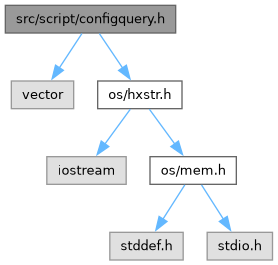
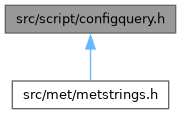
Go to the source code of this file.
Functions | |
| int | QueryConfigFlag (int nEventCode,...) |
| Read one configuration value as a flag through the embedded interpreter. | |
| int | QueryConfigValue (int nEventCode,...) |
| Read one configuration value as an integer through the embedded interpreter. | |
| HxStr | QueryConfigString (int nEventCode,...) |
| Read one configuration value as a string through the embedded interpreter. | |
| void | QueryConfigVector (std::vector< int > *pResult, int nEventCode,...) |
| Fill a vector of integers from one configuration value through the embedded interpreter. | |
| void | QueryConfigStrings (std::vector< HxStr > *pResult, int nEventCode,...) |
| Fill a vector of strings from one configuration value through the embedded interpreter. | |
Function Documentation
◆ QueryConfigFlag()
| int QueryConfigFlag | ( | int | nEventCode, |
| ... ) |
Read one configuration value as a flag through the embedded interpreter.
Every query here works the same way. The code selects a registered script call template through Resid2Str(), the trailing arguments are formatted into it by FmtImp(), and the text is evaluated as a Python expression through EvalScriptExpression(). A result the conversion rejects raises a Py::Exception that the query catches, reports through Fatal() with the expression text, and clears with PyErr_Clear().
This query converts the result to an integer and reports 1 when it is non-zero and 0 otherwise. The codes recovered so far are 0x39a for the async loader state, 0x3a1 and 0x3a4 for display mode, and 0x398 for one of the mixer flags.
- Parameters
-
nEventCode The template identifier.
- Returns
- 1 when the value is non-zero, and 0 otherwise or after a failed conversion.
- Ghidra address:
- NTSC-U/C: 0x005093e0
- Ghidra address:
- PAL: 0x00548628
◆ QueryConfigValue()
| int QueryConfigValue | ( | int | nEventCode, |
| ... ) |
Read one configuration value as an integer through the embedded interpreter.
The same evaluation as QueryConfigFlag(), returning the integer itself.
- Parameters
-
nEventCode The template identifier.
- Returns
- The value, or 0 after a failed conversion.
- Ghidra address:
- NTSC-U/C: 0x00509110
- Ghidra address:
- PAL: 0x00548308
◆ QueryConfigString()
| HxStr QueryConfigString | ( | int | nEventCode, |
| ... ) |
Read one configuration value as a string through the embedded interpreter.
The same evaluation as QueryConfigFlag(), converting the result through Py::String. A failed conversion yields an empty string. Ps2HardSynth's three bank loaders each read a pair of bank paths this way, passing GetHostMode() as the one substituted argument.
- Parameters
-
nEventCode The template identifier.
- Returns
- The value.
- Ghidra address:
- NTSC-U/C: 0x005096d0
- Ghidra address:
- PAL: 0x00548970
◆ QueryConfigVector()
| void QueryConfigVector | ( | std::vector< int > * | pResult, |
| int | nEventCode, | ||
| ... ) |
Fill a vector of integers from one configuration value through the embedded interpreter.
The result is taken as a Py::Sequence, the vector is cleared, and each element is converted through Py::Int and appended. Mixer's constructor reads its per-track table this way under code 0x39f, and GameEnableMgr passes a one-based track number as the substituted argument.
- Parameters
-
pResult The vector the values are written to. nEventCode The template identifier.
- Ghidra address:
- NTSC-U/C: 0x0050a1a0
- Ghidra address:
- PAL: 0x00549528
◆ QueryConfigStrings()
| void QueryConfigStrings | ( | std::vector< HxStr > * | pResult, |
| int | nEventCode, | ||
| ... ) |
Fill a vector of strings from one configuration value through the embedded interpreter.
The same evaluation as QueryConfigVector(), converting each element through Py::String. The front end's song lists read their names this way under codes 0x276 and 0x27a. The title is inferred.
- Parameters
-
pResult The vector the values are written to. nEventCode The template identifier.
- Ghidra address:
- NTSC-U/C: 0x00509b78
- Ghidra address:
- PAL: 0x00548ea0