Player that turns one MultiMuse into messages over time. More...
#include <multimuseplayer.h>
Public Member Functions | |
| MultiMusePlayer (MultiMuse *pMuse, MuseParent *pParent, Sch::TickClock *pClock) | |
| virtual | ~MultiMusePlayer () |
| virtual void | Start (MsgSink *pSink) |
| virtual void | Stop () |
| virtual int | DisplacesSiblings () |
| MusePlayer table slot 4. | |
| virtual void | RetainOnly (MusePlayer *pPlayer) |
| virtual void | PlayerFinished (MusePlayer *pPlayer) |
| void | operator delete (void *pBlock) |
| Release a sink to the tagged heap. | |
| void * | operator new (size_t nSize) |
| Allocate a sink from the tagged heap under the tag "MsgSink". | |
| Public Member Functions inherited from MuseSynth | |
| MuseSynth (Sch::TickClock *pClock) | |
| virtual | ~MuseSynth () |
| Release every player and then the splitter. | |
| void | AddSink (MsgSink *pSink) |
| Register a sink with the splitter every player sends to. | |
| void | CreateSustainer () |
| Build the sustain filter this synthesiser feeds through. | |
| int | IsActive () const |
| Report whether any player is sounding. | |
| void | ReleaseAllPlayers () |
| Stop and release every player. | |
| Public Member Functions inherited from MsgSink | |
| void * | operator new (size_t nSize) |
| Allocate a sink from the tagged heap under the tag "MsgSink". | |
| void | operator delete (void *pBlock) |
| Release a sink to the tagged heap. | |
| virtual | ~MsgSink () |
| virtual void | Dispatch (Message *pMsg) |
| Accept a message. | |
| Public Member Functions inherited from MusePlayer | |
| void * | operator new (size_t nSize) |
| Allocate a player from the untagged heap. | |
| void | operator delete (void *pBlock) |
| Release a player to the untagged heap. | |
| MusePlayer () | |
| Construct a player with the next serial number. | |
| virtual | ~MusePlayer () |
| Inline. | |
Additional Inherited Members | |
| Protected Member Functions inherited from MuseSynth | |
| void | StartNotePlayer (Message *pMsg) |
| Start a note player for one NoteMsg. | |
| void | StartMultiMusePlayer (Message *pMsg) |
| Start a MultiMusePlayer for one MultiMuseMsg. | |
| virtual void | DispatchPriv (Message *pMsg) |
| Act on a message. | |
| void | OnAllNotesOff () |
| The out-of-line copy of the AllNotesOffMsg branch DispatchPriv() expands inline. | |
| void | OnStdMidi (StdMidiMsg *pMsg) |
| The out-of-line copy of the StdMidiMsg branch DispatchPriv() expands inline. | |
| void | OnSustainNote (SustainNoteMsg *pMsg) |
| The out-of-line copy of the SustainNoteMsg branch DispatchPriv() expands inline. | |
| Protected Attributes inherited from MuseSynth | |
| Sch::TickClock * | mClock |
| MsgSplitter | mSplitter |
| SynthSustainer * | mSustainer |
| MsgSink * | mOutput |
| std::list< MusePlayer * > | mPlayers |
Detailed Description
Player that turns one MultiMuse into messages over time.
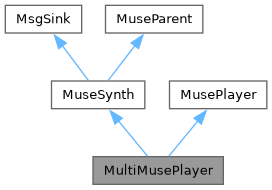
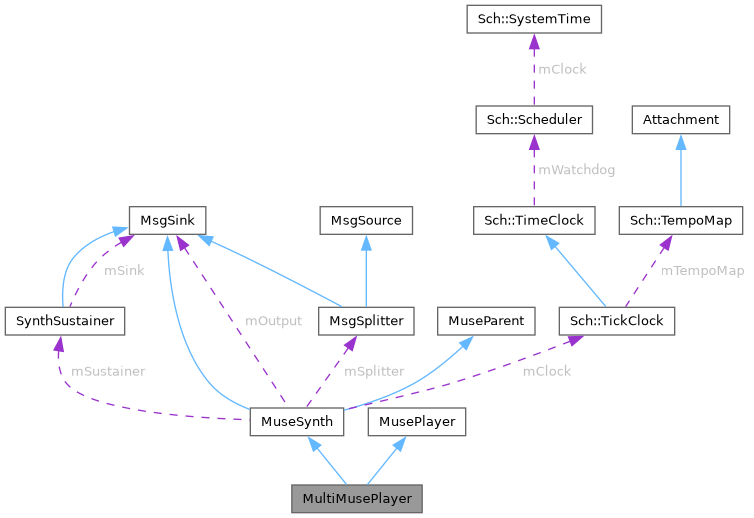
Its RTTI descriptor is at 0x00901c50. It has MuseSynth at offset 0 and MusePlayer at offset 48. The allocation in MuseSynth::StartMultiMusePlayer() measures the object at 0x50 bytes. It has three tables: the primary at 0x007dfd58, the MuseParent one at 0x007dfd38, and the MusePlayer one at 0x007dfd08. The slot indices restart in each table. MuseParent slot 2 and MusePlayer slot 2 are therefore both members of this class.
It is both a player and a MuseSynth. Start() posts a scheduler command over its sequence, and each message that command dispatches arrives back through the MuseSynth half, which creates a player for it. That is why the class inherits MuseSynth::DispatchPriv() unchanged rather than overriding it.
Both MuseParent overrides forward once up the chain. RetainOnly() reports the request to its own parent the first time and never again, and PlayerFinished() reports itself finished to its own parent once the schedule is exhausted and the last child player is gone.
Constructor & Destructor Documentation
◆ MultiMusePlayer()
| MultiMusePlayer::MultiMusePlayer | ( | MultiMuse * | pMuse, |
| MuseParent * | pParent, | ||
| Sch::TickClock * | pClock ) |
- Parameters
-
pMuse The sequence to play, retained for the lifetime of the player. pParent The owner this player reports back to. pClock The clock the schedule is posted against.
- Ghidra address:
- NTSC-U/C: 0x001a9fb8
- Ghidra address:
- PAL: 0x001afd20
◆ ~MultiMusePlayer()
|
virtual |
- Ghidra address:
- NTSC-U/C: 0x001aa100
- Ghidra address:
- PAL: 0x001afe68
Member Function Documentation
◆ Start()
|
virtual |
◆ Stop()
|
virtual |
◆ DisplacesSiblings()
|
virtual |
MusePlayer table slot 4.
The body is one instruction and returns 1.
- Returns
- 1.
- Ghidra address:
- NTSC-U/C: 0x001a9ed0
- Ghidra address:
- PAL: 0x001afc38
Implements MusePlayer.
◆ RetainOnly()
|
virtual |
◆ PlayerFinished()
|
virtual |
◆ operator delete()
|
inline |
Release a sink to the tagged heap.
No out-of-line body exists. The release branch of every derived destructor inlines the call with the literal MsgSink, 294 sites in all.
- Parameters
-
pBlock The block.
◆ operator new()
|
inline |
Allocate a sink from the tagged heap under the tag "MsgSink".
No out-of-line body exists. Every allocation of a derived class inlines the call, 78 sites in all, among them the Synth unit's file-local NullSynth::New() at 0x0013a0c0 and new MetArenasScreen at 0x001fc690. Both pass the literal MsgSink. MsgSource declares no allocation pair. Its destructor at 0x0054a168 proves that by releasing its vector without a tagged free, and a class deriving from both bases therefore resolves the operator here without ambiguity.
- Parameters
-
nSize The object size the compiler supplies.
- Returns
- The block.
The documentation for this class was generated from the following file:
- src/gs/multimuseplayer.h