Event the game passes between a MsgSource and a MsgSink. More...
#include <stdmidimsg.h>
Public Member Functions | |
| StdMidiMsg () | |
| Construct a message with the song position at kTickInfinity and the three bytes unset. | |
| StdMidiMsg (int nTick, unsigned char nStatus, unsigned char nData1, unsigned char nData2) | |
| Construct one channel message at a song position. | |
| virtual Message * | Clone () |
| Produce a heap copy of this message. | |
| virtual int | Type () |
| Report this message's registered identity. | |
| virtual const char * | GetName () const |
| Report this message's class name. | |
| virtual void | PrintExtra (std::ostream &stream) const |
| Write the message to a diagnostic stream. | |
| virtual void | saveGuts (OBStream &stream) const |
| Write the three bytes to a stream, one byte each through OBStream::Write(). | |
| virtual void | restoreGuts (IBStream &stream) |
| Read the three bytes back in place, one byte each through IBStream::Read(). | |
| Public Member Functions inherited from MuseMsg | |
| MuseMsg () | |
| Start the song position at kTickInfinity. | |
| MuseMsg (int nTick) | |
| Start the song position at a tick. | |
| MuseMsg * | CloneAndShift (int nTick) |
| Copy this message and move the copy to a song position. | |
| Public Member Functions inherited from Message | |
| void * | operator new (size_t nSize) |
| Allocate a message from the tagged heap under the tag MSG. | |
| void | operator delete (void *pBlock) |
| Release a message to the tagged heap under the tag MSG. | |
| virtual | ~Message () |
| Vtable slot 1. | |
| std::ostream & | Print (std::ostream &stream) const |
| Write this message to a diagnostic stream as {GetName() PrintExtra()}. | |
Static Public Member Functions | |
| static Message * | New () |
| Produce a default-constructed message on the heap. | |
| Static Public Member Functions inherited from Message | |
| static Message * | NewMessage (int nType) |
| Produce a message of the identified class through the factory list. | |
Public Attributes | |
| unsigned char | mStatus |
| The three bytes of one Standard MIDI channel message. | |
| unsigned char | mData1 |
| unsigned char | mData2 |
| Public Attributes inherited from MuseMsg | |
| int | mTick |
| The song position, in MIDI ticks. | |
Static Public Attributes | |
| static unsigned int | sID |
| Identity that Type() reports. | |
Detailed Description
Event the game passes between a MsgSource and a MsgSink.
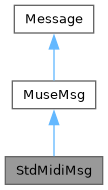
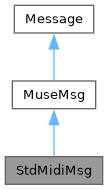
Its RTTI descriptor is at 0x008ef3f0. It has MuseMsg as its one base. The object is 0xc bytes and its vtable is at 0x00812ed8. The members below are the whole of the class. No other routine in the image refers to this type by anything but its vtable. The fields through +0x07 belong to MuseMsg and are declared there.
The payload layout comes from the run of field copies in Clone(), so the offsets and widths are recovered but the purpose of each field is not. Readers of the fields have not been traced, so they are private by default.
Clone() copies only as far as 0xb of the 0xc bytes it allocates, so the remaining 1 are either alignment padding or a field the copy omits.
The destructor at 0x003dbe80 is compiler-generated and has no declaration here.
Constructor & Destructor Documentation
◆ StdMidiMsg() [1/2]
|
inline |
◆ StdMidiMsg() [2/2]
|
inline |
Construct one channel message at a song position.
Inline, with no address of its own. NotePlayer::NoteOn() at 0x001b3fb8 expands it on its stack, storing the position and then the three bytes in order.
- Parameters
-
nTick The song position, in MIDI ticks. nStatus The status byte. nData1 The first data byte. nData2 The second data byte.
Member Function Documentation
◆ New()
|
static |
Produce a default-constructed message on the heap.
The translation unit at 0x003d9818 registers this factory. Only the song position is initialised, by the MuseMsg constructor, and the three bytes are left unset.
- Returns
- The message.
- Ghidra address:
- NTSC-U/C: 0x003d6d40
- Ghidra address:
- PAL: 0x0040ec30
◆ Clone()
|
virtual |
Produce a heap copy of this message.
- Returns
- The copy.
- Ghidra address:
- NTSC-U/C: 0x003dbfa0
- Ghidra address:
- PAL: 0x004143d8
Implements Message.
◆ Type()
|
virtual |
Report this message's registered identity.
- Returns
- sID.
- Ghidra address:
- NTSC-U/C: 0x003dc010
- Ghidra address:
- PAL: 0x00414448
Implements Message.
◆ GetName()
|
virtual |
Report this message's class name.
- Returns
- The literal StdMidiMsg.
- Ghidra address:
- NTSC-U/C: 0x003dc020
- Ghidra address:
- PAL: 0x00414458
Implements Message.
◆ PrintExtra()
|
virtual |
Write the message to a diagnostic stream.
Writes the song position, a short label for the kind in the status byte's high nibble, both data bytes as numbers, and the channel from its low nibble after n. The labels are off, on, poly, ctl, prg, pres, pb, and sys for the kinds 0x80 through 0xf0 in order.
- Parameters
-
stream The stream to write to.
- Ghidra address:
- NTSC-U/C: 0x003d7ec0
- Ghidra address:
- PAL: 0x0040fff8
Reimplemented from Message.
◆ saveGuts()
|
virtual |
Write the three bytes to a stream, one byte each through OBStream::Write().
The song position is not written.
- Parameters
-
stream The stream to write to.
- Ghidra address:
- NTSC-U/C: 0x003e3658
- Ghidra address:
- PAL: 0x0041b9f8
Reimplemented from Message.
◆ restoreGuts()
|
virtual |
Read the three bytes back in place, one byte each through IBStream::Read().
- Parameters
-
stream The stream to read from.
- Ghidra address:
- NTSC-U/C: 0x003e36e8
- Ghidra address:
- PAL: 0x0041ba88
Reimplemented from Message.
Member Data Documentation
◆ sID
|
static |
◆ mStatus
| unsigned char StdMidiMsg::mStatus |
The three bytes of one Standard MIDI channel message.
+0x08, +0x09, and +0x0a
Public because SynthSustainer reads the first two through a StdMidiMsg pointer from outside the hierarchy at 0x001d20f8 and 0x001d2100, and the image exposes no accessor. A friend declaration fits equally well.
The first byte is the status, a message kind in its high nibble over a channel in its low one, which four inlined constructions in the sequencer confirm by composing it as a kind combined with a channel. The two that follow are the data bytes, and their meaning depends on that kind: a control-change status makes them a controller number and a value, while a note status makes the first a note number. Their titles use the MIDI specification's terms, the first and second data bytes, because a single meaning for either would be wrong.
◆ mData1
| unsigned char StdMidiMsg::mData1 |
◆ mData2
| unsigned char StdMidiMsg::mData2 |
The documentation for this class was generated from the following file:
- src/msg/stdmidimsg.h