Something that turns one muse into messages over time. More...
#include <museplayer.h>
Public Member Functions | |
| void * | operator new (size_t nSize) |
| Allocate a player from the untagged heap. | |
| void | operator delete (void *pBlock) |
| Release a player to the untagged heap. | |
| MusePlayer () | |
| Construct a player with the next serial number. | |
| virtual | ~MusePlayer () |
| Inline. | |
| virtual void | Start (MsgSink *pSink)=0 |
| Begin playing, sending every message to one sink. | |
| virtual void | Stop ()=0 |
| Stop playing. | |
| virtual int | DisplacesSiblings ()=0 |
| Report whether this player displaces its siblings. | |
Detailed Description
Something that turns one muse into messages over time.
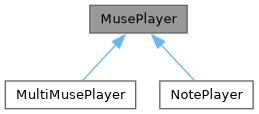
Its RTTI descriptor is at 0x0086f788. It has no base list. One data word sits ahead of the compiler-generated vptr. The vptr is therefore at +0x04, and the subobject is eight bytes. MultiMusePlayer places it at +0x30 and is the one implementation recovered; the 0x20-byte NotePlayer that MuseSynth creates for a NoteMsg is the other, and its constructor at 0x001b4328 takes seven arguments.
The class table at 0x007dfe68 runs five entries. Slots 2 through 4 point to the pure-virtual stub at 0x005381a8, so the class is never instantiated alone. The constructor and destructor install the table while a derived object is being built or torn down.
The three verbs come from MuseSynth, which is the one caller of all three. It calls Start() immediately after creating a player, Stop() on every player it releases, and DisplacesSiblings() on the player that requests exclusivity.
Constructor & Destructor Documentation
◆ MusePlayer()
| MusePlayer::MusePlayer | ( | ) |
Construct a player with the next serial number.
Increments sMuseID and records the new value in mId.
- Ghidra address:
- NTSC-U/C: 0x001aa440
- Ghidra address:
- PAL: 0x001b01a8
◆ ~MusePlayer()
|
inlinevirtual |
Inline.
Identical copies sit at 0x001aa3e8 and 0x001aa4a8, one in each translation unit that emits the table at 0x007dfe68.
- Ghidra address:
- NTSC-U/C: 0x001aa3e8
- Ghidra address:
- PAL: 0x001b0150
Member Function Documentation
◆ operator new()
| void * MusePlayer::operator new | ( | size_t | nSize | ) |
Allocate a player from the untagged heap.
No out-of-line body exists. The destructor's release branch inlines the call.
- Parameters
-
nSize The object size the compiler supplies.
- Returns
- The block.
◆ operator delete()
| void MusePlayer::operator delete | ( | void * | pBlock | ) |
Release a player to the untagged heap.
No out-of-line body exists.
- Parameters
-
pBlock The block.
◆ Start()
|
pure virtual |
Begin playing, sending every message to one sink.
Table slot 2. MultiMusePlayer's override at 0x001a9b48 registers the sink, marks itself running, and posts a scheduler command over its muse's timed entries.
- Parameters
-
pSink The sink every message goes to.
Implemented in MultiMusePlayer, and NotePlayer.
◆ Stop()
|
pure virtual |
Stop playing.
Table slot 3. MultiMusePlayer's override at 0x001aa1b8 performs no work unless it is running, and otherwise releases its own players and withdraws its scheduler command.
Implemented in MultiMusePlayer, and NotePlayer.
◆ DisplacesSiblings()
|
pure virtual |
Report whether this player displaces its siblings.
Table slot 4. MuseParent::RetainOnly() does not perform work unless this member reports non-zero. MultiMusePlayer's override at 0x001a9ed0 returns 1 and NotePlayer's at 0x001b41c0 returns zero.
- Returns
- Non-zero to displace the sibling players.
Implemented in MultiMusePlayer, and NotePlayer.
The documentation for this class was generated from the following file:
- src/gs/museplayer.h