Event the game passes between a MsgSource and a MsgSink. More...
#include <winmsg.h>
Public Member Functions | |
| WinMsg () | |
| Construct a message with no winners. | |
| virtual Message * | Clone () |
| Produce a heap copy of this message. | |
| virtual int | Type () |
| Report this message's registered identity. | |
| virtual const char * | GetName () const |
| Report this message's class name. | |
| void | AddWinner (Player *pPlayer) |
| Append one winning player. | |
| Public Member Functions inherited from Message | |
| void * | operator new (size_t nSize) |
| Allocate a message from the tagged heap under the tag MSG. | |
| void | operator delete (void *pBlock) |
| Release a message to the tagged heap under the tag MSG. | |
| virtual | ~Message () |
| Vtable slot 1. | |
| virtual void | PrintExtra (std::ostream &stream) const |
| Write this message's payload to a stream. | |
| virtual void | saveGuts (OBStream &stream) const |
| Write this message's payload to an output stream. | |
| virtual void | restoreGuts (IBStream &stream) |
| Read this message's payload from an input stream. | |
| std::ostream & | Print (std::ostream &stream) const |
| Write this message to a diagnostic stream as {GetName() PrintExtra()}. | |
Static Public Member Functions | |
| static Message * | New () |
| Produce a default-constructed message on the heap. | |
| Static Public Member Functions inherited from Message | |
| static Message * | NewMessage (int nType) |
| Produce a message of the identified class through the factory list. | |
Public Attributes | |
| std::vector< Player * > | mWinners |
Detailed Description
Event the game passes between a MsgSource and a MsgSink.
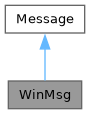
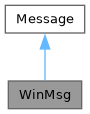
Its RTTI descriptor is at 0x008f09d0. It has Message as its one base. The object is 0x10 bytes and its vtable is at 0x007ce690. The allocation in New() and the allocation in Clone() report the same size.
The payload layout comes from the run of field copies in Clone(). The vector at +0x04 comes from the copy constructor at 0x00116eb8, which allocates one element for every element of the source and moves them with a block copy. Its three words are the start, the finish, and the end of storage.
The vector is public because two handlers outside the class read it directly with no accessor in the image. Overlay::OnWin() at 0x0041e020 searches it for HudTrack::mPlayer with std::find at 0x0041e1d0. That search types the elements as players. TnlArena::DispatchPriv() tests the vector for emptiness.
The destructors at 0x00116238 and 0x003e0c00 are compiler-generated, release mWinners, and have no declaration here. The routine at 0x001162f0 is a further emission of the type-information accessor.
Constructor & Destructor Documentation
◆ WinMsg()
|
inline |
Member Function Documentation
◆ New()
|
static |
Produce a default-constructed message on the heap.
The translation unit at 0x003d9818 registers this factory against identity 421.
- Returns
- The message.
- Ghidra address:
- NTSC-U/C: 0x003d78c0
- Ghidra address:
- PAL: 0x0040f7c0
◆ Clone()
|
virtual |
Produce a heap copy of this message.
- Returns
- The copy.
- Ghidra address:
- NTSC-U/C: 0x00116368
- Ghidra address:
- PAL: 0x00116810
Implements Message.
◆ Type()
|
virtual |
Report this message's registered identity.
- Returns
- g_nWinMsgType.
- Ghidra address:
- NTSC-U/C: 0x001163e0
- Ghidra address:
- PAL: 0x00116888
Implements Message.
◆ GetName()
|
virtual |
◆ AddWinner()
|
inline |
Append one winning player.
Inline. The one out-of-line copy sits at 0x00116400 in Gamer's translation unit, which calls it after building the message on its stack at 0x00112170. The body is mWinners.push_back(), growing the vector through 0x00112cd8 when it is full.
- Parameters
-
pPlayer The winner.
- Ghidra address:
- NTSC-U/C: 0x00116400
- Ghidra address:
- PAL: 0x001168a8
Member Data Documentation
◆ mWinners
| std::vector<Player *> WinMsg::mWinners |
The winning players. +0x04
The documentation for this class was generated from the following file:
- src/msg/winmsg.h