One player's track display on the head-up display. More...
#include <hudtrack.h>
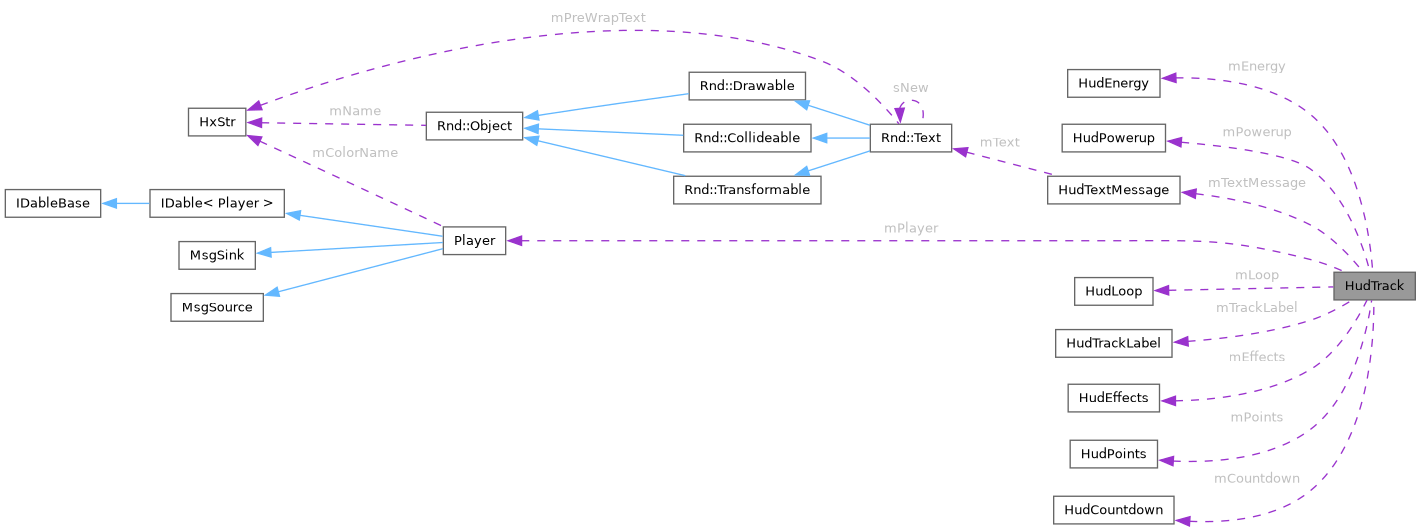
Public Member Functions | |
| HudTrack (Player *pPlayer, int nIndex) | |
| Build the display for one player. | |
| void | SetFrame (float flFrame, float flTime) |
| Advance every animated part. | |
Public Attributes | |
| HudEnergy | mEnergy |
| HudPowerup | mPowerup |
| HudTextMessage | mTextMessage |
| HudLoop | mLoop |
| HudTrackLabel | mTrackLabel |
| HudEffects | mEffects |
| HudPoints | mPoints |
| HudCountdown | mCountdown |
| int | mBlockedCatches |
| int | mTrack |
| int | mReservedE8 |
| int | mDeployedPowerup |
| Player * | mPlayer |
Detailed Description
One player's track display on the head-up display.
The class is not polymorphic and emits no RTTI. Overlay allocates one per world player that has a slot, with the untagged scalar allocator (0xf4 bytes, the size its constructor requests at 0x0041cf50), and stores the pointers in its vector at +0x08. No descriptor, tag, or file path identifies the class, and its name is inferred from the eight parts it aggregates.
The class declares no destructor. The routine at 0x0042aa18 that Overlay's destructor calls on each element is the compiler's deleting destructor, which runs the effect lamps' vector teardown and ~HudTextMessage() and then the scalar free.
Every member is public because Overlay's handlers access the parts directly. They look a display up by mPlayer, set the track name through mTrackLabel, record the track in mTrack, and drive mPoints, mEffects, and the words at +0xe0 and +0xec.
Constructor & Destructor Documentation
◆ HudTrack()
| HudTrack::HudTrack | ( | Player * | pPlayer, |
| int | nIndex ) |
Build the display for one player.
- Parameters
-
pPlayer The player the display shows. nIndex The display number, counted over the players with a slot from 0.
- Ghidra address:
- NTSC-U/C: 0x0041bec8
- Ghidra address:
- PAL: 0x004569f0
Member Function Documentation
◆ SetFrame()
| void HudTrack::SetFrame | ( | float | flFrame, |
| float | flTime ) |
Advance every animated part.
The energy bar and the countdown follow the song position, and the text message and the points readout follow the time.
- Parameters
-
flFrame The song position, in MIDI ticks. flTime The time the text message and the points readout run against.
- Ghidra address:
- NTSC-U/C: 0x0042ab08
- Ghidra address:
- PAL: 0x00465e58
Member Data Documentation
◆ mEnergy
| HudEnergy HudTrack::mEnergy |
The shared energy bar. +0x00
◆ mPowerup
| HudPowerup HudTrack::mPowerup |
The powerup indicator. +0x0c
◆ mTextMessage
| HudTextMessage HudTrack::mTextMessage |
<layout> textmsg<n>. +0x28
◆ mLoop
| HudLoop HudTrack::mLoop |
The loop indicator. +0x48
◆ mTrackLabel
| HudTrackLabel HudTrack::mTrackLabel |
The track name label. +0x50
◆ mEffects
| HudEffects HudTrack::mEffects |
The effect lamps. +0x58
◆ mPoints
| HudPoints HudTrack::mPoints |
The points readout. +0x78
◆ mCountdown
| HudCountdown HudTrack::mCountdown |
The bar countdown. +0xc4
◆ mBlockedCatches
| int HudTrack::mBlockedCatches |
Blocked catches in a row, as Overlay::OnCatch() counts. +0xe0
◆ mTrack
| int HudTrack::mTrack |
The track the player selected. +0xe4
◆ mReservedE8
| int HudTrack::mReservedE8 |
The recovered routines never access it. +0xe8
◆ mDeployedPowerup
| int HudTrack::mDeployedPowerup |
Set once Overlay::OnDeployedPowerup() runs; never read. +0xec
◆ mPlayer
| Player* HudTrack::mPlayer |
The player the display shows. +0xf0
The documentation for this class was generated from the following file:
- src/app/hudtrack.h