Procedural tunnel the game flies the player through. More...
#include <tunnel.h>
Public Member Functions | |
| Tunnel (const HxStr &name) | |
| Construct a tunnel with no sections. | |
| virtual | ~Tunnel () |
| virtual void | DumpText (Dbg &sink) |
| Write the tunnel to the engine text sink. | |
| virtual void | Save (Stream &stream) |
| Serialise the tunnel. | |
| virtual void | Replace (Object *pFrom, Object *pTo) |
| Replace one object reference with another. | |
| virtual const HxStr & | ClassName () const |
| Return the registered class name, "Tunnel". | |
| virtual void | Copy (const Object *pSource, unsigned nFlags) |
| Copy another tunnel over this one. | |
| virtual void | Load (Stream &stream) |
| Load the tunnel. | |
| virtual void | FindCollisions (const Segment &ray, std::list< Collision > &collisions) |
| Test a ray against the tunnel and append what it strikes to sink. | |
| void | Update () |
| Regenerate the geometry that the current state calls for. | |
| Mesh * | GetRingSection (int nSlice) |
| Report the first mesh of one slice. | |
| Mesh * | GetRingSection (int nRing, int nSlice) |
| Report the first mesh of one ring of one slice. | |
| void | LerpRingSectionTangent (int nRing, Vector3 *pOut, float flWeight) |
| Blend the translation of one ring transform towards the next. | |
| void | GetRingXfm (int nRing, Transform *pOut, float flFrame, float flBlend) |
| Build the frame of a point on one ring at a path frame. | |
| void | ProjectSectionToCameraSpace (int nRing, Transform *pOut, float flAnimFrame, float flRingBlend, float flTangentScale) |
| Build the frame of a point on one ring at a path frame, with the ring pushed outwards. | |
| void | ScrollRings () |
| Bring every slice of the current window up to the advanced slice. | |
| void | AdvanceRing (int nSlice) |
| Advance one slice and refresh the section frames. | |
| void | ApplyMeshLodScreenSizes (const std::vector< float > &screenSizes) |
| Replace the level of detail thresholds and apply them to every generated mesh. | |
| void | AddEvent (Drawable *pObject, float flFrame, int nId, int nUser) |
| Schedule a drawable at a frame. | |
| int | MoveEvent (int nId, float flFrame) |
| Move the first event with an identifier to a new frame. | |
| int | RemoveEvent (int nId) |
| Remove the first event with an identifier and drop its reference. | |
| int | RemoveEventsInRange (float flFrom, float flTo) |
| Remove every event whose frame lies in a half open range, dropping each reference. | |
| void | ForEachEvent (void(*pfnVisit)(Drawable *pObject, float flFrame, int nId, void *pUser), void *pUser) |
| Call a function once for every event, in frame order. | |
| void | SetPath (TransAnim *pPath) |
| Replace the path the tunnel follows. | |
| void | GetPathXfm (Transform *pOut, float flFrame) |
| Evaluate the path at a frame. | |
| void | SetLaneChangeFrames (float flFrames) |
| Set mLaneChangeFrames. | |
| TunnelSeeker * | GetSeeker (unsigned nIndex) |
| Report one seeker. | |
| void | ResizeSeekers (unsigned nCount) |
| Set the number of seekers and attach each one to this tunnel. | |
| void | Configure (float flRingRadius, int nRingCount, int nSliceCount, int nLodCount, float flFloorPull, float flLaneEdgeGap, float flFloorEdgeWeight, float flCellEdgeBlendPerStep) |
| Set the shape parameters and rebuild the geometry. | |
| int | FrameToSlice (float flFrame) |
| Convert a frame to a slice. | |
| void | SetLaneDividerColor (int nRing, int nSlice, const Color &color) |
| Colour the wall between one lane and the next on one slice. | |
| void | SetLaneFloorColor (const Color &color) |
| Colour the floor and the second end cap of every lane on every slice. | |
| Public Member Functions inherited from Rnd::Drawable | |
| Drawable () | |
| Construct a visible drawable with no children. | |
| virtual | ~Drawable () |
| Drop this object's references on its children. | |
| void | Draw () |
| Draw this object followed by each of its children. | |
| Drawable * | Parent () |
| Report the drawable that draws this one. | |
| void | AddDraw (Drawable *pDraw, Drawable *pBefore) |
| Insert pDraw into mDraws in front of pBefore. | |
| void | AddDraw (Drawable *pDraw) |
| Insert pDraw at the front of mDraws. | |
| void | RemoveDraw (Drawable *pDraw) |
| Erase pDraw from mDraws. | |
| void | RemoveAllDraws () |
| Empty mDraws, dropping this object's reference on every entry. | |
| void | MoveDraw (Drawable *pDraw, int nSteps) |
| Move pDraw nSteps places later in mDraws, or earlier for a negative count. | |
| virtual void | SetShowing (int nShowing) |
| Set whether this object draws at all. | |
| void | SetShowingRecursive (int nShowing) |
| Set whether this object and every drawable beneath it in mDraws draw at all. | |
| virtual void | SetHighlight (int nHighlight) |
| Set whether this object draws with its highlight treatment. | |
| int | GetHighlight () const |
| Report the highlight flag. | |
| int | GetShowing () const |
| Report the showing flag. | |
| std::list< Drawable * > & | GetDraws () |
| Report the child list. | |
| Public Member Functions inherited from Rnd::Object | |
| Object () | |
| Construct an unnamed object. | |
| Object (const HxStr &name) | |
| Construct an object and register it under name. | |
| virtual | ~Object () |
| Erase the registry entry and release the name buffer. | |
| void | SetName (const HxStr &name) |
| Re-register this object under a different name. | |
| void | AddRef (Object *pReferrer) |
| Register pReferrer as a store of a pointer to this object. | |
| void | RemoveRef (Object *pReferrer) |
| Drop one registration made by AddRef(). | |
| Public Member Functions inherited from Rnd::Animatable | |
| Animatable () | |
| Construct an animatable with no children, no filters, and a zero frame. | |
| virtual | ~Animatable () |
| Drop this object's references on its children and delete its filters. | |
| Animatable * | Parent () |
| Report the animatable that animates this one. | |
| void | AddAnim (Animatable *pAnim) |
| Append pAnim to mAnims. | |
| void | RemoveAnim (Animatable *pAnim) |
| Erase pAnim from mAnims. | |
| void | SetFrame (float flFrame) |
| Drive this object and its whole subtree to a frame. | |
| float | UnfilterFrame (float flValue) |
| Map a value back through mFilters. | |
| void | AddFilter (Filter *pFilter) |
| Append an already-built filter to mFilters. | |
| void | AddScaleOffset (float flScale, float flOffset) |
| Append a new ScaleOffset stage to mFilters. | |
| void | AddMinMaxLoop (float flMin, float flMax, int nLoop) |
| Append a new MinMaxLoop stage to mFilters. | |
| void | AddZeroOrder (float flLevel, float flMaxDelta) |
| Append a new ZeroOrder stage to mFilters. | |
| void | AddFirstOrder (float flLevel, float flRatio) |
| Append a new FirstOrder stage to mFilters. | |
| void | AddSecondOrder (float flLevel, float flSpring, float flDamper) |
| Append a new SecondOrder stage to mFilters. | |
| void | RemoveFilter (int nIndex) |
| Delete and erase the filter at one position in mFilters. | |
| Filter * | FilterAt (int nIndex) |
| Return the filter at one position in mFilters. | |
| void | SetRate (float flRate) |
| Change the multiplier of the ScaleOffset stage at the front of mFilters. | |
| void | SetOffset (float flOffset) |
| Change the addend of the ScaleOffset stage at the front of mFilters. | |
| void | SetLoopRange (float flMin, float flMax) |
| Change both ends of the MinMaxLoop stage at the back of mFilters. | |
| virtual float | FilteredFrameEnd () |
| Report the last frame this object's subtree animates to. | |
| virtual void | StartAnim () |
| Restart the animation of this object and its whole subtree. | |
| void | RemoveAllAnims () |
| Drop this object's reference on every mAnims entry and then empty mAnims. | |
| Public Member Functions inherited from Rnd::Collideable | |
| Collideable () | |
| Construct a collideable with no children. | |
| virtual | ~Collideable () |
| Drop this object's references on its children. | |
| Collideable * | Parent () |
| Report the collideable that hit-tests this one. | |
| void | AddCollide (Collideable *pCollide) |
| Append pCollide to mCollides. | |
| void | RemoveCollide (Collideable *pCollide) |
| Erase pCollide from mCollides. | |
| virtual void | FindCollisions (const Vector2 &point, std::list< Collision > &collisions) |
| Test a screen point against this object and append what it strikes to collisions. | |
Static Public Member Functions | |
| static void * | operator new (size_t nSize) |
| Allocate a tunnel under the tag "Rnd::Tunnel". | |
| static void | operator delete (void *pBlock) |
| Release a tunnel under the tag "Rnd::Tunnel". | |
| Static Public Member Functions inherited from Rnd::Drawable | |
| static Drawable * | Find (const HxStr &name) |
| Resolve a registry key to a drawable. | |
| Static Public Member Functions inherited from Rnd::Animatable | |
| static Filter * | NewFilter (int nType) |
| Build one default-constructed filter for a type tag. | |
Public Attributes | |
| int | mRingCount |
| int | mSliceCount |
| TransAnim * | mPath |
| int | mCulledFarSlices |
| std::vector< float > | mLodScreenSizes |
| int | mDrawLattice |
| int | mDrawPanels |
| Public Attributes inherited from Rnd::Drawable | |
| int | mShowing |
| Public Attributes inherited from Rnd::Object | |
| HxStr | mName |
| int | mInternal |
| Public Attributes inherited from Rnd::Animatable | |
| float | mFilteredFrame |
| The frame SetFrame() last received, after the filter chain. | |
Protected Member Functions | |
| virtual int | DrawShowing () |
| Draw the tunnel. | |
| virtual void | SetFrameSelf (float flFrame) |
| Advance the tunnel to a frame. | |
| Protected Member Functions inherited from Rnd::Drawable | |
| void | ReleaseDrawsRefs () |
| Drop this object's reference on every mDraws entry without emptying the list. | |
| Protected Member Functions inherited from Rnd::Object | |
| void | ReleaseAllRefs () |
| Tell every referrer to drop its pointer to this object. | |
| Protected Member Functions inherited from Rnd::Collideable | |
| void | ReleaseCollidesRefs () |
| Drop this object's reference on every mCollides entry without emptying the list. | |
Friends | |
| class | TunnelSeekSection |
| class | TunnelSeekStrip |
| class | TunnelSeeker |
Additional Inherited Members | |
| Public Types inherited from Rnd::Animatable | |
| enum | FilterType { kFilterScaleOffset = 0 , kFilterMinMaxLoop = 1 , kFilterZeroOrder = 2 , kFilterFirstOrder = 3 , kFilterSecondOrder = 4 } |
| Value a filter reports from Filter::Type() and a .rnd file stores in front of its payload. More... | |
| Protected Attributes inherited from Rnd::Object | |
| std::list< Object * > | mRefs |
Detailed Description
Procedural tunnel the game flies the player through.
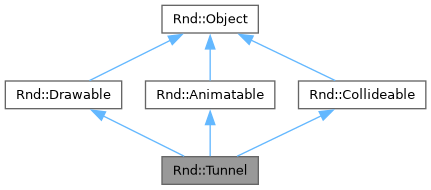
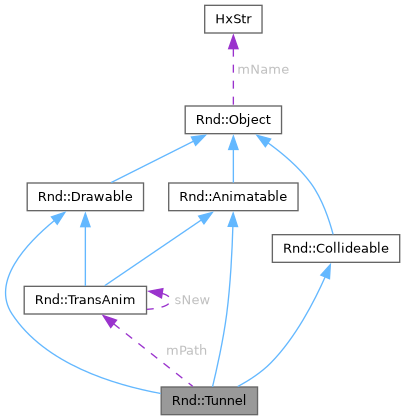
Its RTTI descriptor is at 0x008efdb0. It has three public non-virtual bases: Rnd::Drawable at +0x00, Rnd::Animatable at +0x14, and Rnd::Collideable at +0x2c. All three derive virtually from Rnd::Object. One shared Object subobject sits at +0xe8. The creator allocates exactly 0x104 bytes, 0xe8 plus the 0x1c-byte Object subobject with no surplus, and the three base sizes of 0x14, 0x18, and 0xc account for everything ahead of +0x38. The members of the class itself therefore occupy +0x38 through +0xe7.
This is the only render tunnel in the build. The four other Tnl-prefixed classes, TnlArena, TnlTrigger, TnlPanelFXDelay, and AppTunnel, all derive from MsgSink and belong to the game rather than the renderer.
Four vtables belong to the class, each identified by its own GetTypeInfo slot addressing 0x004761b0 and by an adjustment matching its subobject offset. The Object subobject table at 0x0081d4f0 adjusts by -0xe8, the Collideable table at 0x0081d480 by -0x2c, the Animatable table at 0x0081d4a0 by -0x14, and the Drawable table at 0x0081d4c8 by zero.
Beyond the seven Object virtuals the class overrides exactly three, one in each mix-in: FindCollisions() at Collideable slot 1, SetFrameSelf() at Animatable slot 3, and DrawShowing() at Drawable slot 3. Both remaining Animatable slots and both remaining Drawable slots still address the base implementations.
DumpText() is a stub the original author never finished. It emits the three base dumps and then the two literals "[Tunnel]\n" and "TODO\n", and writes no member at all. No member of this class has a name anywhere in the image, because the text dump is the only routine that would have supplied one. Member titles follow the role their routines give them.
Load() accepts a bounded version range rather than an upper bound alone, which is the only class in the renderer that does. It reports "Can't load new Tunnel" above the range and "Can't load old Tunnel" below it.
The geometry is a ring of mRingCount lanes, each a three-segment trough (LaneProfile), swept along the path mPath one slice of mSliceFrames frames at a time. Each slice owns one chain of lane meshes, "[<name>_lat<slice>.<level>]", and each lane of each slice one chain of cell meshes, "[<name>_pan<cell>.<level>]", that fill the gap to the next lane. The ring advance places one column of every slice mesh per step, and DrawShowing() draws the slices of the visible window. The seekers add "[<name>_seek<index>.<section>]" meshes over the lanes they highlight.
The record the vector at +0xdc stores is Rnd::TunnelSeeker. The routines at 0x00477830 and 0x0046e830 are members of the seeker and of its strip rather than of this class, and the three seek records read private members of this class directly.
Constructor & Destructor Documentation
◆ Tunnel()
| Rnd::Tunnel::Tunnel | ( | const HxStr & | name | ) |
Construct a tunnel with no sections.
The body is not reconstructed. It writes the initial values recorded on the members below and allocates the sentinel node of each list member.
- Parameters
-
name The object name, passed to the Rnd::Object constructor.
- Ghidra address:
- NTSC-U/C: 0x00466620
- Ghidra address:
- PAL: 0x004a4050
◆ ~Tunnel()
|
virtual |
- Ghidra address:
- NTSC-U/C: 0x004676b0
- Ghidra address:
- PAL: 0x004a50e0
Member Function Documentation
◆ operator new()
|
static |
Allocate a tunnel under the tag "Rnd::Tunnel".
- Parameters
-
nSize The object size the compiler supplies.
- Returns
- The block.
- Ghidra address:
- NTSC-U/C: 0x00476218
- Ghidra address:
- PAL: 0x004b3e90
◆ operator delete()
|
static |
Release a tunnel under the tag "Rnd::Tunnel".
- Parameters
-
pBlock The block.
- Ghidra address:
- NTSC-U/C: 0x00476238
- Ghidra address:
- PAL: 0x004b3eb0
◆ DumpText()
|
virtual |
Write the tunnel to the engine text sink.
Emits the Object, Drawable, and Animatable dumps, then the "[Tunnel]" block, which is the literal "TODO" and nothing else. The Collideable dump is not emitted. The block is suppressed while the dump level of the sink is not positive.
- Parameters
-
sink The text sink.
- Ghidra address:
- NTSC-U/C: 0x004768b8
- Ghidra address:
- PAL: 0x004b4530
Reimplemented from Rnd::Drawable.
◆ Save()
|
virtual |
Serialise the tunnel.
- Parameters
-
stream The stream to write to.
- Ghidra address:
- NTSC-U/C: 0x004682a8
- Ghidra address:
- PAL: 0x004a5cd8
Reimplemented from Rnd::Drawable.
◆ Replace()
Replace one object reference with another.
- Parameters
-
pFrom The object being replaced. pTo The object to point at, which may be null.
- Ghidra address:
- NTSC-U/C: 0x004680e0
- Ghidra address:
- PAL: 0x004a5b10
Reimplemented from Rnd::Drawable.
◆ ClassName()
|
virtual |
Return the registered class name, "Tunnel".
- Returns
- The class name.
- Ghidra address:
- NTSC-U/C: 0x004763b8
- Ghidra address:
- PAL: 0x004b4030
Implements Rnd::Object.
◆ Copy()
|
virtual |
Copy another tunnel over this one.
- Parameters
-
pSource The source object, which has to be a tunnel for the copy to have any effect. nFlags The copy flags.
- Ghidra address:
- NTSC-U/C: 0x00476788
- Ghidra address:
- PAL: 0x004b4400
Reimplemented from Rnd::Drawable.
◆ Load()
|
virtual |
Load the tunnel.
Rejects a file outside the version range it accepts, reporting "Can't load new Tunnel" above it and "Can't load old Tunnel" below it.
- Parameters
-
stream The stream to read from.
- Ghidra address:
- NTSC-U/C: 0x00468538
- Ghidra address:
- PAL: 0x004a5f68
Reimplemented from Rnd::Drawable.
◆ FindCollisions()
|
virtual |
Test a ray against the tunnel and append what it strikes to sink.
Rnd::Collideable vtable slot 1.
- Parameters
-
ray The segment to test along. collisions The list to append intersections to.
- Ghidra address:
- NTSC-U/C: 0x00476a10
- Ghidra address:
- PAL: 0x004b4688
Reimplemented from Rnd::Collideable.
◆ Update()
| void Rnd::Tunnel::Update | ( | ) |
Regenerate the geometry that the current state calls for.
- Ghidra address:
- NTSC-U/C: 0x00467f48
- Ghidra address:
- PAL: 0x004a5978
◆ GetRingSection() [1/2]
| Mesh * Rnd::Tunnel::GetRingSection | ( | int | nSlice | ) |
Report the first mesh of one slice.
The slice index wraps through a signed remainder against mSliceCount, so a negative index addresses from the end.
- Parameters
-
nSlice The slice index, taken modulo mSliceCount.
- Returns
- The first mesh of the slice.
- Ghidra address:
- NTSC-U/C: 0x004773e8
- Ghidra address:
- PAL: 0x004b5060
◆ GetRingSection() [2/2]
| Mesh * Rnd::Tunnel::GetRingSection | ( | int | nRing, |
| int | nSlice ) |
Report the first mesh of one ring of one slice.
Both indices wrap through a signed remainder, the ring against mRingCount and the slice against mSliceCount.
- Parameters
-
nRing The ring index, taken modulo mRingCount. nSlice The slice index, taken modulo mSliceCount.
- Returns
- The first mesh of the ring.
- Ghidra address:
- NTSC-U/C: 0x00477388
- Ghidra address:
- PAL: 0x004b5000
◆ LerpRingSectionTangent()
| void Rnd::Tunnel::LerpRingSectionTangent | ( | int | nRing, |
| Vector3 * | pOut, | ||
| float | flWeight ) |
Blend the translation of one ring transform towards the next.
The successor wraps through a signed remainder against mRingCount. Only the three components are blended. The whole quadword is stored, so the padding word of the output receives the padding word of the successor's translation.
- Parameters
-
nRing The ring index. pOut The vector to write the blend into. flWeight The weight of the successor, with the complement applied to entry nRing.
- Ghidra address:
- NTSC-U/C: 0x00477538
- Ghidra address:
- PAL: 0x004b51b0
◆ GetRingXfm()
| void Rnd::Tunnel::GetRingXfm | ( | int | nRing, |
| Transform * | pOut, | ||
| float | flFrame, | ||
| float | flBlend ) |
Build the frame of a point on one ring at a path frame.
Without a path the output is the identity, with the padding words of the three basis rows unwritten. Otherwise the basis rows are those of the ring transform, the translation is blended towards the next ring by LerpRingSectionTangent(), and the result is concatenated with the path transform at flFrame.
- Parameters
-
nRing The ring. pOut The transform to write. flFrame The path frame. flBlend The weight of the next ring's translation.
- Ghidra address:
- NTSC-U/C: 0x0046da40
- Ghidra address:
- PAL: 0x004ab580
◆ ProjectSectionToCameraSpace()
| void Rnd::Tunnel::ProjectSectionToCameraSpace | ( | int | nRing, |
| Transform * | pOut, | ||
| float | flAnimFrame, | ||
| float | flRingBlend, | ||
| float | flTangentScale ) |
Build the frame of a point on one ring at a path frame, with the ring pushed outwards.
A null mPath writes the identity. Otherwise the three basis rows of the ring transform are copied through, the translation row is the blend of that ring's translation and its wrapped successor's, each scaled by flTangentScale, and the result is concatenated with the path transform at flAnimFrame. The AppTunnel helpers (the gem trails, the sabre trail, and the grid markers) call it.
- Parameters
-
nRing The ring. pOut The transform to write. flAnimFrame The path frame. flRingBlend The weight of the next ring's translation. flTangentScale The scale applied to both translations.
- Ghidra address:
- NTSC-U/C: 0x0046db80
- Ghidra address:
- PAL: 0x004ab6c0
◆ ScrollRings()
| void Rnd::Tunnel::ScrollRings | ( | ) |
Bring every slice of the current window up to the advanced slice.
Walks the mSliceCount slices starting at mWindowStartSlice and calls AdvanceRing() for each one whose mPlacedSlices entry differs from its index.
- Ghidra address:
- NTSC-U/C: 0x00476f48
- Ghidra address:
- PAL: 0x004b4bc0
◆ AdvanceRing()
| void Rnd::Tunnel::AdvanceRing | ( | int | nSlice | ) |
Advance one slice and refresh the section frames.
A slice that differs from mPlacingSlice retires the previous slice by writing the 99999999 sentinel into its mPlacedSlices entry, then reloads mPlacingFrame and mPlacingColumn. SetRingSectionFrames() runs either way. The step counter then either expires, which records the slice as current, or decrements and accumulates one step into mPlacingFrame.
- Parameters
-
nSlice The slice to advance to.
- Ghidra address:
- NTSC-U/C: 0x00476fe0
- Ghidra address:
- PAL: 0x004b4c58
◆ ApplyMeshLodScreenSizes()
| void Rnd::Tunnel::ApplyMeshLodScreenSizes | ( | const std::vector< float > & | screenSizes | ) |
Replace the level of detail thresholds and apply them to every generated mesh.
The argument is assigned over mLodScreenSizes, then both mesh grids are walked. Each mesh takes the threshold whose index matches its position within its own list, and a mesh whose position passes the end of the threshold vector is skipped rather than clamped. The title is inferred from Rnd::Mesh::mMinScreen, the member it writes.
Public because the stage classes between 0x00432000 and 0x00444000 supply nine callers, none of which derives from this class. A friend declaration per calling class fits the image equally well.
- Parameters
-
screenSizes One threshold per ring, applied in index order.
- Ghidra address:
- NTSC-U/C: 0x0046d180
- Ghidra address:
- PAL: 0x004aacc0
◆ AddEvent()
| void Rnd::Tunnel::AddEvent | ( | Drawable * | pObject, |
| float | flFrame, | ||
| int | nId, | ||
| int | nUser ) |
Schedule a drawable at a frame.
The event goes before the first one whose frame is not less than flFrame, so equal frames keep the newest first. The tunnel takes a reference on the drawable.
- Parameters
-
pObject The drawable, which may be null. flFrame The frame to schedule at. nId The identifier MoveEvent() and RemoveEvent() match on. nUser A word stored with the event.
- Ghidra address:
- NTSC-U/C: 0x0046d400
- Ghidra address:
- PAL: 0x004aaf40
◆ MoveEvent()
| int Rnd::Tunnel::MoveEvent | ( | int | nId, |
| float | flFrame ) |
Move the first event with an identifier to a new frame.
The event is unlinked and scheduled again through AddEvent(), which takes a second reference on the drawable without the first being dropped, and its user word is reset to zero. The program lists no caller.
- Parameters
-
nId The identifier to match. flFrame The new frame.
- Returns
- One when an event matched, zero otherwise.
- Ghidra address:
- NTSC-U/C: 0x0046d540
- Ghidra address:
- PAL: 0x004ab080
◆ RemoveEvent()
| int Rnd::Tunnel::RemoveEvent | ( | int | nId | ) |
Remove the first event with an identifier and drop its reference.
The image has no caller.
- Parameters
-
nId The identifier to match.
- Returns
- One when an event matched, zero otherwise.
- Ghidra address:
- NTSC-U/C: 0x0046d5d8
- Ghidra address:
- PAL: 0x004ab118
◆ RemoveEventsInRange()
| int Rnd::Tunnel::RemoveEventsInRange | ( | float | flFrom, |
| float | flTo ) |
Remove every event whose frame lies in a half open range, dropping each reference.
- Parameters
-
flFrom The first frame removed. flTo The frame the range stops before.
- Returns
- The number of events removed.
- Ghidra address:
- NTSC-U/C: 0x0046d680
- Ghidra address:
- PAL: 0x004ab1c0
◆ ForEachEvent()
| void Rnd::Tunnel::ForEachEvent | ( | void(* | pfnVisit )(Drawable *pObject, float flFrame, int nId, void *pUser), |
| void * | pUser ) |
Call a function once for every event, in frame order.
The image has no caller.
- Parameters
-
pfnVisit The function, given the drawable, the frame, the identifier, and pUser. pUser Passed through to pfnVisit.
- Ghidra address:
- NTSC-U/C: 0x00477310
- Ghidra address:
- PAL: 0x004b4f88
◆ SetPath()
| void Rnd::Tunnel::SetPath | ( | TransAnim * | pPath | ) |
Replace the path the tunnel follows.
Moves the reference from the previous path to the new one, calls FilteredFrameEnd() on a non-null path and discards the result, and fills mPlacedSlices with the 99999999 sentinel to force a rebuild of every slice.
- Parameters
-
pPath The path, or null.
- Ghidra address:
- NTSC-U/C: 0x004770d0
- Ghidra address:
- PAL: 0x004b4d48
◆ GetPathXfm()
| void Rnd::Tunnel::GetPathXfm | ( | Transform * | pOut, |
| float | flFrame ) |
Evaluate the path at a frame.
Without a path the three basis rows receive the identity with their padding words unwritten, and the translation row receives (0, 0, 0, 1).
- Parameters
-
pOut The transform to write. flFrame The path frame.
- Ghidra address:
- NTSC-U/C: 0x004775b0
- Ghidra address:
- PAL: 0x004b5228
◆ SetLaneChangeFrames()
| void Rnd::Tunnel::SetLaneChangeFrames | ( | float | flFrames | ) |
Set mLaneChangeFrames.
- Parameters
-
flFrames The tunnel frames a seeker takes to move one ring.
- Ghidra address:
- NTSC-U/C: 0x004772c8
- Ghidra address:
- PAL: 0x004b4f40
◆ GetSeeker()
| TunnelSeeker * Rnd::Tunnel::GetSeeker | ( | unsigned | nIndex | ) |
Report one seeker.
- Parameters
-
nIndex The seeker index.
- Returns
- The seeker, or null when nIndex is out of range.
- Ghidra address:
- NTSC-U/C: 0x00477298
- Ghidra address:
- PAL: 0x004b4f10
◆ ResizeSeekers()
| void Rnd::Tunnel::ResizeSeekers | ( | unsigned | nCount | ) |
Set the number of seekers and attach each one to this tunnel.
Every existing seeker releases its references first. New seekers are default constructed.
- Parameters
-
nCount The seeker count.
- Ghidra address:
- NTSC-U/C: 0x0046cfd8
- Ghidra address:
- PAL: 0x004aab18
◆ Configure()
| void Rnd::Tunnel::Configure | ( | float | flRingRadius, |
| int | nRingCount, | ||
| int | nSliceCount, | ||
| int | nLodCount, | ||
| float | flFloorPull, | ||
| float | flLaneEdgeGap, | ||
| float | flFloorEdgeWeight, | ||
| float | flCellEdgeBlendPerStep ) |
Set the shape parameters and rebuild the geometry.
Every seeker releases its references, BuildMesh() runs, and every seeker is attached again. The image has no caller.
- Parameters
-
flRingRadius The value of mRingRadius. nRingCount The ring count. nSliceCount The slice count. nLodCount The value of mLodCount. flFloorPull The value of mFloorPull. flLaneEdgeGap The value of mLaneEdgeGap. flFloorEdgeWeight The value of mFloorEdgeWeight. flCellEdgeBlendPerStep The value of mCellEdgeBlendPerStep.
- Ghidra address:
- NTSC-U/C: 0x00477160
- Ghidra address:
- PAL: 0x004b4dd8
◆ FrameToSlice()
| int Rnd::Tunnel::FrameToSlice | ( | float | flFrame | ) |
Convert a frame to a slice.
The frame is scaled by mSlicesPerFrame and rounded down. The image has no caller.
- Parameters
-
flFrame The frame.
- Returns
- The slice.
- Ghidra address:
- NTSC-U/C: 0x00476540
- Ghidra address:
- PAL: 0x004b41b8
◆ SetLaneDividerColor()
| void Rnd::Tunnel::SetLaneDividerColor | ( | int | nRing, |
| int | nSlice, | ||
| const Color & | color ) |
Colour the wall between one lane and the next on one slice.
Colours the right wall of the lane, the left wall of the following lane, and the first end cap of the lane, then reports the colour change. Both indices wrap.
- Parameters
-
nRing The lane. nSlice The slice. color The colour.
- Ghidra address:
- NTSC-U/C: 0x0046d788
- Ghidra address:
- PAL: 0x004ab2c8
◆ SetLaneFloorColor()
| void Rnd::Tunnel::SetLaneFloorColor | ( | const Color & | color | ) |
Colour the floor and the second end cap of every lane on every slice.
- Parameters
-
color The colour.
- Ghidra address:
- NTSC-U/C: 0x0046d8e8
- Ghidra address:
- PAL: 0x004ab428
◆ DrawShowing()
|
protectedvirtual |
Draw the tunnel.
Rnd::Drawable vtable slot 3.
- Returns
- Non-zero when the children are to be drawn as well.
- Ghidra address:
- NTSC-U/C: 0x00468850
- Ghidra address:
- PAL: 0x004a62b0
Reimplemented from Rnd::Drawable.
◆ SetFrameSelf()
|
protectedvirtual |
Advance the tunnel to a frame.
Rnd::Animatable vtable slot 3.
- Parameters
-
flFrame The filtered frame to animate to.
- Ghidra address:
- NTSC-U/C: 0x00469180
- Ghidra address:
- PAL: 0x004a6c40
Reimplemented from Rnd::Animatable.
Friends And Related Symbol Documentation
◆ TunnelSeekSection
|
friend |
◆ TunnelSeekStrip
|
friend |
◆ TunnelSeeker
|
friend |
Member Data Documentation
◆ mRingCount
| int Rnd::Tunnel::mRingCount |
< The ring count, 3 at construction. It is the modulus of the inner index of mCellChains, the modulus of the index of mRingXfms, and the row stride of mCellChains. Public because the Renderer constructor reads it at 0x0042c9c8 and the image has no accessor. The slice count, 0 at construction. It is the modulus of the index of mSliceChains, the modulus of the outer index of mCellChains, and the length of the array mPlacedSlices addresses. Public on the same evidence, read at 0x0042c9d4.
◆ mSliceCount
| int Rnd::Tunnel::mSliceCount |
◆ mPath
| TransAnim* Rnd::Tunnel::mPath |
< The path the tunnel follows, 0 at construction, which ProjectSectionToCameraSpace() and GetPathXfm() evaluate through Rnd::TransAnim::EvalFrame(). A null path makes both write the identity. Public because AppTunnel's constructor reads it at 0x004433a4 to hand it back to SetPath(), and the image has no accessor. +0x58
◆ mCulledFarSlices
| int Rnd::Tunnel::mCulledFarSlices |
< The slices at the far end of the window that DrawShowing() skips, 0 at construction. Save(), Load(), and Copy() carry it. Public because AppTunnel's constructor writes 2, 3, or 4 there by local player count at 0x004433a0, and the image has no accessor. +0x60
◆ mLodScreenSizes
| std::vector<float> Rnd::Tunnel::mLodScreenSizes |
< One level of detail threshold per chain level, each written into the mMinScreen of the mesh at the matching position of its chain. Copy() assigns it through std::vector<float>::operator=. Public because AppTunnel's constructor copies it at 0x00442fc4 to build the thresholds it passes to ApplyMeshLodScreenSizes(), and the image has no accessor. +0x68
◆ mDrawLattice
| int Rnd::Tunnel::mDrawLattice |
◆ mDrawPanels
| int Rnd::Tunnel::mDrawPanels |
The documentation for this class was generated from the following file:
- src/rnd/tunnel.h