Handle on a Python tuple. More...
#include <tuple.h>
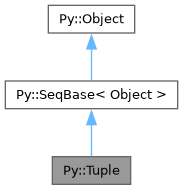
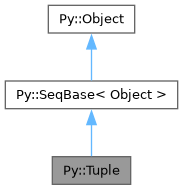
Public Member Functions | |
| Tuple (PyObject *pyob) | |
| Take a borrowed reference to an existing tuple. | |
| Tuple (int nSize) | |
| Create a tuple of a given length. | |
| Tuple (const Object &ob) | |
| Take another handle's reference as a tuple. | |
| virtual void | setItem (int i, const Object &value) |
| Write one element. | |
| virtual bool | accepts (PyObject *pyob) const |
| Accept only a tuple. | |
| Public Member Functions inherited from Py::SeqBase< Object > | |
| SeqBase (const Object &ob) | |
| Take a new reference to an existing object as a sequence. | |
| virtual int | max_size () const |
| Longest sequence this handle could address. | |
| virtual int | capacity () const |
| Elements this handle could address without reallocating, which is its length. | |
| virtual void | swap (SeqBase< Object > &other) |
| Exchange references with another handle of the same kind. | |
| virtual int | size () const |
| Number of elements. | |
| virtual Object | getItem (int i) const |
| Read one element. | |
| int | length () const |
| Number of elements, read without the table. | |
| seqref< Object > | operator[] (int i) |
| Address one element. | |
| iterator | begin () |
| Address the first element. | |
| iterator | end () |
| Address one past the last element. | |
| Public Member Functions inherited from Py::Object | |
| Object (PyObject *pyob=Py_None) | |
| Take a borrowed reference and add a count of its own. | |
| Object (const Object &other) | |
| Copy another handle and add a count of its own. | |
| virtual | ~Object () |
| Release the reference. | |
| Object & | operator= (const Object &other) |
| Replace the reference with another handle's. | |
| Object | getAttr (const HxStr &name) const |
| Read one attribute. | |
| String | str () const |
| Produce the text of str() applied to the object. | |
| HxStr | as_string () const |
| Produce the text of str() applied to the object, as a game string. | |
| Type | type () const |
| Produce the object's type. | |
| bool | isType (const Type &type) const |
| Report whether the object's type is a given type. | |
| bool | isTuple () const |
| Report whether the object is a tuple. | |
| bool | isList () const |
| Report whether the object is a list. | |
Additional Inherited Members | |
| Public Attributes inherited from Py::Object | |
| PyObject * | mPtr |
| Wrapped reference, null only between release() and the next assignment. | |
| Protected Member Functions inherited from Py::SeqBase< Object > | |
| SeqBase () | |
| Produce a handle on None for a derived class that fills it in afterwards. | |
| SeqBase (PyObject *pyob) | |
| Take a borrowed reference on behalf of a derived class. | |
| Protected Member Functions inherited from Py::Object | |
| void | release () |
| Release the reference and empty the handle. | |
| void | set (PyObject *pyob) |
| Replace the reference with a borrowed one and add a count of its own. | |
| void | validate () |
| Enforce this type's accepts() test on the stored reference. | |
Detailed Description
Handle on a Python tuple.
Its RTTI descriptor is at 0x00901d80. It has Py::SeqBase<Py::Object> at offset 0 as its one base. Its accessor is at 0x004c67e8.
The vtable at 0x00821c18 has nine entries, and only the type function, the destructor, accepts (), and slot 8 differ from the base table.
| Slot | Member | Address |
|---|---|---|
| 0 | compiler-generated type function | 0x004c67e8 |
| 1 | compiler-generated destructor | 0x004c6770 |
| 2 | accepts | 0x004c75c0 |
| 3 | inherited max_size | 0x0012ad48 |
| 4 | inherited capacity | 0x0012b378 |
| 5 | inherited swap | 0x0012b3a0 |
| 6 | inherited size | 0x0012b358 |
| 7 | inherited getItem | 0x0012ac48 |
| 8 | setItem | 0x004c7428 |
Constructor & Destructor Documentation
◆ Tuple() [1/3]
|
inlineexplicit |
Take a borrowed reference to an existing tuple.
The routine takes two arguments and no third. Released PyCXX gives the same constructor an owned flag, and this build has none, which is one of the two established differences between the shipped binding and the release.
- Parameters
-
pyob The tuple to wrap.
- Ghidra address:
- NTSC-U/C: 0x004c5448
- Ghidra address:
- PAL: 0x005036d0
◆ Tuple() [2/3]
|
explicit |
Create a tuple of a given length.
The base starts on an empty tuple. The body replaces it with a new tuple of the requested length through set() and fills every slot with None, throwing Py::Exception when a slot cannot be written. PyShell::ReportError() creates a two-element tuple this way.
- Parameters
-
nSize The number of elements.
- Ghidra address:
- NTSC-U/C: 0x004c5690
- Ghidra address:
- PAL: 0x00503918
◆ Tuple() [3/3]
|
explicit |
Take another handle's reference as a tuple.
The body is out of line. It belongs to the vendored binding and is not reconstructed.
- Parameters
-
ob The handle to copy.
- Ghidra address:
- NTSC-U/C: 0x004c5568
- Ghidra address:
- PAL: 0x005037f0
Member Function Documentation
◆ setItem()
|
inlinevirtual |
Write one element.
The override exists for the reference count. PyTuple_SetItem() steals a reference, so the body adds one before the call, where the base's PySequence_SetItem() path borrows and needs no such step.
- Parameters
-
i The index. value The element to store.
- Ghidra address:
- NTSC-U/C: 0x004c7428
- Ghidra address:
- PAL: 0x00505650
Reimplemented from Py::SeqBase< Object >.
◆ accepts()
|
inlinevirtual |
Accept only a tuple.
- Parameters
-
pyob The reference to test.
- Returns
- True when the reference is a tuple.
- Ghidra address:
- NTSC-U/C: 0x004c75c0
- Ghidra address:
- PAL: 0x005057e8
Reimplemented from Py::SeqBase< Object >.
The documentation for this class was generated from the following file:
- src/script/cxx/tuple.h