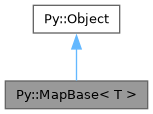
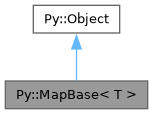
Handle on any Python mapping, and the base of Py::Dict. More...
#include <mapbase.h>
Public Member Functions | |
| virtual bool | accepts (PyObject *pyob) const |
| Accept any reference the mapping protocol supports. | |
| virtual void | setItem (const HxStr &key, const Object &value) |
| Store a value under a name. | |
| virtual void | setItem (const Object &key, const Object &value) |
| Store a value under a key object. | |
| Public Member Functions inherited from Py::Object | |
| Object (PyObject *pyob=Py_None) | |
| Take a borrowed reference and add a count of its own. | |
| Object (const Object &other) | |
| Copy another handle and add a count of its own. | |
| virtual | ~Object () |
| Release the reference. | |
| Object & | operator= (const Object &other) |
| Replace the reference with another handle's. | |
| Object | getAttr (const HxStr &name) const |
| Read one attribute. | |
| String | str () const |
| Produce the text of str() applied to the object. | |
| HxStr | as_string () const |
| Produce the text of str() applied to the object, as a game string. | |
| Type | type () const |
| Produce the object's type. | |
| bool | isType (const Type &type) const |
| Report whether the object's type is a given type. | |
| bool | isTuple () const |
| Report whether the object is a tuple. | |
| bool | isList () const |
| Report whether the object is a list. | |
Protected Member Functions | |
| MapBase () | |
| Produce a handle on None for a derived class that fills it in afterwards. | |
| MapBase (PyObject *pyob) | |
| Take a borrowed reference on behalf of a derived class. | |
| Protected Member Functions inherited from Py::Object | |
| void | release () |
| Release the reference and empty the handle. | |
| void | set (PyObject *pyob) |
| Replace the reference with a borrowed one and add a count of its own. | |
| void | validate () |
| Enforce this type's accepts() test on the stored reference. | |
Additional Inherited Members | |
| Public Attributes inherited from Py::Object | |
| PyObject * | mPtr |
| Wrapped reference, null only between release() and the next assignment. | |
Detailed Description
class Py::MapBase< T >
Handle on any Python mapping, and the base of Py::Dict.
One instantiation exists in the image, Py::MapBase<Py::Object>, with its descriptor at 0x009029a0, deriving from Py::Object at offset 0.
The vtable at 0x00825848, copied at 0x00833278, has five entries, the three Py::Object slots plus two of its own.
| Slot | Member | Address |
|---|---|---|
| 0 | compiler-generated type function | 0x0050d0b0 |
| 1 | inherited destructor | 0x0050d038 |
| 2 | accepts | 0x0050d7f8 |
| 3 | setItem taking a name | 0x0050d6f8 |
| 4 | setItem taking a key object | 0x0050d780 |
Both setItem() bodies are shared with Py::Dict rather than overridden, so the derived table repeats the same two addresses.
Released PyCXX declares a reading half as well, with size(), getItem(), and a mapping reference proxy. None of it is in the table, so none is reconstructed. The image therefore establishes that this instantiation is write-only.
Constructor & Destructor Documentation
◆ MapBase() [1/2]
|
inlineprotected |
Produce a handle on None for a derived class that fills it in afterwards.
The body is empty, which is what the folded vptr write in Py::Dict's default constructor establishes. This compiler omits the intermediate vptr store when the intermediate constructor runs no code between the two stores.
◆ MapBase() [2/2]
|
inlineexplicitprotected |
Take a borrowed reference on behalf of a derived class.
- Parameters
-
pyob The reference to wrap.
Member Function Documentation
◆ accepts()
|
inlinevirtual |
Accept any reference the mapping protocol supports.
- Parameters
-
pyob The reference to test.
- Returns
- True when the reference is a mapping.
- Ghidra address:
- NTSC-U/C: 0x0050d7f8
- Ghidra address:
- PAL: 0x0054ccb0
Reimplemented from Py::Object.
Reimplemented in Py::Dict.
◆ setItem() [1/2]
|
inlinevirtual |
Store a value under a name.
- Parameters
-
key The key, as text. An empty string arrives at the interpreter as g_szEmptyString rather than as a null pointer. value The value to store.
- Ghidra address:
- NTSC-U/C: 0x0050d6f8
- Ghidra address:
- PAL: 0x0054cbb0
◆ setItem() [2/2]
|
inlinevirtual |
Store a value under a key object.
- Parameters
-
key The key. value The value to store.
- Ghidra address:
- NTSC-U/C: 0x0050d780
- Ghidra address:
- PAL: 0x0054cc38
The documentation for this class was generated from the following file:
- src/script/cxx/mapbase.h