Front-end state shared by every screen for the lifetime of the front-end renderer. More...
#include <metfrontendstate.h>
Public Member Functions | |
| MetFrontEndState () | |
| Start with no persona, an empty screen name, and every flag clear. | |
| ~MetFrontEndState () | |
| Delete every persona and release the screen name. | |
| void | Reset () |
| Clear every flag. | |
| MetPersonaData * | GetFirstPersona () |
| Report the first persona the game manager records. | |
Static Public Member Functions | |
| static MetFrontEndState * | shared () |
| Report the instance Create() allocated. | |
| static void | Create () |
| Allocate the instance. | |
| static void | Destroy () |
| Delete the instance and clear the pointer shared() reports. | |
Public Attributes | |
| std::vector< MetPersonaData * > | mPersonas |
| Personas this object owns. | |
| int | mUsingMemcard |
| Set while the game saves to a memory card. | |
| int | mSettingsDirty |
| Set by the configuration screens when a setting changed while mUsingMemcard is set, and cleared by MetMainScreen::EnterAndShow() once it has saved. | |
| int | mUnlockAll |
| Set to 1 by MetLogoScreen::RecordUnlock(). | |
| int | mPendingTransition |
| How the front end was departed for a game (the tutorial, a game, or a quit from the pause screen). | |
| int | mLastTransition |
| The previous value of mPendingTransition. | |
| int | mUnusedFlag |
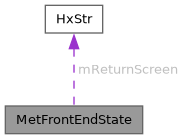
| HxStr | mReturnScreen |
| The name of the screen to return to, which several exit hooks record. | |
| int | mPlayerCount |
| The number of players MetLocNumPlayScreen slot 36 recorded and its slot 5 selects again. | |
Detailed Description
Front-end state shared by every screen for the lifetime of the front-end renderer.
The class is not polymorphic and emits no RTTI descriptor, and no literal or file path in the image records it, so the name is inferred from its use. MetRenderer's constructor creates the one instance through Create() and its destructor releases it through Destroy(). About a hundred routines across the front-end screens reach it through shared() and read or write its flags directly, which is why every member is public.
The object is 0x30 bytes, which the allocation in Create() fixes. The constructor starts the persona vector and the screen name empty and then runs Reset() on every other member.
Constructor & Destructor Documentation
◆ MetFrontEndState()
| MetFrontEndState::MetFrontEndState | ( | ) |
Start with no persona, an empty screen name, and every flag clear.
- Ghidra address:
- NTSC-U/C: 0x00215488
- Ghidra address:
- PAL: 0x0021f0b8
◆ ~MetFrontEndState()
| MetFrontEndState::~MetFrontEndState | ( | ) |
Delete every persona and release the screen name.
- Ghidra address:
- NTSC-U/C: 0x00215568
- Ghidra address:
- PAL: 0x0021f1b0
Member Function Documentation
◆ shared()
|
static |
Report the instance Create() allocated.
- Returns
- The instance, or null outside the lifetime of the front-end renderer.
- Ghidra address:
- NTSC-U/C: 0x00217f30
- Ghidra address:
- PAL: 0x00221bb8
◆ Create()
|
static |
Allocate the instance.
MetRenderer's constructor is the one caller. An existing instance is overwritten rather than released.
- Ghidra address:
- NTSC-U/C: 0x00217f40
- Ghidra address:
- PAL: 0x00221bc8
◆ Destroy()
|
static |
Delete the instance and clear the pointer shared() reports.
MetRenderer's destructor is the one caller.
- Ghidra address:
- NTSC-U/C: 0x00217fa0
- Ghidra address:
- PAL: 0x00221c28
◆ Reset()
| void MetFrontEndState::Reset | ( | ) |
Clear every flag.
The persona vector and the screen name are not touched.
- Ghidra address:
- NTSC-U/C: 0x00217fd8
- Ghidra address:
- PAL: 0x00221c60
◆ GetFirstPersona()
| MetPersonaData * MetFrontEndState::GetFirstPersona | ( | ) |
Report the first persona the game manager records.
The body copies the game manager's whole persona vector and reads the first element of the copy. It does not read this object.
- Returns
- The persona, or null when the game manager records none.
- Ghidra address:
- NTSC-U/C: 0x002156b0
- Ghidra address:
- PAL: 0x0021f310
Member Data Documentation
◆ mPersonas
| std::vector<MetPersonaData *> MetFrontEndState::mPersonas |
Personas this object owns.
The destructor deletes each one. +0x00
◆ mUsingMemcard
| int MetFrontEndState::mUsingMemcard |
Set while the game saves to a memory card.
MetMemDetectScreen sets it once a card is found and clears it when the user continues without one, and about a dozen screens test it before offering a save. +0x0c
◆ mSettingsDirty
| int MetFrontEndState::mSettingsDirty |
Set by the configuration screens when a setting changed while mUsingMemcard is set, and cleared by MetMainScreen::EnterAndShow() once it has saved.
+0x10
◆ mUnlockAll
| int MetFrontEndState::mUnlockAll |
Set to 1 by MetLogoScreen::RecordUnlock().
MetArenasScreen slot 5 and MetSoloStagesScreen read it to unlock every arena and stage. +0x14
◆ mPendingTransition
| int MetFrontEndState::mPendingTransition |
How the front end was departed for a game (the tutorial, a game, or a quit from the pause screen).
The screen entered on return acts on it and clears it after copying the value into mLastTransition. +0x18
◆ mLastTransition
| int MetFrontEndState::mLastTransition |
The previous value of mPendingTransition.
+0x1c
◆ mUnusedFlag
| int MetFrontEndState::mUnusedFlag |
Cleared by Reset(). No reader is identified. +0x20
◆ mReturnScreen
| HxStr MetFrontEndState::mReturnScreen |
The name of the screen to return to, which several exit hooks record.
+0x24
◆ mPlayerCount
| int MetFrontEndState::mPlayerCount |
The number of players MetLocNumPlayScreen slot 36 recorded and its slot 5 selects again.
+0x2c
The documentation for this class was generated from the following file:
- src/met/metfrontendstate.h