Ring of front-end buttons with one of them selected. More...
#include <metbuttonlist.h>
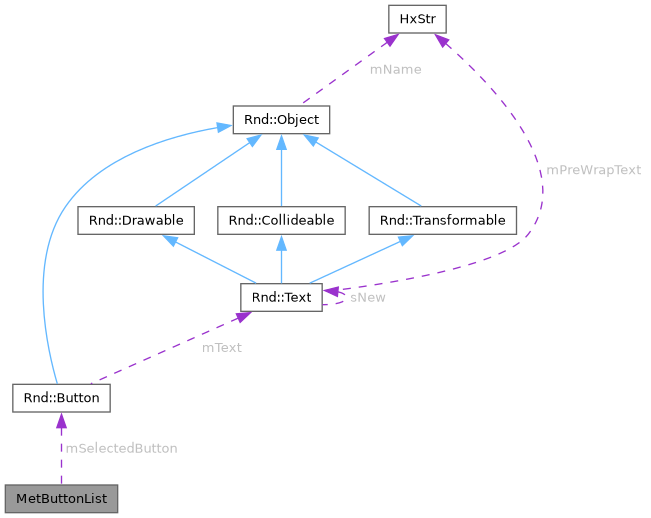
Public Member Functions | |
| void * | operator new (size_t nSize) |
| Allocate an instance from the tagged heap. | |
| void | operator delete (void *pBlock) |
| Release an instance to the tagged heap under the same tag. | |
| MetButtonList () | |
| Construct an empty list with nothing selected. | |
| virtual | ~MetButtonList () |
| Release every button reference and the vector. | |
| virtual void | SelectPrevious () |
| Move the selection to the previous enabled button, wrapping from the first to the last. | |
| virtual void | SelectNext () |
| Move the selection to the next enabled button, wrapping from the last to the first. | |
| virtual void | ChangeButtonSelected (int nPreviousIndex, int nIndex) |
| Respond to the selection moving. | |
| void | Clear () |
| Release every button reference and empty mButtons. | |
| void | Add (const HxStr &objectName, const HxStr &labelText) |
| Resolve one button by object name and append it. | |
| void | Append (Rnd::Button *pButton, const HxStr &labelText) |
| Append one resolved button and apply its label. | |
| void | SetSelected (int nIndex) |
| Move the selection to one index. | |
| Rnd::Button * | GetButton (int nIndex) const |
| Resolve one button by index. | |
Public Attributes | |
| Rnd::Button * | mSelectedButton |
| The button SetSelected() last stored. | |
| std::vector< Rnd::Button * > | mButtons |
| The buttons in list order. | |
| int | mSelected |
| Index of the selected button, or -1 for none. | |
Detailed Description
Ring of front-end buttons with one of them selected.
Its RTTI descriptor is at 0x0086f5f8. It is a leaf class with no base. Following the g++ 2.x layout for a class with no base, the vptr sits after the data members at +0x14, and the object is 0x18 bytes. The five-entry vtable is at 0x007e90f8.
The class supplies its own allocation function, which tags every instance with the literal MetButtonList at 0x007e8e10. That is the one place in the foundation where a Met class declares operator new.
Both navigation virtuals walk mButtons in their own direction, wrap at the end, and skip an entry whose field at +0x1c equals 3, which is how a disabled button is passed over. Both stop after visiting every entry, so a list in which every button is disabled retains the mSelected value it had before the call.
The four declared virtuals are the destructor at 0x001fca30, the two navigation routines at 0x001fcc40 and 0x001fcd10, and the selection-change notification at 0x001feed8. The titles of the two navigation routines are inferred from what the bodies do.
The constructor at 0x001fc9f8 is inline. It writes the vptr, zeroes the first word and the vector, and sets mSelected to -1, which is the sentinel for no selection that the selection-change routine tests for.
Constructor & Destructor Documentation
◆ MetButtonList()
|
inline |
Construct an empty list with nothing selected.
Inline. MetArenasScreen's constructor calls the out-of-line copy.
- Ghidra address:
- NTSC-U/C: 0x001fc9f8
- Ghidra address:
- PAL: 0x00203ea0
◆ ~MetButtonList()
|
virtual |
Release every button reference and the vector.
- Ghidra address:
- NTSC-U/C: 0x001fca30
- Ghidra address:
- PAL: 0x00203ed8
Member Function Documentation
◆ operator new()
| void * MetButtonList::operator new | ( | size_t | nSize | ) |
Allocate an instance from the tagged heap.
- Parameters
-
nSize The object size, which the compiler supplies.
- Returns
- The block.
- Ghidra address:
- NTSC-U/C: 0x001fecc8
- Ghidra address:
- PAL: 0x00206198
◆ operator delete()
| void MetButtonList::operator delete | ( | void * | pBlock | ) |
Release an instance to the tagged heap under the same tag.
The out-of-line copy has no caller.
- Parameters
-
pBlock The block.
- Ghidra address:
- NTSC-U/C: 0x001fece8
- Ghidra address:
- PAL: 0x002061b8
◆ SelectPrevious()
|
virtual |
Move the selection to the previous enabled button, wrapping from the first to the last.
Slot 2. The body steps mSelected down by one. MetMainScreen at 0x002c6820 and MetLoadFreqBaseScreen::HandleCommand() route kMetScreenCommandPrevious here.
- Ghidra address:
- NTSC-U/C: 0x001fcc40
- Ghidra address:
- PAL: 0x002040e8
◆ SelectNext()
|
virtual |
Move the selection to the next enabled button, wrapping from the last to the first.
Slot 3. The body steps mSelected up by one, and the screens route kMetScreenCommandNext here.
- Ghidra address:
- NTSC-U/C: 0x001fcd10
- Ghidra address:
- PAL: 0x002041b8
◆ ChangeButtonSelected()
|
virtual |
Respond to the selection moving.
Slot 4. SetSelected() and both navigation slots call it with the index that was selected and the index that is now selected, in that order. The body puts the previous button back into state 0 and the new one into state 1.
- Parameters
-
nPreviousIndex The index the selection had. nIndex The index the selection now has.
- Ghidra address:
- NTSC-U/C: 0x001feed8
- Ghidra address:
- PAL: 0x002063a8
◆ Clear()
| void MetButtonList::Clear | ( | ) |
Release every button reference and empty mButtons.
The body is the vector clear over mButtons, reached as this + 4, with the per-element release at 0x00520be0. Every class with a vector of four-byte elements shares this body.
- Ghidra address:
- NTSC-U/C: 0x001fedb0
- Ghidra address:
- PAL: 0x00206280
◆ Add()
Resolve one button by object name and append it.
The object is resolved through Rnd::Manager::Find() on Rnd::TheManager and cast to Rnd::Button. A name that resolves to nothing reports through 0x0053dde0 and the null is appended regardless, which is why every reader tests an entry before using it. A label of length zero is not applied, and every MetLoadFreqBaseScreen call site passes the empty literal so that the label is set later by MetLoadFreqBaseScreen::UpdateNameLabel() instead.
- Parameters
-
objectName The button object as written in the .rnd file. labelText The text for the button's label child, or the empty string for none.
- Ghidra address:
- NTSC-U/C: 0x001fcb28
- Ghidra address:
- PAL: 0x00203fd0
◆ Append()
|
inline |
Append one resolved button and apply its label.
Inline. Add() expands it after resolving the button, and the out-of-line copy has no caller. A label of length zero is not applied. The title is inferred.
- Parameters
-
pButton The button, or null. labelText The text for the button's label child, or the empty string for none.
- Ghidra address:
- NTSC-U/C: 0x001fed30
- Ghidra address:
- PAL: 0x00206200
◆ SetSelected()
| void MetButtonList::SetSelected | ( | int | nIndex | ) |
Move the selection to one index.
A call on an empty list does nothing, and so does a call with the index already selected. The sentinel -1 puts the previously selected button back into state 0 and selects nothing. Any other index runs the selection-change notification in vtable slot 4.
The routine then stores mButtons[nIndex] into mSelectedButton on every path, including the sentinel path, where the index is -1 and the read is one element below the first. That is what the binary does.
- Parameters
-
nIndex The index to select, or -1 for none.
- Ghidra address:
- NTSC-U/C: 0x001fee08
- Ghidra address:
- PAL: 0x002062d8
◆ GetButton()
| Rnd::Button * MetButtonList::GetButton | ( | int | nIndex | ) | const |
Resolve one button by index.
- Parameters
-
nIndex The index, or -1.
- Returns
- The button, or null for the -1 sentinel. An index past the end is not checked.
- Ghidra address:
- NTSC-U/C: 0x001fef40
- Ghidra address:
- PAL: 0x00206410
Member Data Documentation
◆ mSelectedButton
| Rnd::Button* MetButtonList::mSelectedButton |
The button SetSelected() last stored.
SetSelected() writes mButtons[nIndex] here on every path, including the path that takes the -1 sentinel, where the read is one element below the first.
Public rather than private, because MetLoadFreqBaseScreen::HandleCommand() passes it straight to MetScreen::StartRepeatingSound() and the image has no accessor to route that read through. A friend declaration fits the image equally well. +0x00
◆ mButtons
| std::vector<Rnd::Button *> MetButtonList::mButtons |
The buttons in list order.
The element is Rnd::Button rather than Rnd::Object. Add() appends the result of a dynamic_cast to Rnd::Button, and both navigation virtuals read Rnd::Button::mState at +0x1c to pass over a disabled entry.
Public rather than private, because MetMsgScreen::Refresh() at 0x002ecd10 reads its size directly and the image has no accessor to route that read through. +0x04
◆ mSelected
| int MetButtonList::mSelected |
Index of the selected button, or -1 for none.
Public rather than private, because MetLoadFreqBaseScreen reads it directly and the image has no accessor to route that read through. A friend declaration fits the image equally well. +0x10
The documentation for this class was generated from the following file:
- src/met/metbuttonlist.h