Read-only interface the game reads one converted level through. More...
#include <leveldata.h>
Public Member Functions | |
| virtual | ~LevelData () |
| virtual int | TrackCount ()=0 |
| Report how many tracks the level has. | |
| virtual int | BackingTrackCount ()=0 |
| Report how many backing tracks the level has. | |
| virtual TrackData * | OwnTrack ()=0 |
| Report the level's own track. | |
| virtual TrackData * | TrackAt (int nIndex)=0 |
| Report one track by index. | |
| virtual TrackData * | BackingTrackAt (int nIndex)=0 |
| Report one backing track by index. | |
| virtual Sch::TempoMap * | GetTempoMap ()=0 |
| Report the level's tempo map. | |
| virtual PlayMap * | GetPlayMap ()=0 |
| Report the level's play map. | |
| virtual int | GetEndBar ()=0 |
| Report the level's end bar. | |
Detailed Description
Read-only interface the game reads one converted level through.
Its RTTI descriptor is at 0x0086f600. It is a leaf with no base list, built through TypeInfo__ConstructBuiltin. The class has no data member, so the vptr sits at +0x00 and the object is four bytes. Its table is at 0x007e7a50 and has ten entries with a zero terminator at index 10. Slots 2 through 9 all address the shared pure-virtual stub at 0x005381a8, so the class is abstract and supplies nothing but the interface.
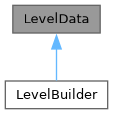
LevelBuilder is the one subclass in the image and it implements all eight slots. Every implementation is a single load or a subtraction and a shift, which is what makes this an accessor interface over data a conversion has already produced.
Every method name here is inferred from the LevelBuilder body behind it. RTTI in this image yields class names only. The labels LevelBuilder's print routine writes, Score Track# and Backing Track#, distinguish the two collections.
Constructor & Destructor Documentation
◆ ~LevelData()
|
virtual |
- Ghidra address:
- NTSC-U/C: 0x001ec388
- Ghidra address:
- PAL: 0x001f2610
Member Function Documentation
◆ TrackCount()
|
pure virtual |
Report how many tracks the level has.
Slot 2, and pure.
- Returns
- The count.
Implemented in LevelBuilder.
◆ BackingTrackCount()
|
pure virtual |
Report how many backing tracks the level has.
Slot 3, and pure.
- Returns
- The count.
Implemented in LevelBuilder.
◆ OwnTrack()
|
pure virtual |
Report the level's own track.
Slot 4, and pure. LevelBuilder returns the one track it manages separately from the collection the two slots above and below describe.
- Returns
- The track.
Implemented in LevelBuilder.
◆ TrackAt()
|
pure virtual |
Report one track by index.
Slot 5, and pure. An index outside the collection is not tested for.
- Parameters
-
nIndex The track.
- Returns
- The track.
Implemented in LevelBuilder.
◆ BackingTrackAt()
|
pure virtual |
Report one backing track by index.
Slot 6, and pure. An index outside the collection is not tested for. The element type comes from LevelBuilder's destructor, which clears all three of its collections with the same deleting function at 0x001ec328, and that function deletes a TrackData. LevelBuilder's print routine labels the collection Backing Track#.
- Parameters
-
nIndex The track.
- Returns
- The track.
Implemented in LevelBuilder.
◆ GetTempoMap()
|
pure virtual |
Report the level's tempo map.
Slot 7, and pure.
LevelBuilder returns the word at its own +0x30. Its constructor fills that word with a 0x28-byte object built by 0x0052d118 with 500000 microseconds per quarter note, which is the Sch::TempoMap constructor, and GrooveWorld::FinishLoad() hands the result to Sch::TickClock::SetTempoMap().
- Returns
- The tempo map.
Implemented in LevelBuilder.
◆ GetPlayMap()
|
pure virtual |
Report the level's play map.
Slot 8, and pure.
LevelBuilder returns the word at its own +0x34. The LevelBuilder constructor at 0x001ea838 fills that word with a 0x74-byte allocation under the tag PlayMap, constructed by 0x00127a80 with PlayMapLinear's table at 0x007d1060 written to its +0x38, and the destructor deletes it through table slot 1.
- Returns
- The play map.
Implemented in LevelBuilder.
◆ GetEndBar()
|
pure virtual |
Report the level's end bar.
Slot 9, and pure.
LevelBuilder returns what PlayMap::GetLength() of its play map reports. GrooveWorld::BuildGraphs() at 0x0018cce8 passes the result to Gamer's constructor as the end bar.
- Returns
- The play map's extent.
Implemented in LevelBuilder.
The documentation for this class was generated from the following file:
- src/game/leveldata.h