Affine map between a song position in MIDI ticks and scheduler time in nanoseconds. More...
#include <tempomap.h>
Public Member Functions | |
| TempoMap (int nMicrosecondsPerQuarter) | |
| Start a map at the requested tempo, with song position zero at scheduler time zero. | |
| virtual | ~TempoMap () |
| Release the map. | |
| void | SetTempo (int nMicrosecondsPerQuarter, long long nTick) |
| Change the tempo from the requested song position onwards. | |
| Public Member Functions inherited from Attachment | |
| Attachment () | |
| virtual | ~Attachment () |
| int | Release () |
| Give back one reference and destroy the object once the last one is gone. | |
| virtual void | Destroy () |
| Destroy the object. | |
Public Attributes | |
| long long | mNanosecondsPerTick |
| Nanoseconds each MIDI tick lasts at the current tempo. | |
| long long | mOriginNanoseconds |
| Scheduler time, in nanoseconds, that song position zero maps to. | |
| long long | mCeilingBias |
| Numerator bias that turns the scheduler-time-to-tick division into a rounding-up one. | |
| int | mMicrosecondsPerQuarter |
| The current tempo, in microseconds per quarter note. | |
| Public Attributes inherited from Attachment | |
| int | mRefs |
Additional Inherited Members | |
| Static Public Member Functions inherited from Attachment | |
| static void | ReleaseIfSet (Attachment *pAttachment) |
| Give back one reference to an object that may be null. | |
Detailed Description
Affine map between a song position in MIDI ticks and scheduler time in nanoseconds.
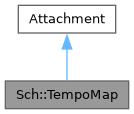
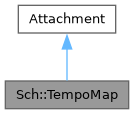
Its RTTI descriptor is at 0x008f2a10. It derives publicly from Attachment at offset 0. The descriptor address is verified against the accessor at 0x0052d260. The accessor guards on 0x008f2a10 and then calls TypeInfo::ConstructSingleInheritance() with the mangled name at 0x00827ca0 and the Attachment descriptor at 0x0086f5a0.
The vtable at 0x00827cb0 runs three entries and then a zero entry, so the class declares no virtual of its own:
- 0, the compiler-generated type function at 0x0052d260
- 1, the destructor at 0x0052d240
- 2, Attachment::Destroy() at 0x004bfea8, inherited
An instance is 0x28 bytes. Three call sites allocate that size (0x001ea8c0, 0x001ec628, and 0x004a7a38), the constructor's highest write lands at +0x20, and the four trailing bytes are the padding that the 8-byte alignment of the three wide members forces. The layout therefore closes.
Every member is public, because code outside the hierarchy reads each one directly and the image exposes no accessor. Sch::TickClock reads mNanosecondsPerTick and mOriginNanoseconds at 0x004a627c and 0x004a6280 to convert a song position into scheduler time, reads mNanosecondsPerTick and mCeilingBias at 0x004a7b2c and 0x004a7b28 to convert the other way, and the clock tempo script command reads mMicrosecondsPerQuarter at 0x00151214.
Two facts fix the units, and each is measured twice. The tempo is in microseconds per quarter note, because Sch::TickClock's constructor at 0x004a7a48 supplies the default 500000, which is the tempo a Standard MIDI File assumes, and the clock tempo command reports the member back unscaled. The resolution is 480 ticks per quarter note, because the scale is the tempo times 25/12, that is 1000 nanoseconds per microsecond over 480 ticks per quarter note, and because the song_bar command at 0x001ac774 divides a song position by 1920, which is four quarter notes at the same resolution. Scheduler time is in nanoseconds, because Sch::Scheduler's clock scales its millisecond readings by 1.0e9 / 1000.0 at 0x005124c8, and because the run loop at 0x004aa8a4 treats a gap of 6000000000 as the point at which it stops catching up.
Constructor & Destructor Documentation
◆ TempoMap()
| Sch::TempoMap::TempoMap | ( | int | nMicrosecondsPerQuarter | ) |
Start a map at the requested tempo, with song position zero at scheduler time zero.
- Parameters
-
nMicrosecondsPerQuarter The tempo, in microseconds per quarter note.
- Ghidra address:
- NTSC-U/C: 0x0052d118
- Ghidra address:
- PAL: 0x0056d7a8
◆ ~TempoMap()
|
virtual |
Release the map.
The body forwards to the Attachment destructor and touches no member of its own.
- Ghidra address:
- NTSC-U/C: 0x0052d240
- Ghidra address:
- PAL: 0x0056d8d0
Member Function Documentation
◆ SetTempo()
| void Sch::TempoMap::SetTempo | ( | int | nMicrosecondsPerQuarter, |
| long long | nTick ) |
Change the tempo from the requested song position onwards.
The scheduler time of that song position is preserved across the change, so a tempo change moves every later position without moving any earlier one. The title is inferred from the clock tempo script command at 0x0015132c, which is the one caller.
- Parameters
-
nMicrosecondsPerQuarter The new tempo, in microseconds per quarter note. nTick The song position the new tempo takes effect at, in MIDI ticks.
- Ghidra address:
- NTSC-U/C: 0x0052d198
- Ghidra address:
- PAL: 0x0056d828
Member Data Documentation
◆ mNanosecondsPerTick
| long long Sch::TempoMap::mNanosecondsPerTick |
Nanoseconds each MIDI tick lasts at the current tempo.
+0x08
◆ mOriginNanoseconds
| long long Sch::TempoMap::mOriginNanoseconds |
Scheduler time, in nanoseconds, that song position zero maps to.
+0x10
◆ mCeilingBias
| long long Sch::TempoMap::mCeilingBias |
Numerator bias that turns the scheduler-time-to-tick division into a rounding-up one.
The value is always mNanosecondsPerTick minus mOriginNanoseconds minus one, which makes (time + mCeilingBias) / mNanosecondsPerTick the smallest MIDI tick at or after the requested time. Sch::TickClock::SongTick() at 0x004a7b28 is the one reader.
+0x18
◆ mMicrosecondsPerQuarter
| int Sch::TempoMap::mMicrosecondsPerQuarter |
The current tempo, in microseconds per quarter note.
+0x20
The documentation for this class was generated from the following file:
- src/sch/tempomap.h