Event the game passes between a MsgSource and a MsgSink. More...
#include <caughtpowerbarmsg.h>
Public Member Functions | |
| virtual Message * | Clone () |
| Produce a heap copy of this message. | |
| virtual int | Type () |
| Report this message's registered identity. | |
| virtual const char * | GetName () const |
| Report this message's class name. | |
| virtual void | PrintExtra (std::ostream &stream) const |
| Write the item kind to a diagnostic stream as a number. | |
| Public Member Functions inherited from Message | |
| void * | operator new (size_t nSize) |
| Allocate a message from the tagged heap under the tag MSG. | |
| void | operator delete (void *pBlock) |
| Release a message to the tagged heap under the tag MSG. | |
| virtual | ~Message () |
| Vtable slot 1. | |
| virtual void | saveGuts (OBStream &stream) const |
| Write this message's payload to an output stream. | |
| virtual void | restoreGuts (IBStream &stream) |
| Read this message's payload from an input stream. | |
| std::ostream & | Print (std::ostream &stream) const |
| Write this message to a diagnostic stream as {GetName() PrintExtra()}. | |
Static Public Member Functions | |
| static Message * | New () |
| Produce a default-constructed message on the heap. | |
| Static Public Member Functions inherited from Message | |
| static Message * | NewMessage (int nType) |
| Produce a message of the identified class through the factory list. | |
Public Attributes | |
| PowerupType | mKind |
| Player * | mPlayer |
Detailed Description
Event the game passes between a MsgSource and a MsgSink.
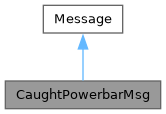
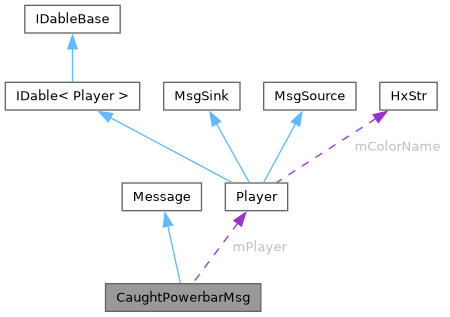
Its RTTI descriptor is at 0x008eeca8. It has Message as its one base. The object is 0xc bytes and its vtable is at 0x00812c90. The members below are the whole of the class. No other routine in the image refers to this type by anything but its vtable.
The payload layout comes from the run of field copies in Clone(). Both members are public because Overlay::OnCaughtPowerbar() at 0x0041eba0 reads them directly with no accessor in the image. It compares mPlayer with HudTrack::mPlayer and passes mKind to HudPowerupName() at 0x0041ebf4. That call types mKind.
The destructor at 0x003dce20 is compiler-generated and has no declaration here.
Member Function Documentation
◆ New()
|
static |
Produce a default-constructed message on the heap.
The translation unit at 0x003d9818 registers this factory. The payload is left unset.
- Returns
- The message.
- Ghidra address:
- NTSC-U/C: 0x003d6f58
- Ghidra address:
- PAL: 0x0040ee48
◆ Clone()
|
virtual |
Produce a heap copy of this message.
- Returns
- The copy.
- Ghidra address:
- NTSC-U/C: 0x003dcf10
- Ghidra address:
- PAL: 0x00415348
Implements Message.
◆ Type()
|
virtual |
Report this message's registered identity.
- Returns
- g_nCaughtPowerbarMsgType.
- Ghidra address:
- NTSC-U/C: 0x003dcf60
- Ghidra address:
- PAL: 0x00415398
Implements Message.
◆ GetName()
|
virtual |
Report this message's class name.
- Returns
- The literal CaughtPowerbarMsg.
- Ghidra address:
- NTSC-U/C: 0x003dcf70
- Ghidra address:
- PAL: 0x004153a8
Implements Message.
◆ PrintExtra()
|
virtual |
Write the item kind to a diagnostic stream as a number.
- Parameters
-
stream The stream to write to.
- Ghidra address:
- NTSC-U/C: 0x003e3cb8
- Ghidra address:
- PAL: 0x0041be88
Reimplemented from Message.
Member Data Documentation
◆ mKind
| PowerupType CaughtPowerbarMsg::mKind |
The captured item. +0x04
◆ mPlayer
| Player* CaughtPowerbarMsg::mPlayer |
The capturing player. +0x08
The documentation for this class was generated from the following file:
- src/msg/caughtpowerbarmsg.h