Piece of MIDI performance that a Scheduler plays. More...
#include <muse.h>
Classes | |
| class | NoteCB |
| Receiver of each note a muse starts. More... | |
Public Member Functions | |
| ~Muse () override | |
| Release the muse. | |
| virtual void | Play (Scheduler *pScheduler)=0 |
| Play from the start. | |
| virtual void | PlayFrom (Scheduler *pScheduler, int nOffset)=0 |
| Play with every event moved by an offset. | |
| virtual void | PlayWindow (Scheduler *pScheduler, int nStart, int nEnd)=0 |
| Play the events that fall in a window. | |
| virtual void | Stop ()=0 |
| Withdraw every event still queued and silence the notes that sound. | |
| virtual bool | IsPlaying ()=0 |
| Report whether a note of the muse still sounds or waits to sound. | |
| virtual int | GetLength ()=0 |
| Report the length of the muse. | |
| virtual Muse * | Clone ()=0 |
| Produce a copy of the muse on the heap. | |
| virtual void | SetNoteCB (NoteCB *pNoteCB)=0 |
| Set the receiver of the notes the muse starts. | |
| Public Member Functions inherited from Attachment | |
| Attachment () | |
| Construct an object with no reference. | |
| virtual | ~Attachment () |
| Release the object. | |
| void | AddRef () |
| Take one reference. | |
| void | Release () |
| Give back one reference and delete the object once the last one is gone. | |
Additional Inherited Members | |
| Static Public Member Functions inherited from Attachment | |
| static void | ReleaseIfSet (Attachment *pAttachment) |
| Give back one reference to an object that may be null. | |
Detailed Description
Piece of MIDI performance that a Scheduler plays.
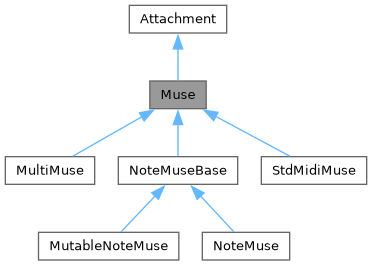
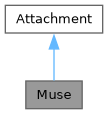
The RTTI includes the class name and records Attachment as the base. The vtable lists eight pure members after the destructor.
Constructor & Destructor Documentation
◆ ~Muse()
|
inlineoverride |
Release the muse.
- Ghidra address:
- NTSC-U/C: 0x0034e3a8
- Ghidra address:
- PAL: 0x003bb7d0
Member Function Documentation
◆ Play()
|
pure virtual |
Play from the start.
- Parameters
-
pScheduler The scheduler that plays the events.
Implemented in MultiMuse, MutableNoteMuse, NoteMuseBase, and StdMidiMuse.
◆ PlayFrom()
|
pure virtual |
Play with every event moved by an offset.
- Parameters
-
pScheduler The scheduler that plays the events. nOffset The offset in ticks.
Implemented in MultiMuse, MutableNoteMuse, NoteMuseBase, and StdMidiMuse.
◆ PlayWindow()
|
pure virtual |
Play the events that fall in a window.
- Parameters
-
pScheduler The scheduler that plays the events. nStart The first tick of the window. nEnd The tick after the window.
Implemented in MultiMuse, MutableNoteMuse, NoteMuseBase, and StdMidiMuse.
◆ Stop()
|
pure virtual |
Withdraw every event still queued and silence the notes that sound.
Implemented in MultiMuse, NoteMuseBase, and StdMidiMuse.
◆ IsPlaying()
|
pure virtual |
Report whether a note of the muse still sounds or waits to sound.
- Returns
- Whether the muse plays.
Implemented in MultiMuse, NoteMuseBase, and StdMidiMuse.
◆ GetLength()
|
pure virtual |
Report the length of the muse.
- Returns
- The length in ticks.
Implemented in MultiMuse, NoteMuseBase, and StdMidiMuse.
◆ Clone()
|
pure virtual |
Produce a copy of the muse on the heap.
- Returns
- The copy, with no reference taken.
Implemented in MultiMuse, MutableNoteMuse, NoteMuse, and StdMidiMuse.
◆ SetNoteCB()
|
pure virtual |
Set the receiver of the notes the muse starts.
- Parameters
-
pNoteCB The receiver, or null.
Implemented in MultiMuse, NoteMuseBase, and StdMidiMuse.
The documentation for this class was generated from the following file:
- src/gs/muse.h