Front end and flow of the whole game, from the start-up screens through a song and back. More...
#include <metagame.h>
Public Member Functions | |
| Metagame () | |
| Construct the metagame in kStateFrontEnd with nothing loaded. | |
| ~Metagame () override | |
| Destroy the metagame. | |
| void | ShowLoadingScreen () |
| Load one of the four loading screens at random from metagame\loadingd.rnd and draw it. | |
| void | Init () |
| Read the metagame configuration, start the front end, and register the script commands. | |
| void | Terminate () |
| Unregister the script commands and release what Init() and the loads created. | |
| int | GetState () const |
| Report mState. | |
| const char * | SelectedArenaName () |
| Report the display name of the arena chosen last. | |
| const char * | ArenaName (const char *pszArena) |
| Report the display name of an arena. | |
| void | EnterFrontEnd () |
| Enter kStateFrontEnd. | |
| void | EnterLoading () |
| Enter kStateLoading. | |
| void | EnterPlaying () |
| Enter kStatePlaying. | |
| void | EnterLeaving () |
| Enter kStateLeaving. | |
| void | EnterRestarting () |
| Enter kStateRestarting. | |
| int | Update () |
| Advance the front end by one frame and report the request it made. | |
| void | ShowBlankScreen () |
| Show the blank screen unless a dialog is showing. | |
| void | SetHelpText (const char *pszText) |
| Show a help text on the help panel. | |
| void | SetActionText (const char *pszText) |
| Show a text of the buttons on the help panel. | |
| void | Draw () |
| Draw the part of the front end that goes under the world, the arena scene. | |
| void | DrawOverlay () |
| Draw the part of the front end that goes over the world. | |
| void | ShowUnlockedArenas () |
| Show the arenas the player has unlocked on the arena scene. | |
| void | RecordCampaignResult () |
| Record the result of a campaign song in the profile of the first player. | |
| void | QueueUnlocks () |
| Queue the unlock screens of the items the last song unlocked. | |
| void | ShowDialog (DialogType type, DialogCallback pfnCallback, void *pUserData, int nPad) |
| Show a dialog over the song and report the player's choice to a callback. | |
| void | ShowDialogToAll (DialogType type, DialogCallback pfnCallback, void *pUserData) |
| Show a dialog over the song that listens to every controller. | |
| void | ShowEndGameScreens (DialogAction action) |
| Show the screens that follow a song, from its result to the queued unlocks. | |
| void | AdvanceUnlocks () |
| Show the next queued unlock screen, or finish the dialog once the queue is empty. | |
| void | SetSongScreenMix (bool bIdle) |
| Switch the menu music of the song screen to mix 7 over 1920 ticks while no song clip plays, or to mix 9 over 500 ticks before a clip starts. | |
| bool | DispatchPriv (Message *pMsg) override |
| Handle a message sent to the metagame. | |
| void | SetEvent (int nEvent) |
| Set the Event that Update() reports next. | |
| Mix * | GetMusic () const |
| float | GetTickMs () const |
| float | GetSpeed () const |
| Gizmo * | GetGizmo () const |
| const char * | GetSelectedArena () const |
| void | SetSelectedArena (const char *pszArena) |
| Choose an arena. | |
| const NetChatroomInfo & | GetChatroom () const |
| void | SetChatroom (const NetChatroomInfo &chatroom) |
| Record the chat room this console joined. | |
| int | GetFreqsOnCard () const |
| void | SetFreqsOnCard (int bFreqsOnCard) |
| Record whether the memory card check found saved Freqs. | |
| int | GetNetScreenPending () const |
| const char * | GetNetScreen () const |
| void | SetDialogAction (DialogAction action) |
| Record the choice made in the dialog. | |
| void | SetReserved144 (int nValue) |
| Set the field at +0x144, which is not yet identified. | |
| Public Member Functions inherited from MsgSink | |
| void * | operator new (size_t nSize) |
| Allocate a sink from the pool heaps under the tag "MsgSink". | |
| void | operator delete (void *pBlock) |
| Return a sink to the pool heaps. | |
| virtual | ~MsgSink () |
| virtual bool | Dispatch (Message *pMsg) |
| Accept a message. | |
| void * | operator new (size_t size) |
| Allocate from the main heap under the name MsgSink. | |
| void | operator delete (void *mem) |
| Return memory to its heap. | |
| virtual | ~MsgSink () |
| Destroy the sink. | |
| virtual bool | Dispatch (Message *msg) |
| Handle a message. | |
Detailed Description
Front end and flow of the whole game, from the start-up screens through a song and back.
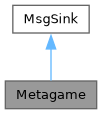
The RTTI includes the name and records MsgSink as the one base. The vptr sits at offset 0. The one instance is TheMetagame.
The main loop drives it together with WorldMgr. Update() reports what the front end requested, and the main loop answers by moving WorldMgr and calling the matching Enter routine here.
At start-up the metagame walks through the stages of LoadStage. It loads the screen groups, shows the memory card check and the presented-by screen, loads the sound banks, the arena scene, and the menu music, plays the intro movie once the screens reach blank, and then moves the front end to pre_logo, which leads to the title.
Member Typedef Documentation
◆ DialogCallback
| typedef void(* Metagame::DialogCallback) (DialogAction action, void *pUserData) |
Routine a dialog reports the player's choice to.
- Parameters
-
action The choice. pUserData The value given to ShowDialog().
Member Enumeration Documentation
◆ State
| enum Metagame::State |
◆ Event
| enum Metagame::Event |
Values Update() reports.
◆ LoadStage
| enum Metagame::LoadStage |
Values of mLoadStage, the progress of the front end through its loads.
◆ DialogType
| enum Metagame::DialogType |
Kinds of dialog ShowDialog() shows over a song.
◆ UnlockEvent
The screens that follow a song, in the order QueueUnlocks() queues them.
◆ DialogAction
Choices a dialog reports to its callback.
Constructor & Destructor Documentation
◆ Metagame()
| Metagame::Metagame | ( | ) |
Construct the metagame in kStateFrontEnd with nothing loaded.
- Ghidra address:
- NTSC-U/C: 0x00163328
- Ghidra address:
- PAL: 0x001660a0
◆ ~Metagame()
|
override |
Destroy the metagame.
- Ghidra address:
- NTSC-U/C: 0x00354d70
- Ghidra address:
- PAL: 0x003c1fc0
Member Function Documentation
◆ ShowLoadingScreen()
| void Metagame::ShowLoadingScreen | ( | ) |
Load one of the four loading screens at random from metagame\loadingd.rnd and draw it.
The main loop calls the routine before the other subsystems start, and the screen therefore shows while they load. The screen is drawn into both frame buffers.
- Ghidra address:
- NTSC-U/C: 0x00164500
- Ghidra address:
- PAL: 0x00167350
◆ Init()
| void Metagame::Init | ( | ) |
Read the metagame configuration, start the front end, and register the script commands.
The screen classes are registered, the screen file is read, and the always group starts loading. The metagame listens to the front end, the controllers, and the keyboard.
- Ghidra address:
- NTSC-U/C: 0x00164650
- Ghidra address:
- PAL: 0x001674f0
◆ Terminate()
| void Metagame::Terminate | ( | ) |
Unregister the script commands and release what Init() and the loads created.
- Ghidra address:
- NTSC-U/C: 0x00164a10
- Ghidra address:
- PAL: 0x001678c8
◆ GetState()
| int Metagame::GetState | ( | ) | const |
Report mState.
- Returns
- One of State.
- Ghidra address:
- NTSC-U/C: 0x00164b40
- Ghidra address:
- PAL: 0x00167a00
◆ SelectedArenaName()
| const char * Metagame::SelectedArenaName | ( | ) |
Report the display name of the arena chosen last.
- Returns
- The localized name.
- Ghidra address:
- NTSC-U/C: 0x00164b48
- Ghidra address:
- PAL: 0x00167a08
◆ ArenaName()
| const char * Metagame::ArenaName | ( | const char * | pszArena | ) |
Report the display name of an arena.
- Parameters
-
pszArena The arena token.
- Returns
- The localized name.
- Ghidra address:
- NTSC-U/C: 0x00164b68
- Ghidra address:
- PAL: 0x00167a28
◆ EnterFrontEnd()
| void Metagame::EnterFrontEnd | ( | ) |
Enter kStateFrontEnd.
- Ghidra address:
- NTSC-U/C: 0x00164b90
- Ghidra address:
- PAL: 0x00167a50
◆ EnterLoading()
| void Metagame::EnterLoading | ( | ) |
Enter kStateLoading.
- Ghidra address:
- NTSC-U/C: 0x00164c18
- Ghidra address:
- PAL: 0x00167ad8
◆ EnterPlaying()
| void Metagame::EnterPlaying | ( | ) |
Enter kStatePlaying.
- Ghidra address:
- NTSC-U/C: 0x00164c98
- Ghidra address:
- PAL: 0x00167b58
◆ EnterLeaving()
| void Metagame::EnterLeaving | ( | ) |
Enter kStateLeaving.
- Ghidra address:
- NTSC-U/C: 0x00164cd0
- Ghidra address:
- PAL: 0x00167b90
◆ EnterRestarting()
| void Metagame::EnterRestarting | ( | ) |
Enter kStateRestarting.
- Ghidra address:
- NTSC-U/C: 0x00164d10
- Ghidra address:
- PAL: 0x00167bd0
◆ Update()
| int Metagame::Update | ( | ) |
Advance the front end by one frame and report the request it made.
The pending event is cleared as it is reported.
- Returns
- One of Event.
- Ghidra address:
- NTSC-U/C: 0x00164d48
- Ghidra address:
- PAL: 0x00167c08
◆ ShowBlankScreen()
| void Metagame::ShowBlankScreen | ( | ) |
Show the blank screen unless a dialog is showing.
GameLogic::Start() schedules the routine shortly before the first bar. The name is inferred.
- Ghidra address:
- NTSC-U/C: 0x00165048
- Ghidra address:
- PAL: 0x00167f08
◆ SetHelpText()
| void Metagame::SetHelpText | ( | const char * | pszText | ) |
Show a help text on the help panel.
- Parameters
-
pszText The text.
- Ghidra address:
- NTSC-U/C: 0x00165080
- Ghidra address:
- PAL: 0x00167f40
◆ SetActionText()
| void Metagame::SetActionText | ( | const char * | pszText | ) |
Show a text of the buttons on the help panel.
- Parameters
-
pszText The text.
- Ghidra address:
- NTSC-U/C: 0x001650a0
- Ghidra address:
- PAL: 0x00167f60
◆ Draw()
| void Metagame::Draw | ( | ) |
Draw the part of the front end that goes under the world, the arena scene.
- Ghidra address:
- NTSC-U/C: 0x001655e8
- Ghidra address:
- PAL: 0x001684f8
◆ DrawOverlay()
| void Metagame::DrawOverlay | ( | ) |
Draw the part of the front end that goes over the world.
While the screen groups load, the loading screen fades out. Afterwards the front end camera, the gizmo, the front end lights, and the screens are drawn.
- Ghidra address:
- NTSC-U/C: 0x00165618
- Ghidra address:
- PAL: 0x00168528
◆ ShowUnlockedArenas()
| void Metagame::ShowUnlockedArenas | ( | ) |
Show the arenas the player has unlocked on the arena scene.
- Ghidra address:
- NTSC-U/C: 0x00164630
- Ghidra address:
- PAL: 0x001674d0
◆ RecordCampaignResult()
| void Metagame::RecordCampaignResult | ( | ) |
Record the result of a campaign song in the profile of the first player.
A remix, a practice song, and a demo record nothing.
- Ghidra address:
- NTSC-U/C: 0x00165fb8
- Ghidra address:
- PAL: 0x00168f80
◆ QueueUnlocks()
| void Metagame::QueueUnlocks | ( | ) |
Queue the unlock screens of the items the last song unlocked.
- Ghidra address:
- NTSC-U/C: 0x001660c8
- Ghidra address:
- PAL: 0x00169090
◆ ShowDialog()
| void Metagame::ShowDialog | ( | DialogType | type, |
| DialogCallback | pfnCallback, | ||
| void * | pUserData, | ||
| int | nPad ) |
Show a dialog over the song and report the player's choice to a callback.
- Parameters
-
type The dialog. pfnCallback The routine the choice is reported to. pUserData A value passed back to the callback unchanged. nPad The controller the dialog listens to, or -1 for every controller.
- Ghidra address:
- NTSC-U/C: 0x00166840
- Ghidra address:
- PAL: 0x00169808
◆ ShowDialogToAll()
|
inline |
Show a dialog over the song that listens to every controller.
A scheduled dialog command calls the routine through this form, which passes -1 for the controller.
- Parameters
-
type The dialog. pfnCallback The routine the choice is reported to. pUserData A value passed back to the callback unchanged.
◆ ShowEndGameScreens()
| void Metagame::ShowEndGameScreens | ( | DialogAction | action | ) |
Show the screens that follow a song, from its result to the queued unlocks.
- Parameters
-
action The choice the result dialog reported.
- Ghidra address:
- NTSC-U/C: 0x00166cb8
- Ghidra address:
- PAL: 0x00169ca8
◆ AdvanceUnlocks()
| void Metagame::AdvanceUnlocks | ( | ) |
Show the next queued unlock screen, or finish the dialog once the queue is empty.
- Ghidra address:
- NTSC-U/C: 0x00166e08
- Ghidra address:
- PAL: 0x00169df8
◆ SetSongScreenMix()
| void Metagame::SetSongScreenMix | ( | bool | bIdle | ) |
Switch the menu music of the song screen to mix 7 over 1920 ticks while no song clip plays, or to mix 9 over 500 ticks before a clip starts.
- Parameters
-
bIdle Whether no song clip plays.
- Ghidra address:
- NTSC-U/C: 0x001692c0
- Ghidra address:
- PAL: 0x0016c448
◆ DispatchPriv()
|
overridevirtual |
Handle a message sent to the metagame.
- Parameters
-
pMsg The message.
- Returns
- The result of the handler of the message's type, or false for any other message.
- Ghidra address:
- NTSC-U/C: 0x00168038
- Ghidra address:
- PAL: 0x0016b0c8
Implements MsgSink.
◆ SetEvent()
|
inline |
◆ GetMusic()
|
inline |
- Returns
- The menu music, or null while the front end does not show.
◆ GetTickMs()
|
inline |
- Returns
- The milliseconds of one tick of the front end clock.
◆ GetSpeed()
|
inline |
- Returns
- The rate of the front end clock against the scheduler.
◆ GetGizmo()
|
inline |
- Returns
- The projector of the menu screens.
◆ GetSelectedArena()
|
inline |
- Returns
- The identifier of the arena chosen last. SelectedArenaName() localises it.
◆ SetSelectedArena()
|
inline |
Choose an arena.
- Parameters
-
pszArena The identifier of the arena.
◆ GetChatroom()
|
inline |
- Returns
- The chat room this console joined last.
◆ SetChatroom()
|
inline |
Record the chat room this console joined.
- Parameters
-
chatroom The chat room.
◆ GetFreqsOnCard()
|
inline |
- Returns
- Non-zero when the memory card check found saved Freqs.
◆ SetFreqsOnCard()
|
inline |
Record whether the memory card check found saved Freqs.
- Parameters
-
bFreqsOnCard Non-zero when it found some.
◆ GetNetScreenPending()
|
inline |
- Returns
- Whether the network screen waits to be shown.
◆ GetNetScreen()
|
inline |
- Returns
- The network screen to show once a launchpad screen shows.
◆ SetDialogAction()
|
inline |
Record the choice made in the dialog.
- Parameters
-
action The choice.
◆ SetReserved144()
|
inline |
Set the field at +0x144, which is not yet identified.
- Parameters
-
nValue The value.
The documentation for this class was generated from the following file:
- src/met/metagame.h