Loading...
Searching...
No Matches
ExpInterpolator Class Reference
Interpolator whose output follows a power of the input's position in the range. More...
#include <interpolator.h>
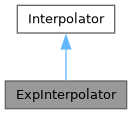
Inheritance diagram for ExpInterpolator:
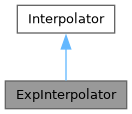
Collaboration diagram for ExpInterpolator:
Public Member Functions | |
| ~ExpInterpolator () override=default | |
| Destroy the object. | |
| ExpInterpolator (float fY0, float fY1, float fX0, float fX1, float fExponent) | |
| Construct an interpolator. | |
| void | Reset (float fY0, float fY1, float fX0, float fX1, float fExponent) |
| Replace the end points and the power. | |
| void | Reset (float fY0, float fY1, float fX0, float fX1) override |
| Replace the end points and preserve the power. | |
| float | Interp (float fX) override |
| Map an input along the curve. | |
| Public Member Functions inherited from Interpolator | |
| virtual | ~Interpolator () |
| Release the interpolator. | |
| virtual float | Eval (float fX) |
| Map an input, clamping it to the range first. | |
| float | GetY0 () const |
| float | GetY1 () const |
| float | GetX0 () const |
| float | GetX1 () const |
Additional Inherited Members | |
| Protected Attributes inherited from Interpolator | |
| float | mY0 |
| float | mY1 |
| float | mX0 |
| float | mX1 |
Detailed Description
Interpolator whose output follows a power of the input's position in the range.
The RTTI records the class as deriving from Interpolator. The object is 0x20 bytes.
Constructor & Destructor Documentation
◆ ~ExpInterpolator()
|
overridedefault |
Destroy the object.
- Ghidra address:
- NTSC-U/C: 0x003a86d0
- Ghidra address:
- PAL: 0x004173b0
◆ ExpInterpolator()
| ExpInterpolator::ExpInterpolator | ( | float | fY0, |
| float | fY1, | ||
| float | fX0, | ||
| float | fX1, | ||
| float | fExponent ) |
Construct an interpolator.
- Parameters
-
fY0 The output at the start of the range. fY1 The output at the end of the range. fX0 The start of the input range. fX1 The end of the input range. fExponent The power.
- Ghidra address:
- NTSC-U/C: 0x00291668
- Ghidra address:
- PAL: 0x0029b030
Member Function Documentation
◆ Reset() [1/2]
| void ExpInterpolator::Reset | ( | float | fY0, |
| float | fY1, | ||
| float | fX0, | ||
| float | fX1, | ||
| float | fExponent ) |
Replace the end points and the power.
An input range narrower than 1e-6 gives a scale of 1.
- Parameters
-
fY0 The output at the start of the range. fY1 The output at the end of the range. fX0 The start of the input range. fX1 The end of the input range. fExponent The power.
- Ghidra address:
- NTSC-U/C: 0x002916a0
- Ghidra address:
- PAL: 0x0029b068
◆ Reset() [2/2]
|
overridevirtual |
Replace the end points and preserve the power.
- Parameters
-
fY0 The output at the start of the range. fY1 The output at the end of the range. fX0 The start of the input range. fX1 The end of the input range.
- Ghidra address:
- NTSC-U/C: 0x002916f8
- Ghidra address:
- PAL: 0x0029b0c0
Implements Interpolator.
◆ Interp()
|
overridevirtual |
Map an input along the curve.
- Parameters
-
fX The input.
- Returns
- mY0 plus mRange times the input's position in the range raised to mExponent.
- Ghidra address:
- NTSC-U/C: 0x00291718
- Ghidra address:
- PAL: 0x0029b0e0
Implements Interpolator.
The documentation for this class was generated from the following file:
- src/math/interpolator.h