Tetris for UEFI













A Tetris clone that runs as a UEFI application. It uses the Graphics Output Protocol (GOP) at the firmware’s current mode, draws coloured tetrominoes with a back-buffered + Blt render path, includes a ghost-piece preview, and supports hold (store/recall). On game over you can start a new game or quit back to the firmware.
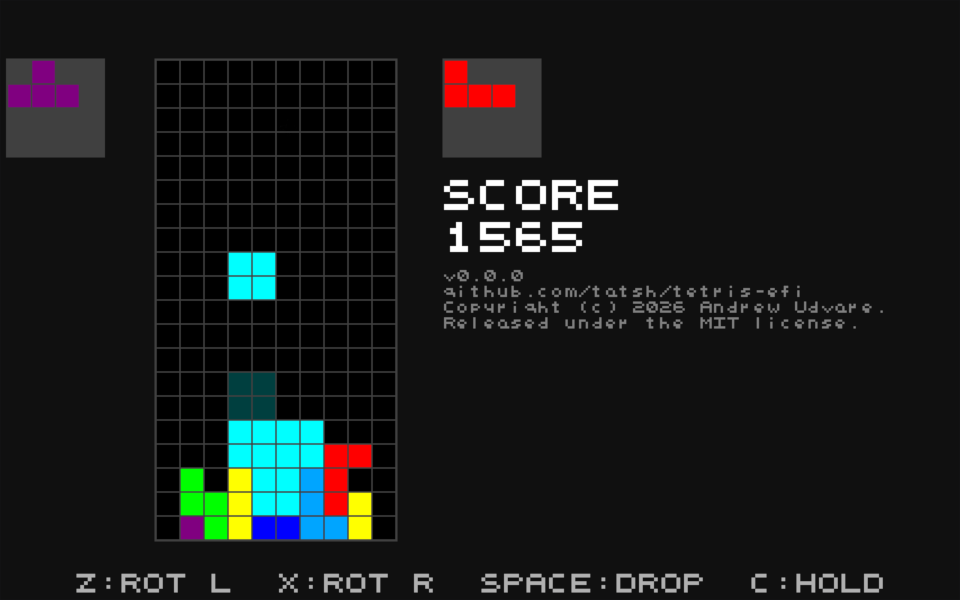
Based on hello-world-efi and Roderick W. Smith’s EFI programming examples.
Features
- GOP rendering - Double-buffered to RAM, pushed to the framebuffer with a single
Blt, so no flicker. - Coloured tetrominoes - I (cyan), O (yellow), T (purple), S (green), Z (red), J (blue), L (orange).
- Ghost piece - A dimmed preview of where the current piece will land on a hard drop.
- Hold (store/recall) - Press C to store the current piece or swap with the held piece (once per drop).
- In-game UI - Score, version + project URL, and on-screen controls hint, all drawn with a built-in 5x5 bitmap font.
- Game over - N for a new game, Q to quit to firmware.
Controls
Arrow keys move; the four actions also have keyboard alternatives.
| Action | Primary | Alternates |
|---|---|---|
| Move left | Left arrow | H |
| Move right | Right arrow | L |
| Soft drop | Down arrow | J |
| Hard drop | Up arrow, Space | K |
| Rotate left (CCW) | Z |
A |
| Rotate right (CW) | X |
S |
| Hold | C |
none |
How to build
Required tools: cmake, GNU EFI, mtools (mformat, mmd, mcopy), and an ISO 9660 builder
that supports -eltorito-platform efi (xorrisofs from xorriso, or mkisofs from cdrtools).
- Have
cmakein your PATH. - Install GNU EFI on your system.
- Clone this repository and open a terminal in its root.
mkdir build && cd buildcmake -G Ninja ..(orcmake ..for Make)ninja(ormake)
Output: tetris.efi and a minimal UEFI-bootable tetris.iso (~1.4 MB). The ISO contains a
single FAT EFI System Partition image carrying \EFI\BOOT\BOOTX64.EFI, exposed via El Torito
with platform ID 0xEF. UEFI firmware loads that file directly — no GRUB or other bootloader.
Project layout
src/- game code split intofont.{c,h},piece.{c,h},game.{c,h},loop.{c,h},render.{c,h}, plusmain.c(the EFI entry point).tests/- cmocka-based host tests.CMakeLists.txt- top-level build orchestration (compile, linktetris.efi, build the ISO, QEMU launcher target).
How to run in QEMU
From the build directory:
ninja run-qemu # or `make run-qemu`
The run-qemu CMake target auto-detects an installed OVMF firmware and boots tetris.iso.
How to run tests
Configure with -DBUILD_TESTS=ON and run ctest:
cmake -G Ninja -DBUILD_TESTS=ON ..
ninja
ctest --output-on-failure
Tests live in tests/ and use cmocka. Each test executable compiles the
relevant src/*.c files directly so cmocka --wrap can intercept gnu-efi calls without
linking the full libefi/libgnuefi runtime. Tests can only be built with GCC.