#include "math/vector3.h"
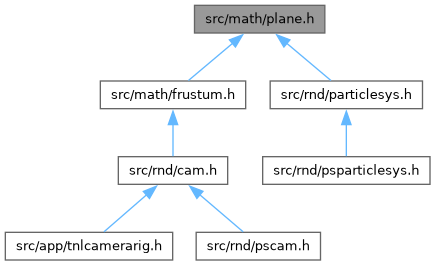
Go to the source code of this file.
Classes | |
| struct | Plane |
| Plane equation, padded to a PlayStation 2 quadword. More... | |
| struct | Segment |
| Two points that fix a line or a segment. More... | |
Functions | |
| Plane | TransformPlaneToWorld (const Plane &plane, const float *pXfm) |
| Move a plane out of the space a transform is expressed in. | |
| void | InterpolateFourFloats (const float *pFrom, const float *pTo, float *pOut, float flT) |
| Blend four consecutive floats linearly. | |
| bool | IntersectSegmentWithPlane (const Vector3 segment[2], const Plane &plane, float *pT) |
| Find where a segment crosses a plane. | |
| Segment | IntersectPlanes (const Plane &first, const Plane &second) |
| Find the line two planes meet along. | |
| Vector3 | IntersectPlanes (const Plane &first, const Plane &second, const Plane &third) |
| Find the point three planes meet at. | |
Function Documentation
◆ TransformPlaneToWorld()
Move a plane out of the space a transform is expressed in.
The normal is rotated by the three basis rows on VU0 in macro mode, and the distance becomes the original distance less the dot of the translation row with the rotated normal.
- Parameters
-
plane The plane, in the space the transform maps from. pXfm The transform, four rows of four floats.
- Returns
- The plane in the space the transform maps to.
- Ghidra address:
- NTSC-U/C: 0x00550fa8
- Ghidra address:
- PAL: 0x005915e8
◆ InterpolateFourFloats()
| void InterpolateFourFloats | ( | const float * | pFrom, |
| const float * | pTo, | ||
| float * | pOut, | ||
| float | flT ) |
Blend four consecutive floats linearly.
Each result is from + (to - from) * flT. TnlCameraRig::SetFrame() blends a camera screen rectangle with it. The title is inferred.
- Parameters
-
pFrom The four values at flT of 0. pTo The four values at flT of 1. pOut Receives the four blended values. flT The blend weight.
- Ghidra address:
- NTSC-U/C: 0x00551078
- Ghidra address:
- PAL: 0x005916b8
◆ IntersectSegmentWithPlane()
Find where a segment crosses a plane.
The parameter is the signed distance of the start divided by the difference between the signed distances of the start and the end. It is stored whether or not the segment crosses the plane.
- Parameters
-
segment The start and the end of the segment. plane The plane. pT Receives the crossing as a fraction of the way from the start to the end.
- Returns
- Whether the fraction lies in [0, 1].
- Ghidra address:
- NTSC-U/C: 0x00551218
- Ghidra address:
- PAL: 0x00591858
◆ IntersectPlanes() [1/2]
Find the line two planes meet along.
The direction is the cross product of the two normals, and the result is a point and that point plus the direction. The point comes from a segment test against pSecond whose start is the first normal scaled by the negated first distance and whose end is the cross product of the direction with the first normal. That end is a direction treated as a position. The point therefore lies on the second plane, and on the first only when the first distance is zero. The title is inferred.
- Parameters
-
first The first plane. second The second plane.
- Returns
- The point, then the point plus the direction.
- Ghidra address:
- NTSC-U/C: 0x0054fcf8
- Ghidra address:
- PAL: 0x00590338
◆ IntersectPlanes() [2/2]
Find the point three planes meet at.
The line of the first two planes from IntersectPlanes() is tested against the third, and the point is the one the segment test places at its fraction along that line. The shipped program does not call it. The title is inferred.
- Parameters
-
first The first plane. second The second plane. third The third plane.
- Returns
- The point.
- Ghidra address:
- NTSC-U/C: 0x005510e0
- Ghidra address:
- PAL: 0x00591720