#include "os/timer.h"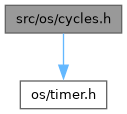
Go to the source code of this file.
Functions | |
| unsigned | ReadCycleCount () |
| Read the free-running cycle counter. | |
| int | GetElapsedMilliseconds () |
| Report the milliseconds elapsed since the machine started. | |
| int | GetMillisecondsPerSecond () |
| Report how many units GetElapsedMilliseconds() counts in one second. | |
Variables | |
| constexpr unsigned | kCyclesPerMillisecond = 294912 |
| EE clock in cycles per millisecond, which is the divisor the elapsed time is computed with. | |
| constexpr int | kMillisecondsPerSecond = 1000 |
| Milliseconds in one second, the rate GetMillisecondsPerSecond() reports. | |
Function Documentation
◆ ReadCycleCount()
| unsigned ReadCycleCount | ( | ) |
Read the free-running cycle counter.
Every caller in the image inlines the read, so the image has no out-of-line copy and there is no address to record. On the shipped target the read is the EE Count coprocessor register, which is the one genuinely machine-specific part of the timing instrumentation, so a port supplies its own implementation file for this declaration.
- Returns
- The counter, which wraps.
◆ GetElapsedMilliseconds()
|
inline |
Report the milliseconds elapsed since the machine started.
The body is here rather than in a source file because around thirty routines across the engine inline it, among them MainLoop::PumpTimers(), Sch::SystemTime::Mark(), and the per-frame slots of MetRenderer. Only one out-of-line copy exists, at the address below, and the two routines in the asynchronous file layer are its only callers.
The result is returned as an int and widened by its callers, which puts the ceiling at about 24 days of running time.
The name is inferred from the arithmetic. Nothing in the image attests it.
- Returns
- The elapsed milliseconds.
- Ghidra address:
- NTSC-U/C: 0x00466300
- Ghidra address:
- PAL: 0x004a3d30
◆ GetMillisecondsPerSecond()
|
inline |
Report how many units GetElapsedMilliseconds() counts in one second.
The body is here rather than in a source file for the reason recorded on GetElapsedMilliseconds(). Its one out-of-line copy follows that routine's copy directly, in the unit whose static initialiser is at 0x004662d0 and which also defines ShowReportedMessage(). HudScreenFlash's constructor calls that copy, and Sch::SystemTime divides its scale by the result.
The name is inferred from the value. Nothing in the image attests it.
- Returns
- 1000.
- Ghidra address:
- NTSC-U/C: 0x00466360
- Ghidra address:
- PAL: 0x004a3d90
Variable Documentation
◆ kCyclesPerMillisecond
|
constexpr |
EE clock in cycles per millisecond, which is the divisor the elapsed time is computed with.
◆ kMillisecondsPerSecond
|
constexpr |
Milliseconds in one second, the rate GetMillisecondsPerSecond() reports.