One queued command, together with the time the scheduler is to run it at. More...
#include <timedcommand.h>
Public Member Functions | |
| TimedCommand (Command *pCommand, Time tick, int bDelta) | |
| Wrap a command, taking a reference to it. | |
| TimedCommand () | |
| Construct an empty wrapper for Load() to fill. | |
| virtual | ~TimedCommand () |
| Give back the reference to the command and release the wrapper. | |
| void | Run () |
| Run the wrapped command. | |
| void | Print (std::ostream &stream) |
| Write a description of the wrapper to a diagnostic stream. | |
| void | Save (OBStream &stream) |
| Write the wrapper and the command it refers to. | |
| void | Load (IBStream &stream) |
| Read the wrapper and the command it refers to back. | |
| Public Member Functions inherited from Attachment | |
| Attachment () | |
| virtual | ~Attachment () |
| int | Release () |
| Give back one reference and destroy the object once the last one is gone. | |
| virtual void | Destroy () |
| Destroy the object. | |
Public Attributes | |
| Command * | mCommand |
| The command to run, or null. | |
| int | mOrder |
| Order among the wrappers that share one due tick. | |
| Time | mDueTick |
| Scheduler time the command is to run at. | |
| Time | mLocalTick |
| The tick the caller requested, in the caller's own clock frame. | |
| CmdID | mCmdID |
| Handle the queueing request was made under. | |
| Public Attributes inherited from Attachment | |
| int | mRefs |
Additional Inherited Members | |
| Static Public Member Functions inherited from Attachment | |
| static void | ReleaseIfSet (Attachment *pAttachment) |
| Give back one reference to an object that may be null. | |
Detailed Description
One queued command, together with the time the scheduler is to run it at.
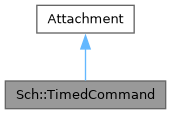
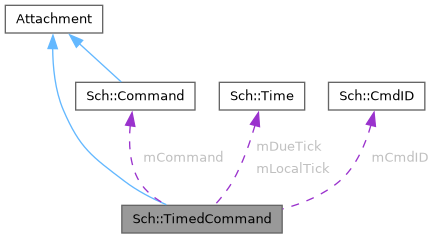
Its RTTI descriptor is at 0x008ef760. It derives publicly from Attachment at offset 0. Despite the shared prefix of the two names, this class does not derive from Sch::Command; the two are siblings under Attachment, and this one refers to a command rather than being one.
The vtable at 0x00835f08 runs three entries and then a zero entry. The class therefore declares one virtual of its own:
- 0, the compiler-generated type function at 0x005d31f0
- 1, the destructor at 0x005d33e8
- 2, Attachment::Destroy() at 0x004bfea8, inherited
Run(), Print(), Save(), and Load() are therefore ordinary members rather than virtuals, and all four are dispatched by a direct call.
An instance is 0x28 bytes. The allocation at 0x004a6284 and the seven writes of the constructor at 0x005d32f8 agree on the size. Every byte is accounted for and the layout closes, with no reserved run and no padding beyond the natural alignment of the two 8-byte members.
Print() at 0x005d30b0 recovers the original word for four members. It writes [, then mDueTick, then the literal local: at 0x00835ef0, then mLocalTick, then either abs at 0x00835ee0 or delta at 0x00835ee8, then id: at 0x00835ef8, then mCmdID, then a space, then the command, then ]. The names of mDueTick, mLocalTick, mDelta, and mCmdID come from those four literals; the name of mOrder alone comes from behaviour, because Print() does not write it.
Constructor & Destructor Documentation
◆ TimedCommand() [1/2]
Wrap a command, taking a reference to it.
The constructor writes mOrder, mDueTick, and mCmdID with -1. A wrapper that the scheduler has not yet queued therefore reports no due time, no order, and no handle.
The reference is taken by incrementing the command's Attachment reference count directly at 0x005d3338, because the image declares no AddRef. Reading and writing the count of an object whose class does not derive from this one is what makes Attachment::mRefs public.
The tick argument lands at mLocalTick rather than at mDueTick, and mDueTick starts at -1. The scheduler resolves the due time when it queues the wrapper.
- Parameters
-
pCommand The command to run, or null. tick The tick the caller requested, in the caller's own frame. bDelta Non-zero when the requested tick is a distance from now rather than an absolute scheduler time.
- Ghidra address:
- NTSC-U/C: 0x005d32f8
- Ghidra address:
- PAL: 0x00615360
◆ TimedCommand() [2/2]
|
inline |
Construct an empty wrapper for Load() to fill.
The image has no out-of-line copy. Playbacker::Load() expands it at 0x00594ad8, zeroing both ticks and writing -1 to mCmdID. mCommand, mOrder, and mDelta are not written.
◆ ~TimedCommand()
|
virtual |
Give back the reference to the command and release the wrapper.
- Ghidra address:
- NTSC-U/C: 0x005d33e8
- Ghidra address:
- PAL: 0x00615450
Member Function Documentation
◆ Run()
| void Sch::TimedCommand::Run | ( | ) |
Run the wrapped command.
The body dispatches Sch::Command::Execute() and does nothing else. The title is inferred from that body, and the scheduler run loop at 0x004aae68 is the one caller.
- Ghidra address:
- NTSC-U/C: 0x005d33b8
- Ghidra address:
- PAL: 0x00615420
◆ Print()
| void Sch::TimedCommand::Print | ( | std::ostream & | stream | ) |
Write a description of the wrapper to a diagnostic stream.
- Parameters
-
stream The stream to write to.
- Ghidra address:
- NTSC-U/C: 0x005d30b0
- Ghidra address:
- PAL: 0x006150f8
◆ Save()
| void Sch::TimedCommand::Save | ( | OBStream & | stream | ) |
Write the wrapper and the command it refers to.
- Parameters
-
stream The stream to write to.
- Ghidra address:
- NTSC-U/C: 0x005d3440
- Ghidra address:
- PAL: 0x006154a8
◆ Load()
| void Sch::TimedCommand::Load | ( | IBStream & | stream | ) |
Read the wrapper and the command it refers to back.
The order matches Save() field for field.
- Parameters
-
stream The stream to read from.
- Ghidra address:
- NTSC-U/C: 0x005d34d0
- Ghidra address:
- PAL: 0x00615538
Member Data Documentation
◆ mCommand
| Command* Sch::TimedCommand::mCommand |
The command to run, or null.
Public because the scheduler dereferences it directly. The deferred queueing path at 0x004ac764 marks the command as queued through it, and the run loop at 0x004aae84 clears that mark the same way.
+0x08
◆ mOrder
| int Sch::TimedCommand::mOrder |
Order among the wrappers that share one due tick.
The scheduler orders its queue by mDueTick first and by this member second, comparing it as an unsigned quantity at 0x004ac53c and 0x004ac5a0. A smaller value therefore runs earlier, and the -1 the constructor writes sorts last. Every queueing call site in the image supplies -1, at 0x004a6034, 0x004a6104, 0x004a61dc, 0x004a62c0, 0x004a63b0, 0x004a792c, and 0x004a7958, so the second key never changes the order in the shipped build. Public because the two queueing paths write it, at 0x004ac62c and 0x004ac70c.
The title is inferred from the comparison alone, because Print() does not write this member and no literal in the image identifies it.
+0x0c
◆ mDueTick
| Time Sch::TimedCommand::mDueTick |
Scheduler time the command is to run at.
Public because the scheduler writes it at 0x004ac634 and 0x004ac710, the run loop compares it against the clock at 0x004aa908 and copies it into the scheduler's current time at 0x004aae64, and the queue's ordering predicate reads it at 0x004ac518. The comparison stops the loop as soon as the earliest entry is still in the future.
+0x10
◆ mLocalTick
| Time Sch::TimedCommand::mLocalTick |
The tick the caller requested, in the caller's own clock frame.
Print() labels this member local:, which is what distinguishes it from mDueTick. The absolute queueing path at 0x004ac634 subtracts the requesting clock's origin to produce mDueTick, and the delta path at 0x004ac700 adds the scheduler's current time instead, so the two differ whenever the requesting clock has an origin of its own. Only the constructor writes this member, and only Print(), Save(), and Load() read it.
+0x18
◆ mCmdID
| CmdID Sch::TimedCommand::mCmdID |
Handle the queueing request was made under.
The constructor writes -1 and both queueing paths replace it with the caller's handle, at 0x004ac660 and 0x004ac73c, allocating a fresh value first when the caller's handle is still -2. Public because the scheduler writes it.
+0x24
The documentation for this class was generated from the following file:
- src/sch/timedcommand.h