Base of every C++ object the binding exposes to Python as an extension object. More...
#include <pythonextensionbase.h>
Public Member Functions | |
| virtual | ~PythonExtensionBase () |
| Destroy the object. | |
| virtual int | print (FILE *pFile, int nFlags) |
| Print the object. | |
| virtual Object | getattr (const char *pszName) |
| Read an attribute by name. | |
| virtual int | setattr (const char *pszName, const Object &value) |
| Write an attribute by name. | |
| virtual Object | getattro (const Object &name) |
| Read an attribute by name object. | |
| virtual int | setattro (const Object &name, const Object &value) |
| Write an attribute by name object. | |
| virtual int | compare (const Object &other) |
| Compare with another object. | |
| virtual Object | repr () |
| Produce the repr() text. | |
| virtual Object | str () |
| Produce the str() text. | |
| virtual Py_LONG | hash () |
| Produce the hash. | |
| virtual Object | call (const Object &args, const Object &keywords) |
| Call the object. | |
| virtual int | sequence_length () |
| Report the sequence length. | |
| virtual Object | sequence_concat (const Object &other) |
| Concatenate a sequence. | |
| virtual Object | sequence_repeat (int nCount) |
| Repeat the sequence. | |
| virtual Object | sequence_item (int nIndex) |
| Read one sequence element. | |
| virtual Object | sequence_slice (int nFirst, int nLast) |
| Read a sequence slice. | |
| virtual int | sequence_ass_item (int nIndex, const Object &value) |
| Write one sequence element. | |
| virtual int | sequence_ass_slice (int nFirst, int nLast, const Object &value) |
| Write a sequence slice. | |
| virtual int | mapping_length () |
| Report the mapping length. | |
| virtual Object | mapping_subscript (const Object &key) |
| Read one mapping entry. | |
| virtual int | mapping_ass_subscript (const Object &key, const Object &value) |
| Write one mapping entry. | |
| virtual int | number_nonzero () |
| Report whether the number is nonzero. | |
| virtual Object | number_negative () |
| Negate the number. | |
| virtual Object | number_positive () |
| Apply unary plus. | |
| virtual Object | number_absolute () |
| Produce the absolute value. | |
| virtual Object | number_invert () |
| Invert the bits. | |
| virtual Object | number_int () |
| Convert to an integer. | |
| virtual Object | number_float () |
| Convert to a float. | |
| virtual Object | number_long () |
| Convert to a long integer. | |
| virtual Object | number_oct () |
| Produce the octal text. | |
| virtual Object | number_hex () |
| Produce the hexadecimal text. | |
| virtual Object | number_add (const Object &other) |
| Add a number. | |
| virtual Object | number_subtract (const Object &other) |
| Subtract a number. | |
| virtual Object | number_multiply (const Object &other) |
| Multiply by a number. | |
| virtual Object | number_divide (const Object &other) |
| Divide by a number. | |
| virtual Object | number_remainder (const Object &other) |
| Produce the remainder. | |
| virtual Object | number_divmod (const Object &other) |
| Produce the quotient and remainder. | |
| virtual Object | number_lshift (const Object &other) |
| Shift left. | |
| virtual Object | number_rshift (const Object &other) |
| Shift right. | |
| virtual Object | number_and (const Object &other) |
| Apply bitwise and. | |
| virtual Object | number_xor (const Object &other) |
| Apply bitwise exclusive or. | |
| virtual Object | number_or (const Object &other) |
| Apply bitwise or. | |
| virtual Object | number_power (const Object &exponent, const Object &modulus) |
| Raise to a power. | |
| virtual int | buffer_getreadbuffer (int nSegment, void **ppData) |
| Expose a read buffer segment. | |
| virtual int | buffer_getwritebuffer (int nSegment, void **ppData) |
| Expose a write buffer segment. | |
| virtual int | buffer_getsegcount (int *pnLength) |
| Count the buffer segments. | |
Static Public Member Functions | |
| static int | print_handler (PyObject *self, FILE *pFile, int nFlags) |
| Forward tp_print to print(). | |
| static Py_LONG | hash_handler (PyObject *self) |
| Forward tp_hash to hash(). | |
| static int | sequence_length_handler (PyObject *self) |
| Forward sq_length to sequence_length(). | |
| static int | mapping_length_handler (PyObject *self) |
| Forward mp_length to mapping_length(). | |
| static int | number_nonzero_handler (PyObject *self) |
| Forward nb_nonzero to number_nonzero(). | |
| static int | buffer_getreadbuffer_handler (PyObject *self, int nSegment, void **ppData) |
| Forward bf_getreadbuffer to buffer_getreadbuffer(). | |
| static int | buffer_getwritebuffer_handler (PyObject *self, int nSegment, void **ppData) |
| Forward bf_getwritebuffer to buffer_getwritebuffer(). | |
| static int | buffer_getsegcount_handler (PyObject *self, int *pnLength) |
| Forward bf_getsegcount to buffer_getsegcount(). | |
| static PyObject * | sequence_concat_handler (PyObject *self, PyObject *other) |
| Forward sq_concat to sequence_concat(). | |
| static PyObject * | sequence_repeat_handler (PyObject *self, int nCount) |
| Forward sq_repeat to sequence_repeat(). | |
| static PyObject * | sequence_item_handler (PyObject *self, int nIndex) |
| Forward sq_item to sequence_item(). | |
| static PyObject * | sequence_slice_handler (PyObject *self, int nFirst, int nLast) |
| Forward sq_slice to sequence_slice(). | |
| static int | sequence_ass_item_handler (PyObject *self, int nIndex, PyObject *value) |
| Forward sq_ass_item to sequence_ass_item(). | |
| static int | sequence_ass_slice_handler (PyObject *self, int nFirst, int nLast, PyObject *value) |
| Forward sq_ass_slice to sequence_ass_slice(). | |
| static PyObject * | mapping_subscript_handler (PyObject *self, PyObject *key) |
| Forward mp_subscript to mapping_subscript(). | |
| static int | mapping_ass_subscript_handler (PyObject *self, PyObject *key, PyObject *value) |
| Forward mp_ass_subscript to mapping_ass_subscript(). | |
Detailed Description
Base of every C++ object the binding exposes to Python as an extension object.
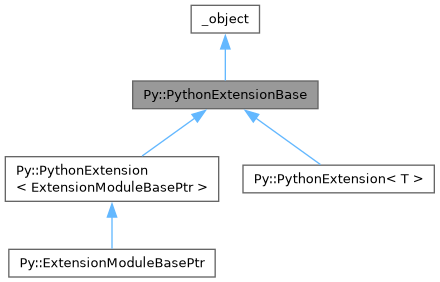
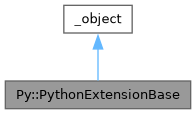
Its RTTI descriptor is at 0x008effc0. It has _object at offset 0 as its one base. Its accessor is at 0x005aba90, and the mangled name string sits at 0x00833418.
The base is the interpreter's own PyObject structure, which is what makes an instance usable from Python without a separate header block. Released PyCXX instead places the header inside PythonExtension<T> through the PyObject_HEAD macro, so the inheritance here is a difference between the shipped binding and the release rather than a reading of it.
_object has its own descriptor at 0x0086f6a8, with an accessor at 0x005ae738. That descriptor belongs to the interpreter and is excluded from reconstruction.
The vtable at 0x00833060 has 47 entries. Slot 0 is the compiler-generated type function, slot 1 the destructor, and slots 2 to 46 the protocol members below in released PyCXX's declaration order. Every protocol member is a default that calls missing_method(). A derived class responds only to the protocols it overrides. Slot 3, getattr(), is pure virtual in released PyCXX and has a default body here.
The static handlers are the PyTypeObject entry points for the members that return an integer. Each forwards to its member and turns a thrown Py::Exception into a return of 0.
Constructor & Destructor Documentation
◆ ~PythonExtensionBase()
|
inlinevirtual |
Destroy the object.
- Ghidra address:
- NTSC-U/C: 0x005abaf8
- Ghidra address:
- PAL: 0x005ee020
Member Function Documentation
◆ print()
|
virtual |
Print the object.
- Parameters
-
pFile The stream. nFlags The print flags.
- Returns
- 0.
- Ghidra address:
- NTSC-U/C: 0x005ac880
- Ghidra address:
- PAL: 0x005eeda8
◆ getattr()
|
virtual |
Read an attribute by name.
- Parameters
-
pszName The attribute name.
- Returns
- None.
- Ghidra address:
- NTSC-U/C: 0x005ac8a0
- Ghidra address:
- PAL: 0x005eedc8
◆ setattr()
|
virtual |
Write an attribute by name.
- Parameters
-
pszName The attribute name. value The value.
- Returns
- 0.
- Ghidra address:
- NTSC-U/C: 0x005ac900
- Ghidra address:
- PAL: 0x005eee28
◆ getattro()
Read an attribute by name object.
- Parameters
-
name The attribute name.
- Returns
- None.
- Ghidra address:
- NTSC-U/C: 0x005ac920
- Ghidra address:
- PAL: 0x005eee48
◆ setattro()
Write an attribute by name object.
- Parameters
-
name The attribute name. value The value.
- Returns
- 0.
- Ghidra address:
- NTSC-U/C: 0x005ac980
- Ghidra address:
- PAL: 0x005eeea8
◆ compare()
|
virtual |
Compare with another object.
- Parameters
-
other The other object.
- Returns
- 0.
- Ghidra address:
- NTSC-U/C: 0x005ac9a0
- Ghidra address:
- PAL: 0x005eeec8
◆ repr()
|
virtual |
Produce the repr() text.
- Returns
- None.
- Ghidra address:
- NTSC-U/C: 0x005ac9c0
- Ghidra address:
- PAL: 0x005eeee8
◆ str()
|
virtual |
Produce the str() text.
- Returns
- None.
- Ghidra address:
- NTSC-U/C: 0x005aca20
- Ghidra address:
- PAL: 0x005eef48
◆ hash()
|
virtual |
Produce the hash.
- Returns
- 0.
- Ghidra address:
- NTSC-U/C: 0x005aca80
- Ghidra address:
- PAL: 0x005eefa8
◆ call()
|
virtual |
Call the object.
- Parameters
-
args The positional arguments. keywords The keyword arguments.
- Returns
- None.
- Ghidra address:
- NTSC-U/C: 0x005acaa0
- Ghidra address:
- PAL: 0x005eefc8
◆ sequence_length()
|
virtual |
Report the sequence length.
- Returns
- 0.
- Ghidra address:
- NTSC-U/C: 0x005acb00
- Ghidra address:
- PAL: 0x005ef028
◆ sequence_concat()
Concatenate a sequence.
- Parameters
-
other The other sequence.
- Returns
- None.
- Ghidra address:
- NTSC-U/C: 0x005acb20
- Ghidra address:
- PAL: 0x005ef048
◆ sequence_repeat()
|
virtual |
Repeat the sequence.
- Parameters
-
nCount The repeat count.
- Returns
- None.
- Ghidra address:
- NTSC-U/C: 0x005acb80
- Ghidra address:
- PAL: 0x005ef0a8
◆ sequence_item()
|
virtual |
Read one sequence element.
- Parameters
-
nIndex The index.
- Returns
- None.
- Ghidra address:
- NTSC-U/C: 0x005acbe0
- Ghidra address:
- PAL: 0x005ef108
◆ sequence_slice()
|
virtual |
Read a sequence slice.
- Parameters
-
nFirst The first index. nLast The index past the slice.
- Returns
- None.
- Ghidra address:
- NTSC-U/C: 0x005acc40
- Ghidra address:
- PAL: 0x005ef168
◆ sequence_ass_item()
|
virtual |
Write one sequence element.
- Parameters
-
nIndex The index. value The value.
- Returns
- 0.
- Ghidra address:
- NTSC-U/C: 0x005acca0
- Ghidra address:
- PAL: 0x005ef1c8
◆ sequence_ass_slice()
|
virtual |
Write a sequence slice.
- Parameters
-
nFirst The first index. nLast The index past the slice. value The value.
- Returns
- 0.
- Ghidra address:
- NTSC-U/C: 0x005accc0
- Ghidra address:
- PAL: 0x005ef1e8
◆ mapping_length()
|
virtual |
Report the mapping length.
- Returns
- 0.
- Ghidra address:
- NTSC-U/C: 0x005acce0
- Ghidra address:
- PAL: 0x005ef208
◆ mapping_subscript()
Read one mapping entry.
- Parameters
-
key The key.
- Returns
- None.
- Ghidra address:
- NTSC-U/C: 0x005acd00
- Ghidra address:
- PAL: 0x005ef228
◆ mapping_ass_subscript()
|
virtual |
Write one mapping entry.
- Parameters
-
key The key. value The value.
- Returns
- 0.
- Ghidra address:
- NTSC-U/C: 0x005acd60
- Ghidra address:
- PAL: 0x005ef288
◆ number_nonzero()
|
virtual |
Report whether the number is nonzero.
- Returns
- 0.
- Ghidra address:
- NTSC-U/C: 0x005acd80
- Ghidra address:
- PAL: 0x005ef2a8
◆ number_negative()
|
virtual |
Negate the number.
- Returns
- None.
- Ghidra address:
- NTSC-U/C: 0x005acda0
- Ghidra address:
- PAL: 0x005ef2c8
◆ number_positive()
|
virtual |
Apply unary plus.
- Returns
- None.
- Ghidra address:
- NTSC-U/C: 0x005ace00
- Ghidra address:
- PAL: 0x005ef328
◆ number_absolute()
|
virtual |
Produce the absolute value.
- Returns
- None.
- Ghidra address:
- NTSC-U/C: 0x005ace60
- Ghidra address:
- PAL: 0x005ef388
◆ number_invert()
|
virtual |
Invert the bits.
- Returns
- None.
- Ghidra address:
- NTSC-U/C: 0x005acec0
- Ghidra address:
- PAL: 0x005ef3e8
◆ number_int()
|
virtual |
Convert to an integer.
- Returns
- None.
- Ghidra address:
- NTSC-U/C: 0x005acf20
- Ghidra address:
- PAL: 0x005ef448
◆ number_float()
|
virtual |
Convert to a float.
- Returns
- None.
- Ghidra address:
- NTSC-U/C: 0x005acf80
- Ghidra address:
- PAL: 0x005ef4a8
◆ number_long()
|
virtual |
Convert to a long integer.
- Returns
- None.
- Ghidra address:
- NTSC-U/C: 0x005acfe0
- Ghidra address:
- PAL: 0x005ef508
◆ number_oct()
|
virtual |
Produce the octal text.
- Returns
- None.
- Ghidra address:
- NTSC-U/C: 0x005ad040
- Ghidra address:
- PAL: 0x005ef568
◆ number_hex()
|
virtual |
Produce the hexadecimal text.
- Returns
- None.
- Ghidra address:
- NTSC-U/C: 0x005ad0a0
- Ghidra address:
- PAL: 0x005ef5c8
◆ number_add()
Add a number.
- Parameters
-
other The other operand.
- Returns
- None.
- Ghidra address:
- NTSC-U/C: 0x005ad100
- Ghidra address:
- PAL: 0x005ef628
◆ number_subtract()
Subtract a number.
- Parameters
-
other The other operand.
- Returns
- None.
- Ghidra address:
- NTSC-U/C: 0x005ad160
- Ghidra address:
- PAL: 0x005ef688
◆ number_multiply()
Multiply by a number.
- Parameters
-
other The other operand.
- Returns
- None.
- Ghidra address:
- NTSC-U/C: 0x005ad1c0
- Ghidra address:
- PAL: 0x005ef6e8
◆ number_divide()
Divide by a number.
- Parameters
-
other The other operand.
- Returns
- None.
- Ghidra address:
- NTSC-U/C: 0x005ad220
- Ghidra address:
- PAL: 0x005ef748
◆ number_remainder()
Produce the remainder.
- Parameters
-
other The other operand.
- Returns
- None.
- Ghidra address:
- NTSC-U/C: 0x005ad280
- Ghidra address:
- PAL: 0x005ef7a8
◆ number_divmod()
Produce the quotient and remainder.
- Parameters
-
other The other operand.
- Returns
- None.
- Ghidra address:
- NTSC-U/C: 0x005ad2e0
- Ghidra address:
- PAL: 0x005ef808
◆ number_lshift()
Shift left.
- Parameters
-
other The other operand.
- Returns
- None.
- Ghidra address:
- NTSC-U/C: 0x005ad340
- Ghidra address:
- PAL: 0x005ef868
◆ number_rshift()
Shift right.
- Parameters
-
other The other operand.
- Returns
- None.
- Ghidra address:
- NTSC-U/C: 0x005ad3a0
- Ghidra address:
- PAL: 0x005ef8c8
◆ number_and()
Apply bitwise and.
- Parameters
-
other The other operand.
- Returns
- None.
- Ghidra address:
- NTSC-U/C: 0x005ad400
- Ghidra address:
- PAL: 0x005ef928
◆ number_xor()
Apply bitwise exclusive or.
- Parameters
-
other The other operand.
- Returns
- None.
- Ghidra address:
- NTSC-U/C: 0x005ad460
- Ghidra address:
- PAL: 0x005ef988
◆ number_or()
Apply bitwise or.
- Parameters
-
other The other operand.
- Returns
- None.
- Ghidra address:
- NTSC-U/C: 0x005ad4c0
- Ghidra address:
- PAL: 0x005ef9e8
◆ number_power()
|
virtual |
Raise to a power.
- Parameters
-
exponent The exponent. modulus The modulus.
- Returns
- None.
- Ghidra address:
- NTSC-U/C: 0x005ad520
- Ghidra address:
- PAL: 0x005efa48
◆ buffer_getreadbuffer()
|
virtual |
Expose a read buffer segment.
- Parameters
-
nSegment The segment. ppData Receives the segment address.
- Returns
- 0.
- Ghidra address:
- NTSC-U/C: 0x005ad580
- Ghidra address:
- PAL: 0x005efaa8
◆ buffer_getwritebuffer()
|
virtual |
Expose a write buffer segment.
- Parameters
-
nSegment The segment. ppData Receives the segment address.
- Returns
- 0.
- Ghidra address:
- NTSC-U/C: 0x005ad5a0
- Ghidra address:
- PAL: 0x005efac8
◆ buffer_getsegcount()
|
virtual |
Count the buffer segments.
- Parameters
-
pnLength Receives the total length.
- Returns
- 0.
- Ghidra address:
- NTSC-U/C: 0x005ad5c0
- Ghidra address:
- PAL: 0x005efae8
◆ print_handler()
|
static |
Forward tp_print to print().
- Parameters
-
self The object. pFile The stream. nFlags The print flags.
- Returns
- The member's result, or 0 after a thrown Py::Exception.
- Ghidra address:
- NTSC-U/C: 0x005ac3c0
- Ghidra address:
- PAL: 0x005ee8e8
◆ hash_handler()
|
static |
Forward tp_hash to hash().
- Parameters
-
self The object.
- Returns
- The member's result, or 0 after a thrown Py::Exception.
- Ghidra address:
- NTSC-U/C: 0x005ac458
- Ghidra address:
- PAL: 0x005ee980
◆ sequence_length_handler()
|
static |
Forward sq_length to sequence_length().
- Parameters
-
self The object.
- Returns
- The member's result, or 0 after a thrown Py::Exception.
- Ghidra address:
- NTSC-U/C: 0x005ac4f0
- Ghidra address:
- PAL: 0x005eea18
◆ mapping_length_handler()
|
static |
Forward mp_length to mapping_length().
- Parameters
-
self The object.
- Returns
- The member's result, or 0 after a thrown Py::Exception.
- Ghidra address:
- NTSC-U/C: 0x005ac588
- Ghidra address:
- PAL: 0x005eeab0
◆ number_nonzero_handler()
|
static |
Forward nb_nonzero to number_nonzero().
- Parameters
-
self The object.
- Returns
- The member's result, or 0 after a thrown Py::Exception.
- Ghidra address:
- NTSC-U/C: 0x005ac620
- Ghidra address:
- PAL: 0x005eeb48
◆ buffer_getreadbuffer_handler()
|
static |
Forward bf_getreadbuffer to buffer_getreadbuffer().
- Parameters
-
self The object. nSegment The segment. ppData Receives the segment address.
- Returns
- The member's result, or 0 after a thrown Py::Exception.
- Ghidra address:
- NTSC-U/C: 0x005ac6b8
- Ghidra address:
- PAL: 0x005eebe0
◆ buffer_getwritebuffer_handler()
|
static |
Forward bf_getwritebuffer to buffer_getwritebuffer().
- Parameters
-
self The object. nSegment The segment. ppData Receives the segment address.
- Returns
- The member's result, or 0 after a thrown Py::Exception.
- Ghidra address:
- NTSC-U/C: 0x005ac750
- Ghidra address:
- PAL: 0x005eec78
◆ buffer_getsegcount_handler()
|
static |
Forward bf_getsegcount to buffer_getsegcount().
- Parameters
-
self The object. pnLength Receives the total length.
- Returns
- The member's result, or 0 after a thrown Py::Exception.
- Ghidra address:
- NTSC-U/C: 0x005ac7e8
- Ghidra address:
- PAL: 0x005eed10
◆ sequence_concat_handler()
|
static |
Forward sq_concat to sequence_concat().
- Parameters
-
self The object. other The other sequence.
- Returns
- A new reference to the member's result, or null after a thrown Py::Exception.
- Ghidra address:
- NTSC-U/C: 0x005a7258
- Ghidra address:
- PAL: 0x005e9768
◆ sequence_repeat_handler()
|
static |
Forward sq_repeat to sequence_repeat().
- Parameters
-
self The object. nCount The repeat count.
- Returns
- A new reference to the member's result, or null after a thrown Py::Exception.
- Ghidra address:
- NTSC-U/C: 0x005a7460
- Ghidra address:
- PAL: 0x005e9970
◆ sequence_item_handler()
|
static |
Forward sq_item to sequence_item().
- Parameters
-
self The object. nIndex The index.
- Returns
- A new reference to the member's result, or null after a thrown Py::Exception.
- Ghidra address:
- NTSC-U/C: 0x005a75a8
- Ghidra address:
- PAL: 0x005e9ab8
◆ sequence_slice_handler()
|
static |
Forward sq_slice to sequence_slice().
- Parameters
-
self The object. nFirst The first index. nLast The index past the slice.
- Returns
- A new reference to the member's result, or null after a thrown Py::Exception.
- Ghidra address:
- NTSC-U/C: 0x005a76f0
- Ghidra address:
- PAL: 0x005e9c00
◆ sequence_ass_item_handler()
|
static |
Forward sq_ass_item to sequence_ass_item().
- Parameters
-
self The object. nIndex The index. value The value.
- Returns
- The member's result, or 0 after a thrown Py::Exception.
- Ghidra address:
- NTSC-U/C: 0x005a7838
- Ghidra address:
- PAL: 0x005e9d48
◆ sequence_ass_slice_handler()
|
static |
Forward sq_ass_slice to sequence_ass_slice().
- Parameters
-
self The object. nFirst The first index. nLast The index past the slice. value The value.
- Returns
- The member's result, or 0 after a thrown Py::Exception.
- Ghidra address:
- NTSC-U/C: 0x005a79b8
- Ghidra address:
- PAL: 0x005e9ec8
◆ mapping_subscript_handler()
|
static |
Forward mp_subscript to mapping_subscript().
- Parameters
-
self The object. key The key.
- Returns
- A new reference to the member's result, or null after a thrown Py::Exception.
- Ghidra address:
- NTSC-U/C: 0x005a7b48
- Ghidra address:
- PAL: 0x005ea058
◆ mapping_ass_subscript_handler()
|
static |
Forward mp_ass_subscript to mapping_ass_subscript().
- Parameters
-
self The object. key The key. value The value.
- Returns
- The member's result, or 0 after a thrown Py::Exception.
- Ghidra address:
- NTSC-U/C: 0x005a7d50
- Ghidra address:
- PAL: 0x005ea260
The documentation for this class was generated from the following file:
- src/script/cxx/pythonextensionbase.h