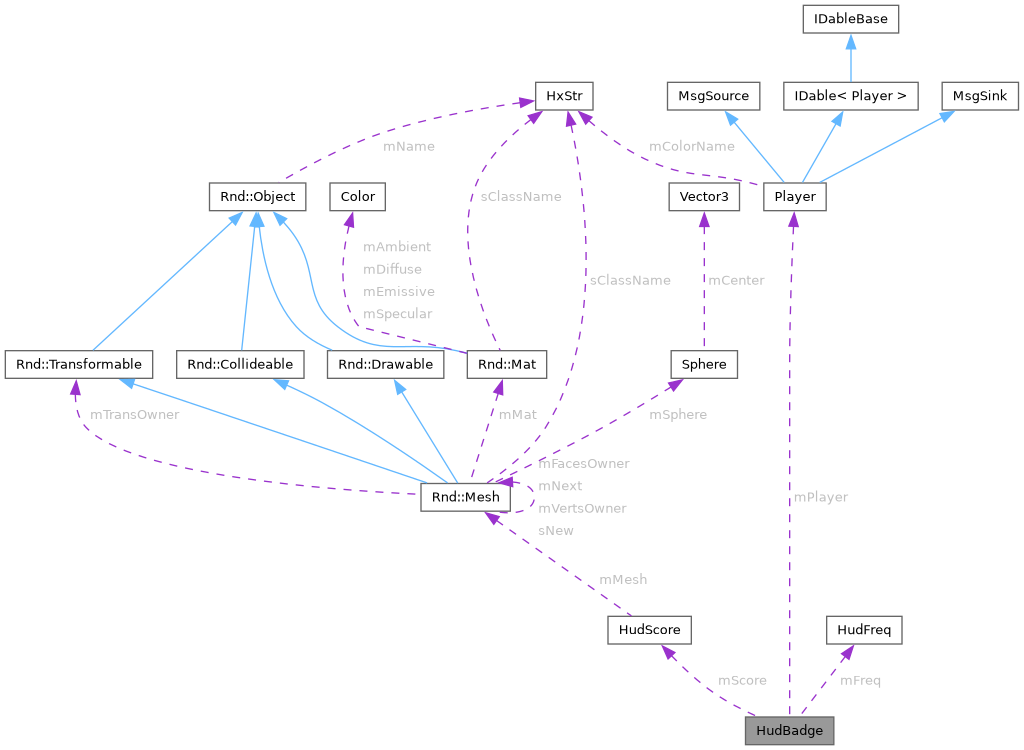
One player's badge on the head-up display, a score readout over a FreQ icon. More...
#include <hudbadge.h>
Public Member Functions | |
| HudBadge (Player *pPlayer, int nIndex) | |
| Build the badge for one player. | |
| void | SetFrame (float flFrame, float flTime) |
| Advance the icon to the song position and redraw a settled score. | |
Public Attributes | |
| HudScore | mScore |
| HudFreq | mFreq |
| Player * | mPlayer |
Detailed Description
One player's badge on the head-up display, a score readout over a FreQ icon.
The class is not polymorphic and emits no RTTI. Overlay allocates one per world player with the untagged scalar allocator (0x2c bytes, the size its constructor requests at 0x0041cfd4) and stores the pointers in its vector at +0x14. Overlay's destructor releases them with the scalar free and runs no destructor, and the class therefore declares none. No descriptor, tag, or file path identifies the class, and its name is inferred from its two parts.
Overlay's constructor inlines the constructor. The members are public because code outside the class accesses them directly. Overlay looks a badge up by mPlayer and marks the leader through mFreq, and HudScorePulse reads the position of mScore's mesh.
Constructor & Destructor Documentation
◆ HudBadge()
| HudBadge::HudBadge | ( | Player * | pPlayer, |
| int | nIndex ) |
Build the badge for one player.
Overlay::Overlay() inlines the body, and this copy has no caller.
- Parameters
-
pPlayer The player the badge shows. nIndex The badge number, counted over the world's players from 0.
- Ghidra address:
- NTSC-U/C: 0x0042ac58
- Ghidra address:
- PAL: 0x00465fa8
Member Function Documentation
◆ SetFrame()
| void HudBadge::SetFrame | ( | float | flFrame, |
| float | flTime ) |
Advance the icon to the song position and redraw a settled score.
- Parameters
-
flFrame The song position, in MIDI ticks. flTime The time HudScore::Update() compares against.
- Ghidra address:
- NTSC-U/C: 0x0041c0f8
- Ghidra address:
- PAL: 0x00466008
Member Data Documentation
◆ mScore
| HudScore HudBadge::mScore |
The score readout. +0x00
◆ mFreq
| HudFreq HudBadge::mFreq |
The FreQ icon. +0x10
◆ mPlayer
| Player* HudBadge::mPlayer |
The player the badge shows. +0x28
The documentation for this class was generated from the following file:
- src/app/hudbadge.h