Owner of the display, the GIF packet buffer, and the frame timing counters. More...
#include <gfxdevice.h>
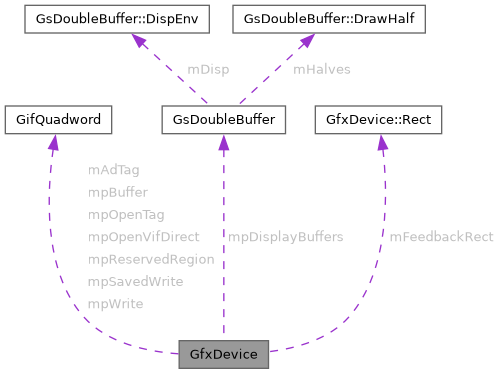
Classes | |
| struct | Rect |
| Rectangle of four floats. More... | |
Public Member Functions | |
| GfxDevice () | |
| Construct the device with an empty packet and the default feedback and clear settings. | |
| ~GfxDevice () | |
| Undo what Init() installs. | |
| void | Terminate () |
| Restore the base render class factories that Init() replaced. | |
| void | ResetVramAndSavePacket () |
| Release every video memory record and save the packet under construction. | |
| void | SavePacket () |
| Wait for the GIF and VIF1 channels to stop, then copy the packet into mSavedPacket. | |
| void | RestorePacket () |
| Copy mSavedPacket back over the packet buffer, for the length SavePacket() used. | |
| void | Init (int nWidth, int nHeight, int nBitDepth) |
| Bring up the display and the drawing subsystems. | |
| void | BeginFrame () |
| Start a frame. | |
| void | PresentFrame (int nSwapBuffers) |
| Finish a frame and show it. | |
| void | InitDisplayMode () |
| Program the GS display registers for the recorded geometry. | |
| int | GetReservedVramWords () const |
| Words of video memory the display and depth buffers occupy. | |
| void | SetGsReg (int nReg, unsigned long long qwValue, unsigned long long qwMask) |
| Set the masked part of one GS register, unless it already agrees. | |
| void | ReserveGifSpace (int nQuadwords) |
| Divert writes into a region carved off the end of the packet buffer. | |
| void | SwapGifWrite () |
| Exchange the write pointer with the one the reservation preserved. | |
| void | FlushReservedGif () |
| Copy the reserved region into the main stream and close the reservation. | |
| void | CloseGifTag (int bEndOfPacket) |
| Fill in the loop count of the open GIFtag, and optionally end the packet. | |
| void | WriteGifTag (const GifQuadword *pTag) |
| Start a GIFtag at the write pointer. | |
| int | FlushGifPacket (int bRetainOpenTag, int bOnlyWhenFull) |
| Send the assembled packet and move to the other scratchpad half. | |
| void | EnterVu1Path () |
| Route later packets through VIF1 and VU1 rather than straight to the GIF. | |
| void | LeaveVu1Path () |
| Return to sending packets straight to the GIF. | |
| void | RestoreFrameBufferTarget () |
| Point FRAME_1 and XYOFFSET_1 back at the display buffer being drawn. | |
| void | SetClearColor (const Color &color) |
| Record the colour both halves of the double buffer clear to. | |
| void | DrawRenderStatsOverlay () |
| Draw the render statistics as debug text. | |
| void | DrawSubsystemTimingGraph (int nFullScaleMs) |
| Draw one bar per profiler timer, scaled against a full-scale time. | |
| void | SetupGsDrawContext () |
| Blend the displayed frame back over the frame being drawn. | |
| void | FlipFrameBuffer () |
| Put the draw environment of the current half, then run SwapBuffers(). | |
Public Attributes | |
| GifQuadword * | mpWrite |
| Where the next quadword is written. | |
| GifQuadword * | mpBuffer |
| Scratchpad half currently being filled. | |
| GifQuadword * | mpSavedWrite |
| Write pointer preserved across a reservation. | |
| GifQuadword * | mpReservedRegion |
| Start of the reserved region, or null when none is open. | |
| std::vector< GifQuadword > | mSavedPacket |
| Copy of the packet under construction, filled by SavePacket(). | |
| GifQuadword * | mpOpenTag |
| GIFtag whose loop count is still to be filled in, or null when none is open. | |
| int | mnDisplayWidth |
| Display width in pixels, as Init() recorded it. | |
| int | mnDisplayHeight |
| Display height in pixels. | |
| int | mnPixelBytes |
| Framebuffer bytes per pixel, the Init() bit depth divided by 8. | |
| int | mnDepthBytes |
| Depth buffer bytes per sample, which InitDisplayMode() derives from mnPixelBytes. | |
| GifQuadword | mAdTag |
| A+D GIFtag SetGsReg() opens when the open tag is not already an A+D tag. | |
| unsigned long long | mGsRegs [kGsRegisterCount] |
| Last value written to each GS register, indexed by register number. | |
| int | mnSwapVblank |
| Vertical blank count before which SwapBuffers() does not show the next frame. | |
| int | mnDrawBuffer |
| Half of the double buffer being drawn, which RestoreFrameBufferTarget() selects by. | |
| GsDoubleBuffer * | mpDisplayBuffers |
| Double buffer InitDisplayMode() builds at 0x006f36c0, addressed through its uncached alias. | |
| int | mnUseVu1 |
| Non-zero while geometry is submitted through VU1 rather than the software path. | |
| GifQuadword * | mpOpenVifDirect |
| First quadword after the VIF DIRECT code that WriteGifTag() opened, or null. | |
| int | mFeedbackEnabled |
| Non-zero while the feedback effect is enabled, stored as a whole word. | |
| Rect | mFeedbackRect |
| Rectangle SetupGsDrawContext() draws and samples, in fractions of the display. | |
| float | mFeedbackAlpha |
| Blend factor SetupGsDrawContext() writes into ALPHA_1 FIX after scaling it by 128. | |
| int | mFeedbackInset |
| Inset of the texture window at both corners, in sixteenths of a texel. | |
Detailed Description
Owner of the display, the GIF packet buffer, and the frame timing counters.
The class is not polymorphic and has no RTTI. Its name is inferred from its methods. They build GIF packets, set GS registers, and flip the framebuffer.
Packets are assembled in PlayStation 2 scratchpad memory and double buffered between 0x70000000 and 0x70002000, the two halves of the 16 KiB region. Submitting a packet kicks a DMA channel at the half just filled and moves the write pointer to the other half. The next packet is therefore built while the previous one is in flight. The address given to the DMA controller is derived from the buffer base by moving bit 30 up to bit 31, the scratchpad flag.
Constructor & Destructor Documentation
◆ GfxDevice()
| GfxDevice::GfxDevice | ( | ) |
Construct the device with an empty packet and the default feedback and clear settings.
mSavedPacket is sized to 0x200 zeroed quadwords, the size of one scratchpad half. The feedback rectangle covers the whole display at an alpha of 0.78, the clear colour is opaque black, and mAdTag becomes an A+D GIFtag with one register and no loops.
- Ghidra address:
- NTSC-U/C: 0x0049ac50
- Ghidra address:
- PAL: 0x004d8bd0
◆ ~GfxDevice()
|
inline |
Undo what Init() installs.
The unit's static initialiser runs Terminate() on Rnd::ThePs and then destroys mSavedPacket, which identifies the destructor as inline around the call.
Member Function Documentation
◆ Terminate()
| void GfxDevice::Terminate | ( | ) |
Restore the base render class factories that Init() replaced.
Every hook Init() pointed at a PlayStation 2 factory is pointed back at its base factory and the base class is registered again under the same key. Rnd::PsCam's teardown also destroys the default camera, and Rnd::PsEnviron's is called rather than inlined. The routine ends by calling Rnd::TheVRAM's destructor explicitly. The name is inferred.
- Ghidra address:
- NTSC-U/C: 0x0049afe0
- Ghidra address:
- PAL: 0x004d8ff8
◆ ResetVramAndSavePacket()
| void GfxDevice::ResetVramAndSavePacket | ( | ) |
Release every video memory record and save the packet under construction.
MetSonyScreen calls it before handing the display to another renderer. The name is inferred.
- Ghidra address:
- NTSC-U/C: 0x0049fef0
- Ghidra address:
- PAL: 0x004ddf78
◆ SavePacket()
| void GfxDevice::SavePacket | ( | ) |
Wait for the GIF and VIF1 channels to stop, then copy the packet into mSavedPacket.
The length copied is the whole quadwords between mpBuffer and mpWrite. The name is inferred.
- Ghidra address:
- NTSC-U/C: 0x0049ff28
- Ghidra address:
- PAL: 0x004ddfb0
◆ RestorePacket()
| void GfxDevice::RestorePacket | ( | ) |
Copy mSavedPacket back over the packet buffer, for the length SavePacket() used.
InitDisplayMode() is the one caller. The name is inferred.
- Ghidra address:
- NTSC-U/C: 0x0049ff98
- Ghidra address:
- PAL: 0x004de020
◆ Init()
| void GfxDevice::Init | ( | int | nWidth, |
| int | nHeight, | ||
| int | nBitDepth ) |
Bring up the display and the drawing subsystems.
Labels g_profileTimers records 8 to 13 "setup", "vram", "billboard", "vert", "prim", and "sync", records the display geometry with mnPixelBytes as nBitDepth / 8, points the packet buffer at the first scratchpad half, and runs InitDisplayMode(). The PAL build instead rounds the width down to 640, 512, 384, or 256 and the height down to 512, 448, 256, or 224, chooses NTSC output for 448 and 224 and PAL output otherwise, and takes two bytes a pixel for a depth under 32 bits and four otherwise. It then installs the PlayStation 2 creators for meshes, cameras, materials, textures, environments, particle systems, and multi-meshes, and initialises Rnd::TheVRAM.
- Parameters
-
nWidth The display width in pixels. nHeight The display height in pixels. nBitDepth The framebuffer depth in bits.
- Ghidra address:
- NTSC-U/C: 0x0049ae20
- Ghidra address:
- PAL: 0x004d8da0
◆ BeginFrame()
| void GfxDevice::BeginFrame | ( | ) |
Start a frame.
Runs SwapBuffers(), clears g_renderStats, draws Rnd::PsCam::sDefault, selects the default material, and starts the video memory frame. The timers of the frame just ended are copied into g_lastFrameProfileTimers, and every record of g_profileTimers then has its cycles and depth cleared.
- Ghidra address:
- NTSC-U/C: 0x0049b930
- Ghidra address:
- PAL: 0x004d9950
◆ PresentFrame()
| void GfxDevice::PresentFrame | ( | int | nSwapBuffers | ) |
Finish a frame and show it.
Draws the feedback effect when mFeedbackEnabled is set, submits the packet, and ends the video memory frame. A swap then runs SwapBuffers() and inverts mnDrawBuffer once more.
- Parameters
-
nSwapBuffers Non-zero to flip the framebuffer.
- Ghidra address:
- NTSC-U/C: 0x0049bac8
- Ghidra address:
- PAL: 0x004d9ae8
◆ InitDisplayMode()
| void GfxDevice::InitDisplayMode | ( | ) |
Program the GS display registers for the recorded geometry.
Every register shadow is set to all ones (FOGCOL's to 1), and the GS, the DMA controller, and the display are reset for NTSC interlaced field output (in the PAL build, PAL output unless mnNtscOutput is set). The pixel depth selects the frame and depth buffer formats and mnDepthBytes; a depth other than 16, 24, or 32 bits reports "Unsupported video mode" and falls back to 32. The double buffer is then built and shown, the vertical blank handler installed, the saved packet restored, and the VU0 and VU1 microcode sent before VU1 runs its program at 0x3c0.
- Ghidra address:
- NTSC-U/C: 0x0049b138
- Ghidra address:
- PAL: 0x004d9150
◆ GetReservedVramWords()
| int GfxDevice::GetReservedVramWords | ( | ) | const |
Words of video memory the display and depth buffers occupy.
Rnd::VRAM::Init() divides the result by the words in a block to find where the palette region begins. The depth buffer page, at 2048 words a page, locates the end of both frame buffers, and the display geometry at mnDepthBytes a pixel adds the depth buffer itself.
- Returns
- Words in use, at four bytes each.
- Ghidra address:
- NTSC-U/C: 0x0049fec0
- Ghidra address:
- PAL: 0x004ddf48
◆ SetGsReg()
| void GfxDevice::SetGsReg | ( | int | nReg, |
| unsigned long long | qwValue, | ||
| unsigned long long | qwMask ) |
Set the masked part of one GS register, unless it already agrees.
The device shadows every GS register in an array of 64-bit words, indexed by register number, and compares the masked incoming value against the shadow before emitting anything. A write that would not change the masked bits is dropped. Callers therefore pass a mask covering only the field they mean to set rather than the whole register.
A write that does change the register opens an A+D GIFtag from mAdTag unless the open tag is already one, and then submits the buffer if it has filled. Setting PRIM to a line strip, a triangle strip, or a triangle fan leaves the shadow's primitive type at 7, a value no caller sets. The next PRIM write therefore always reaches the GS and starts a new strip.
- Parameters
-
nReg The GS register number. qwValue The value to set, of which only the masked bits are used. qwMask The bits of the register this call owns.
- Ghidra address:
- NTSC-U/C: 0x0049ffd0
- Ghidra address:
- PAL: 0x004de058
◆ ReserveGifSpace()
| void GfxDevice::ReserveGifSpace | ( | int | nQuadwords | ) |
Divert writes into a region carved off the end of the packet buffer.
The region begins where the requested number of quadwords ends the buffer. The current write pointer is preserved for SwapGifWrite() to return to. A second reservation while one is open does nothing, and the whole routine does nothing while the software path is selected.
A caller reserves space, programs its registers into the region, swaps back to the main stream to append the bulk data, and finally splices the region in with FlushReservedGif(). That order exists because the register writes are only known to be needed once the bulk data has been measured.
- Parameters
-
nQuadwords The space to reserve.
- Ghidra address:
- NTSC-U/C: 0x0049fd98
- Ghidra address:
- PAL: 0x004dde20
◆ SwapGifWrite()
| void GfxDevice::SwapGifWrite | ( | ) |
Exchange the write pointer with the one the reservation preserved.
Calling it twice returns to where it started. That is how a caller alternates between the reserved region and the main stream. It does nothing unless a reservation is open.
- Ghidra address:
- NTSC-U/C: 0x0049fe08
- Ghidra address:
- PAL: 0x004dde90
◆ FlushReservedGif()
| void GfxDevice::FlushReservedGif | ( | ) |
Copy the reserved region into the main stream and close the reservation.
The quadword count comes from how far the region's own write pointer advanced. Nothing is copied when the region is empty, and the reservation is closed either way.
- Ghidra address:
- NTSC-U/C: 0x0049fe38
- Ghidra address:
- PAL: 0x004ddec0
◆ CloseGifTag()
| void GfxDevice::CloseGifTag | ( | int | bEndOfPacket | ) |
Fill in the loop count of the open GIFtag, and optionally end the packet.
The count is the quadwords written after the tag divided by the registers each loop consumes. That divisor is the tag's own NREG shifted right by its FLG. The same expression is correct for all three formats. A packed loop spends one quadword per register, a register list spends one per two, and an image loop spends one per four.
Ending the packet on the VU1 path also fills in the count of the open VIF DIRECT code.
- Parameters
-
bEndOfPacket Non-zero to set the tag's end-of-packet bit.
- Ghidra address:
- NTSC-U/C: 0x004a0158
- Ghidra address:
- PAL: 0x004de1e0
◆ WriteGifTag()
| void GfxDevice::WriteGifTag | ( | const GifQuadword * | pTag | ) |
Start a GIFtag at the write pointer.
The open tag is closed first without the end-of-packet bit. On the VU1 path a VIF DIRECT code goes ahead of the tag unless one is already open.
- Parameters
-
pTag The tag to write, whose loop count CloseGifTag() fills in later.
- Ghidra address:
- NTSC-U/C: 0x0049b5a8
- Ghidra address:
- PAL: 0x004d95c8
◆ FlushGifPacket()
| int GfxDevice::FlushGifPacket | ( | int | bRetainOpenTag, |
| int | bOnlyWhenFull ) |
Send the assembled packet and move to the other scratchpad half.
Closes the open tag with the end-of-packet bit, then kicks VIF1 while the VU1 path is selected and the GIF otherwise. An empty buffer is not sent. Retaining the open tag reopens it in the new half, letting a caller submit in the middle of a primitive.
Every submission advances the video memory cache to its next lock generation and then runs the long operation poll callback through RunLongOperationPollProc().
- Parameters
-
bRetainOpenTag Non-zero to reopen the current tag in the new buffer half. bOnlyWhenFull Non-zero to submit only once the buffer is full.
- Returns
- Non-zero when a packet was sent.
- Ghidra address:
- NTSC-U/C: 0x0049b478
- Ghidra address:
- PAL: 0x004d9498
◆ EnterVu1Path()
| void GfxDevice::EnterVu1Path | ( | ) |
Route later packets through VIF1 and VU1 rather than straight to the GIF.
Does nothing when the VU1 path is already selected. Otherwise it submits whatever the buffer has before switching, because a packet built for one path cannot be sent down the other.
- Ghidra address:
- NTSC-U/C: 0x004a0348
- Ghidra address:
- PAL: 0x004de3d0
◆ LeaveVu1Path()
| void GfxDevice::LeaveVu1Path | ( | ) |
Return to sending packets straight to the GIF.
Does nothing unless the VU1 path is selected. Otherwise it ends the open tag, submits the buffer, and waits for the GS paths to drain before switching.
- Ghidra address:
- NTSC-U/C: 0x0049b838
- Ghidra address:
- PAL: 0x004d9858
◆ RestoreFrameBufferTarget()
| void GfxDevice::RestoreFrameBufferTarget | ( | ) |
Point FRAME_1 and XYOFFSET_1 back at the display buffer being drawn.
Rnd::PsCam::DrawShowing() calls it when the previous camera drew into a texture. Both values come from the draw environment of the half mnDrawBuffer selects, and the binary open-codes the body of SetGsReg() for each.
- Ghidra address:
- NTSC-U/C: 0x0049b6b8
- Ghidra address:
- PAL: 0x004d96d8
◆ SetClearColor()
| void GfxDevice::SetClearColor | ( | const Color & | color | ) |
Record the colour both halves of the double buffer clear to.
Stores the colour in mClearColor and writes it into the RGBAQ pair of each half's clear, red, green, and blue scaled by 255, alpha by 128, and Q at 1.0. The data cache is then written back, because the double buffer is read through its uncached alias.
- Parameters
-
color The clear colour, each component from 0 to 1.
- Ghidra address:
- NTSC-U/C: 0x0049b368
- Ghidra address:
- PAL: 0x004d9388
◆ DrawRenderStatsOverlay()
| void GfxDevice::DrawRenderStatsOverlay | ( | ) |
Draw the render statistics as debug text.
One line each for the frame rate and for every RenderStats counter, then the kilobytes of texture the VRAM table uploaded in the last frame.
- Ghidra address:
- NTSC-U/C: 0x0049bec8
- Ghidra address:
- PAL: 0x004d9ee8
◆ DrawSubsystemTimingGraph()
| void GfxDevice::DrawSubsystemTimingGraph | ( | int | nFullScaleMs | ) |
Draw one bar per profiler timer, scaled against a full-scale time.
- Parameters
-
nFullScaleMs Milliseconds a bar spanning 95 per cent of the display width stands for.
- Ghidra address:
- NTSC-U/C: 0x0049c778
- Ghidra address:
- PAL: 0x004da798
◆ SetupGsDrawContext()
| void GfxDevice::SetupGsDrawContext | ( | ) |
Blend the displayed frame back over the frame being drawn.
Disables the depth test and depth writes, sets ALPHA_1 to blend by mFeedbackAlpha, and binds the frame buffer of the half not being drawn as a 1024 by 1024 texture. It then draws one sprite over mFeedbackRect that samples the same rectangle of the texture, inset by mFeedbackInset at both corners. The title covers only the register setup, although the routine also draws. Renderer::Draw() calls it while g_nLsdMode is set.
- Ghidra address:
- NTSC-U/C: 0x0049ccb8
- Ghidra address:
- PAL: 0x004dacd8
◆ FlipFrameBuffer()
| void GfxDevice::FlipFrameBuffer | ( | ) |
Put the draw environment of the current half, then run SwapBuffers().
InitDisplayMode() and MetLoadGameScreen::OnFadeInDone() at 0x0028e118 are the callers.
- Ghidra address:
- NTSC-U/C: 0x004a0388
- Ghidra address:
- PAL: 0x004de410
Member Data Documentation
◆ mpWrite
| GifQuadword* GfxDevice::mpWrite |
Where the next quadword is written.
◆ mpBuffer
| GifQuadword* GfxDevice::mpBuffer |
Scratchpad half currently being filled.
◆ mpSavedWrite
| GifQuadword* GfxDevice::mpSavedWrite |
Write pointer preserved across a reservation.
◆ mpReservedRegion
| GifQuadword* GfxDevice::mpReservedRegion |
Start of the reserved region, or null when none is open.
◆ mSavedPacket
| std::vector<GifQuadword> GfxDevice::mSavedPacket |
Copy of the packet under construction, filled by SavePacket().
+0x10
◆ mpOpenTag
| GifQuadword* GfxDevice::mpOpenTag |
GIFtag whose loop count is still to be filled in, or null when none is open.
◆ mnDisplayWidth
| int GfxDevice::mnDisplayWidth |
Display width in pixels, as Init() recorded it.
Rnd::PsCam::ScreenToPixels() reads it.
◆ mnDisplayHeight
| int GfxDevice::mnDisplayHeight |
Display height in pixels.
Read alongside the width by the same routine.
◆ mnPixelBytes
| int GfxDevice::mnPixelBytes |
Framebuffer bytes per pixel, the Init() bit depth divided by 8.
+0x28
◆ mnDepthBytes
| int GfxDevice::mnDepthBytes |
Depth buffer bytes per sample, which InitDisplayMode() derives from mnPixelBytes.
Rnd::PsCam::DrawShowing() reads it to find the largest depth value. +0x2c
◆ mAdTag
| GifQuadword GfxDevice::mAdTag |
A+D GIFtag SetGsReg() opens when the open tag is not already an A+D tag.
+0x30
◆ mGsRegs
| unsigned long long GfxDevice::mGsRegs[kGsRegisterCount] |
Last value written to each GS register, indexed by register number.
+0x40
◆ mnSwapVblank
| int GfxDevice::mnSwapVblank |
Vertical blank count before which SwapBuffers() does not show the next frame.
InitDisplayMode() and SwapBuffers() set it to one past the current count. +0x440
◆ mnDrawBuffer
| int GfxDevice::mnDrawBuffer |
Half of the double buffer being drawn, which RestoreFrameBufferTarget() selects by.
+0x444
◆ mpDisplayBuffers
| GsDoubleBuffer* GfxDevice::mpDisplayBuffers |
Double buffer InitDisplayMode() builds at 0x006f36c0, addressed through its uncached alias.
GetReservedVramWords() reads the depth buffer page from it. +0x448
◆ mnUseVu1
| int GfxDevice::mnUseVu1 |
Non-zero while geometry is submitted through VU1 rather than the software path.
+0x44c
◆ mpOpenVifDirect
| GifQuadword* GfxDevice::mpOpenVifDirect |
First quadword after the VIF DIRECT code that WriteGifTag() opened, or null.
On the VU1 path every run of GIF data travels inside a DIRECT code, whose immediate is the quadword count that follows it. WriteGifTag() writes the code with a count of zero, and CloseGifTag() with the end-of-packet bit fills the count in from this pointer. +0x450
◆ mFeedbackEnabled
| int GfxDevice::mFeedbackEnabled |
Non-zero while the feedback effect is enabled, stored as a whole word.
Written directly, with no accessor, by the panel's count-in component at 0x0041bc50, which sets and clears it during the song intro, and cleared by Overlay's destructor at 0x0041daec. +0x468
◆ mFeedbackRect
| Rect GfxDevice::mFeedbackRect |
Rectangle SetupGsDrawContext() draws and samples, in fractions of the display.
Renderer::Draw() writes it directly, with no accessor, before each call. +0x46c
◆ mFeedbackAlpha
| float GfxDevice::mFeedbackAlpha |
Blend factor SetupGsDrawContext() writes into ALPHA_1 FIX after scaling it by 128.
Renderer::Draw() writes it directly. +0x47c
◆ mFeedbackInset
| int GfxDevice::mFeedbackInset |
Inset of the texture window at both corners, in sixteenths of a texel.
Renderer::Draw() writes it directly. +0x480
The documentation for this class was generated from the following file:
- src/gfx/gfxdevice.h