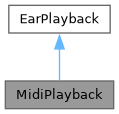
MIDI playback through the shared MCI sequencer and Windows MIDI mixer. More...
#include <playbackimplementations.h>
Public Member Functions | |
| MidiPlayback () | |
| Initialise empty media state; a gain adjustment must assign pendingGain before playback. | |
| void | ReleaseEarPlaybackResources () override |
| Unregister playback and delete any temporary MIDI file and allocated temporary path. | |
| void | SetEarPlaybackDirectionalGain (std::uint16_t direction, double gain, std::uint16_t matrix) override |
| Set shared MIDI mixer volume when active, or cache gain for the next start when inactive. | |
| int | InitializeEarPlayback (const void *source, int streaming, int looping) override |
| Open source media in the shared sequencer and query sequence length. | |
| int | StartEarPlayback () override |
| Seek to a specified fractional start, post an enabled notification, and play the sequence. | |
| int | PauseEarPlayback () override |
| Set paused status and pause the sequencer when active. | |
| int | ResumeEarPlayback () override |
| Attempt to resume an active paused sequencer and clear paused status on success. | |
| void | SetEarPlaybackMute (int muted) override |
| Store mute state and write the shared Windows MIDI mixer's mute control. | |
| int | IsBufferedEarPlaybackComplete () override |
| Query MCI stop state unless inactive or a shared completion query is already in progress. | |
| Public Member Functions inherited from EarPlayback | |
| ~EarPlayback () | |
| Invoke the base finalisation hook without releasing playback resources or derived storage. | |
| void | SetEarPlaybackFlags (std::uint16_t flags) |
| Store source flags without validation or reinitialisation. | |
| int | GetStatus () |
| int | IsActive () |
| void | MarkComplete () |
| Request completion for the next completion check without stopping the device immediately. | |
| int | GetEarPlaybackMute () |
| int | IsEarPlaybackStreaming () |
| int | ResetPlaybackCompletion () |
| Withdraw a request to complete the playback. | |
| void | ClearPlaybackCompletion () |
| Withdraw a request to complete the playback. | |
| virtual void | SetEarPlaybackDirectionalMatrix (std::uint16_t direction, std::uint16_t matrix) |
| Store directional matrix identifiers without resolving an entry or updating output. | |
| virtual void | ProcessEarPlaybackSmoothing () |
| Apply a frequency, gain, and pan smoothing pass to the current device buffer. | |
| virtual void | SetPlaybackSuppressionParameters (std::uint32_t enabled, std::uint16_t marker) |
| Store suppression controls without starting or stopping playback. | |
| virtual void | SetEarPlaybackStartPosition (double position) |
| Store an ordered nonzero start position and mark it specified; zero and NaN are ignored. | |
| virtual void | SetEarPlaybackStartMilliseconds (std::uint16_t milliseconds) |
| Store an absolute start offset for wave-stream preparation. | |
| virtual void | SetReservedPlaybackEventControl (std::uint32_t control) |
| Store a backend-specific event control value without applying it immediately. | |
| virtual void | CompleteEarPlayback () |
| Perform implementation-specific completion; the base implementation does not change state. | |
| virtual void | ApplyPreset (EarWaveSample *preset) |
| Apply implementation-specific preset data; the base implementation ignores the request. | |
| virtual std::uint32_t | GetEarPlaybackMediaLength () |
| virtual void | SetBackendPlaybackOverrideEnabled (int enabled) |
| Store the implementation-specific playback override marker. | |
| virtual void | SetEarPlaybackFrequencyScale (double scale) |
| Clamp an ordered changed scale to 0..6.5535 and recalculate frequency from the base rate. | |
| virtual void | SetEarPlaybackBaseFrequencyScale (double scale) |
| Store the initial frequency multiplier without validation or device updates. | |
| virtual void | SetCachedBackendPlaybackParameter (double value) |
| Store an ordered changed backend parameter and invoke the parameter-change hook. | |
| virtual void | SetEarPlaybackLooping (int enabled) |
| Store looping state without changing the currently playing buffer's device flags. | |
| virtual void | SetEarPlaybackNotification (std::uint32_t flags, std::uint16_t event) |
| Store notification controls for later playback transitions. | |
Protected Member Functions | |
| void | CloseRegisteredEarPlayback () override |
| Request zero gain, record shared sequencer use, post an enabled end message, and unregister. | |
| Protected Member Functions inherited from EarPlayback | |
| virtual void | OnPlaybackWaveSampleAttached (EarWaveSample *sample) |
| Respond to sample attachment; the base implementation ignores the notification. | |
| virtual int | IsDirectSoundBufferStopped () |
| Query the device buffer; a non-null buffer is required. | |
| EarPlayback () | |
| Initialise inactive playback and smoothing defaults without allocating media or a buffer. | |
| void | SetPlaybackBufferBytes (std::uint32_t bytes) |
| Store buffer capacity without reallocating storage. | |
| void | SetStreamHalfBytes (std::uint32_t bytes) |
| Store the refill-half capacity without changing the buffer. | |
| void | DisablePlaybackStreaming () |
| Clear the streaming marker without changing device looping flags. | |
| std::uint16_t | GetPlaybackStartMilliseconds () const |
| bool | HasPlaybackStartPosition () const |
| void | SpecifyPlaybackStartPosition () |
| Mark the stored start position specified without changing its value. | |
| void | SetPlaybackStreamingAndLooping (int isStreaming, int isLooping) |
| Store stream and loop markers without validation or device changes. | |
| double | GetPlaybackBaseFrequencyScale () const |
| void | SetPlaybackBaseFrequency (std::uint32_t value) |
| Store base frequency without updating the current device frequency. | |
| void | SetPlaybackHandle (std::uint32_t handle) |
| Store a registration handle without modifying the playback registry. | |
| std::uint32_t | GetPlaybackHandle () const |
| HRESULT | CreateDirectSoundPlaybackBuffer (IDirectSound *device, _DSBUFFERDESC *description) |
| Create a Windows device buffer; an existing buffer must be released before replacement. | |
| void | ResetPlaybackBufferFrequency () |
| Reset current frequency to the initialised base frequency without updating the device. | |
| std::uint32_t | GetPlaybackBufferBytes () const |
| bool | HasNonStreamingStartPosition () const |
| double | GetPlaybackStartPosition () const |
| void | ClearPlaybackStartPosition () |
| Clear the specified marker and reset the start position to zero. | |
| EarDirectSoundPlaybackState::Buffer * | GetDirectSoundBuffer () const |
| std::uint32_t | IncrementLoopDrainCount () |
| void | EndStreamingPlaybackLoop () |
| Clear both loop and stream markers without stopping the device immediately. | |
| std::uint16_t | GetPlaybackSourceFlags () const |
| bool | IsPlaybackLooping () const |
| bool | HasPlaybackHandle () const |
| void | DisablePlaybackLooping () |
| Clear the looping marker without changing device playback flags. | |
| std::uint32_t | GetStreamHalfIndex () const |
| std::uint32_t | GetStreamHalfBytes () const |
| void | FlipStreamHalfIndex () |
| Toggle the refill-half index between zero and one. | |
Additional Inherited Members | |
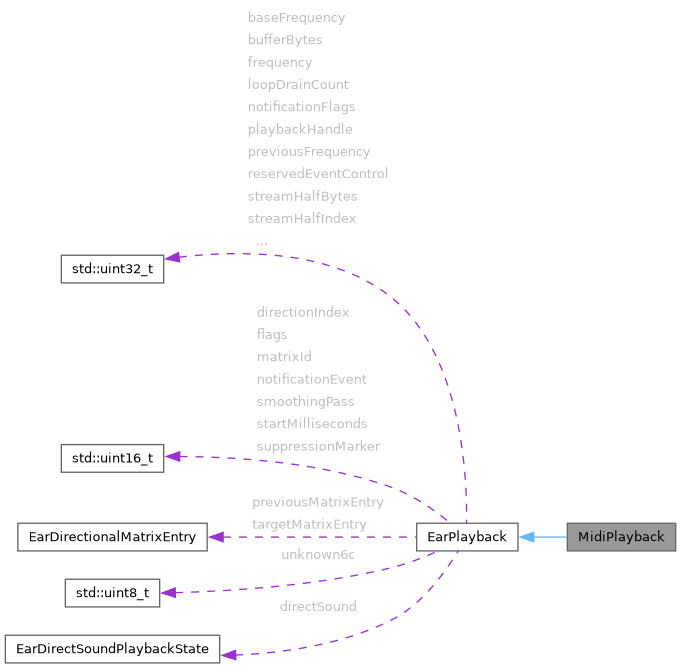
| Protected Attributes inherited from EarPlayback | |
| std::uint32_t | playbackHandle |
| Playback registry key, or zero when unregistered. | |
| std::uint32_t | reservedEventControl |
| Implementation-specific event control, including in-memory MIDI source length in bytes. | |
| std::uint32_t | notificationFlags |
| Notification bits for starts (1) and registered closures (2). | |
| std::uint16_t | notificationEvent |
| Event identifier included in window notifications. | |
| std::uint16_t | flags |
| Source flags interpreted by derived media implementations; base construction omits them. | |
| int | looping |
| Nonzero while looping is requested. | |
| int | streaming |
| Nonzero while media requires half-buffer refills. | |
| int | completionRequested |
| Nonzero after completion is requested or detected. | |
| std::uint32_t | streamHalfIndex |
| Next streaming half to refill, initially one. | |
| int | active |
| Nonzero after successful playback starts, including during a pause. | |
| int | muted |
| Nonzero when muted; cached gain remains available for unmuting. | |
| int | status |
| Pause status, zero when unpaused. | |
| int | backendOverrideEnabled |
| Nonzero when implementation-specific position or frequency overrides are enabled. | |
| std::uint32_t | suppressionEnabled |
| Nonzero when spatial suppression processing is enabled. | |
| int | startPositionSpecified |
| Nonzero when startPosition is specified rather than merely stored. | |
| std::uint16_t | suppressionMarker |
| Suppression role, with one suppressing base device starts. | |
| std::uint16_t | startMilliseconds |
| Wave-stream initial offset in milliseconds, or zero when disabled. | |
| std::uint16_t | matrixId |
| Selected directional matrix handle, initially 16. | |
| std::uint16_t | directionIndex |
| Selected directional row index, normally 0..127. | |
| double | previousGain |
| Linear gain at the start of the current smoothing transition. | |
| double | targetGain |
| Target linear gain before directional and master attenuation. | |
| EarDirectionalMatrixEntry | previousMatrixEntry |
| Directional pan and gain at the start of the current smoothing transition. | |
| EarDirectionalMatrixEntry | targetMatrixEntry |
| Target directional pan and gain resolved from the selected matrix. | |
| std::uint32_t | frequency |
| Target sample frequency in hertz before device range clamping. | |
| std::uint32_t | previousFrequency |
| Sample frequency in hertz at the start of the smoothing transition. | |
| std::uint8_t | unknown6c [2] |
| Unrecovered bytes retained at the original object offset. | |
| std::uint16_t | smoothingPass |
| Smoothing pass index; zero selects the target directly. | |
| std::uint32_t | bufferBytes |
| Decoded device sample-buffer capacity in bytes. | |
| std::uint32_t | streamHalfBytes |
| Decoded byte count in each streaming half. | |
| double | startPosition |
| Implementation-specific start position, usually a fraction of media length. | |
| double | frequencyScale |
| Current dimensionless playback frequency multiplier. | |
| double | baseFrequencyScale |
| Initial frequency multiplier applied while preparing media. | |
| std::uint32_t | baseFrequency |
| Initial sample frequency in hertz; derived initialisation must assign it. | |
| double | cachedBackendParameter |
| Cached implementation-specific parameter, initially -1. | |
| std::uint32_t | loopDrainCount |
| Number of post-data streaming refills used while draining non-looping playback. | |
| EarDirectSoundPlaybackState | directSound |
| Device buffer reference and cached byte cursors; resource release is explicit. | |
Detailed Description
MIDI playback through the shared MCI sequencer and Windows MIDI mixer.
Music devices and mixer controls must be initialised before playback operations.
Constructor & Destructor Documentation
◆ MidiPlayback()
| MidiPlayback::MidiPlayback | ( | ) |
Initialise empty media state; a gain adjustment must assign pendingGain before playback.
- Ghidra address:
- EAR: 0x10008d20
Member Function Documentation
◆ ReleaseEarPlaybackResources()
|
overridevirtual |
Unregister playback and delete any temporary MIDI file and allocated temporary path.
Caller-supplied source paths remain borrowed.
- Ghidra address:
- EAR: 0x10008d8d
Reimplemented from EarPlayback.
◆ SetEarPlaybackDirectionalGain()
|
overridevirtual |
Set shared MIDI mixer volume when active, or cache gain for the next start when inactive.
- Parameters
-
direction The unused directional row index. gain The linear multiplier of the MIDI mixer's maximum volume, without clamping. matrix The unused directional matrix handle.
- Ghidra address:
- EAR: 0x100093d5
Reimplemented from EarPlayback.
◆ InitializeEarPlayback()
|
overridevirtual |
Open source media in the shared sequencer and query sequence length.
Source flag 0x2000 writes reservedEventControl bytes to a temporary MIDI file first.
- Parameters
-
source A borrowed terminated path, or readable MIDI bytes for memory-source flags. A borrowed path must remain valid until resource release. streaming The ignored streaming request; MIDI streaming is disabled. looping The looping marker, with nonzero enabling loop handling at completion.
- Returns
- One when MCI opens the sequence; zero when opening fails.
- Ghidra address:
- EAR: 0x1000914d
Reimplemented from EarPlayback.
◆ StartEarPlayback()
|
overridevirtual |
Seek to a specified fractional start, post an enabled notification, and play the sequence.
- Returns
- One on successful playback; zero on failure, after closing the sequencer.
- Ghidra address:
- EAR: 0x10009051
Reimplemented from EarPlayback.
◆ PauseEarPlayback()
|
overridevirtual |
Set paused status and pause the sequencer when active.
- Returns
- The paused marker, one unless pausing an active sequencer fails.
- Ghidra address:
- EAR: 0x10009009
Reimplemented from EarPlayback.
◆ ResumeEarPlayback()
|
overridevirtual |
Attempt to resume an active paused sequencer and clear paused status on success.
- Returns
- Nonzero when unpaused after the attempt, including when already unpaused.
- Ghidra address:
- EAR: 0x1000948b
Reimplemented from EarPlayback.
◆ SetEarPlaybackMute()
|
overridevirtual |
Store mute state and write the shared Windows MIDI mixer's mute control.
- Parameters
-
muted The mute marker, with nonzero indicating mute.
- Ghidra address:
- EAR: 0x10008f83
Reimplemented from EarPlayback.
◆ IsBufferedEarPlaybackComplete()
|
overridevirtual |
Query MCI stop state unless inactive or a shared completion query is already in progress.
A completed loop seeks to the start, clears active state, and posts an end notification. Loop completion posts the notification regardless of notification flags.
- Returns
- Nonzero on requested or detected non-looping completion; otherwise zero.
- Ghidra address:
- EAR: 0x10008e5b
Reimplemented from EarPlayback.
◆ CloseRegisteredEarPlayback()
|
overrideprotectedvirtual |
Request zero gain, record shared sequencer use, post an enabled end message, and unregister.
The sequencer remains open; an absent playback handle suppresses closure work.
- Ghidra address:
- EAR: 0x10008df4
Reimplemented from EarPlayback.
The documentation for this class was generated from the following file:
- src/common/ear/playbackimplementations.h
Generated by
 1.15.0